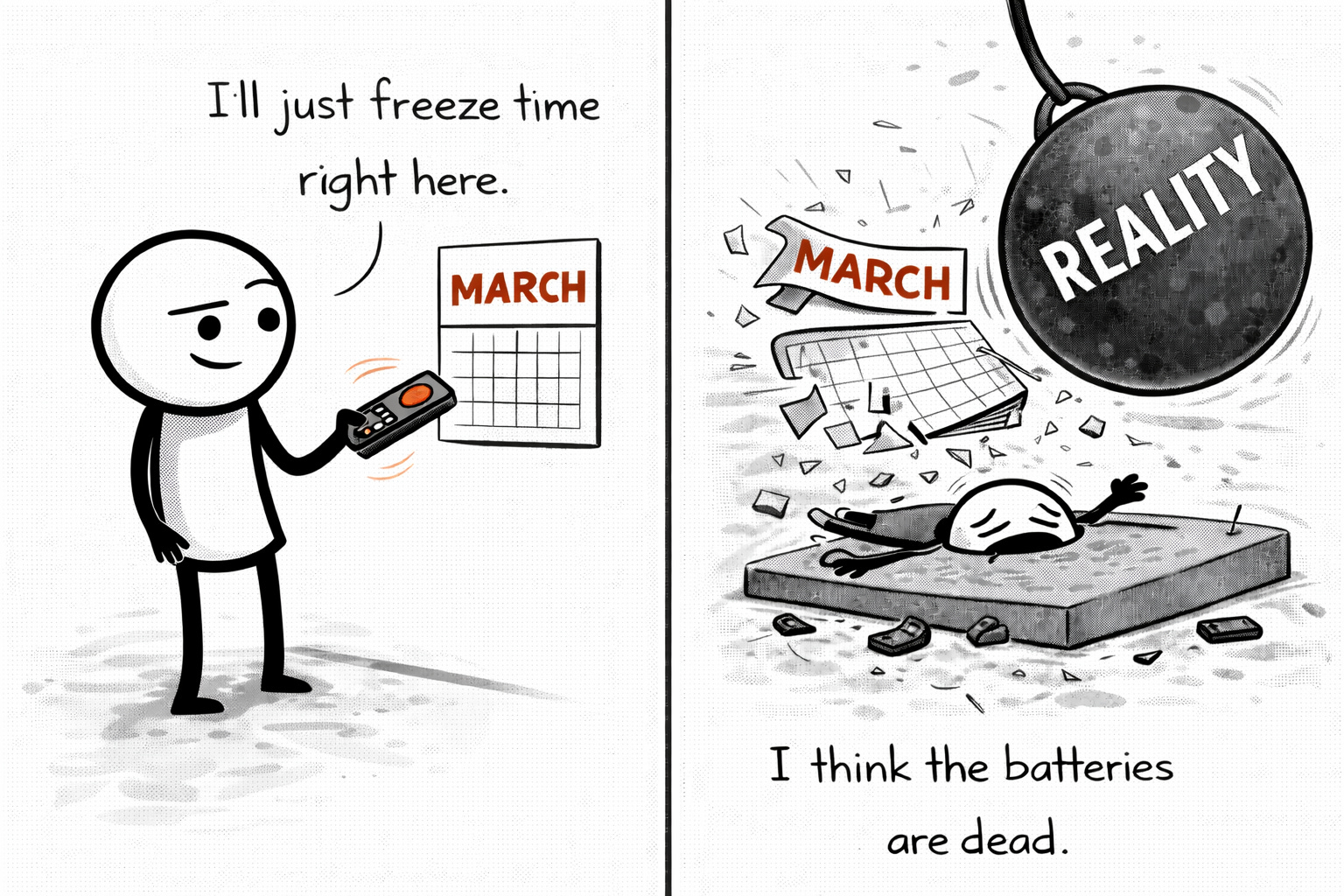
The system has a habit of treating March like a courtesy month.
Nothing visibly breaks. Accounts still exist. Forms are still editable. The calendar still looks forgiving. From the outside, it feels like a safe place to pause, reassess, and make a cleaner decision once more information is available.
That is exactly what the image at the top is quietly mocking.
March is not a pause. It is the point where the system has already sorted decisions into two piles, even if the person involved has not. Some options are still flexible. Others have hardened into facts. The trouble is that nothing announces which is which until the consequences show up later.
Most people think March decisions are small.
They feel administrative. Cosmetic. Temporary. A box not checked yet. A form not submitted yet. A choice deferred in the name of being careful.
The misconception is that March is early. April is the deadline month, so March feels like time that still belongs to the planning phase. In reality, March is often when the system locks in outcomes based on what did or did not happen before the year changed.
By the time someone notices, the decision is no longer a decision. It is a condition.
Here is the rule underneath all of this.
The system does not care when you think you decided. It cares when the action legally occurred.
Some actions are governed by the calendar year. Once December 31 passes, those actions either happened or they did not. No amount of spring activity changes that.
Some actions are governed by the tax filing deadline. Those can feel forgiving because paperwork and funding may still be possible months later.
Correction windows exist only when something was done incorrectly. They do not exist for things that were postponed out of existence.
What happens if something is done later instead depends entirely on which clock applied. Later might be fine. Later might move the action into a different year. Later might trigger penalties. Later might eliminate the option completely.
March is where those differences stop being theoretical.
Roth conversions are a common place where a March decision becomes unavoidable.
A conversion feels optional. Strategic. Adjustable. You can wait for income numbers. You can see where taxes land. You can run projections. That flexibility is real, but it is calendar bound.
If the conversion did not happen by December 31, it belongs to the next year. Doing it in March does not preserve the original plan. It creates a new transaction with a new tax year, a new interaction with income, and potentially new Medicare premium consequences two years later.
March does not reopen the prior year. It confirms that the choice now belongs to the current one.
At that point, the decision is no longer whether to convert. It is whether to accept the new consequences or not convert at all.
Required minimum distributions show the same pattern with higher stakes.
If an RMD is missed at the end of December, March does not feel urgent. The reporting comes later. The penalty notice comes even later. Everything appears calm.
But the decision already happened. The system marked the distribution as missed. Taking it later does not make it timely. It only limits how much worse the penalty becomes.
What was once a simple requirement turns into a corrective action. The choice is no longer optional. It is unavoidable.
Employer plans are where March decisions quietly reshape entire years.
Some plans allow contributions after year end. Some do not. Some depend on when the plan existed. Some depend on how the business is structured.
A SEP IRA may still be opened and funded after the year ends if the business owner is within the tax filing deadline or extension window. In that case, a March decision can still produce a prior year outcome.
Solo 401(k) plans behave differently depending on the business. A sole proprietor may still have flexibility to establish and fund after year end. An S corporation owner generally cannot make employee deferrals if the plan did not exist by December 31.
In one case, March preserves opportunity. In another, March confirms it is gone.
The same month. The same delay. Completely different results.
Here is how this usually plays out.
Someone finishes a strong income year knowing they should make a retirement move. They plan to circle back once the year closes. January is busy. February is foggy. March arrives with tax documents and good intentions.
They finally sit down and ask whether they can still do what they planned.
Sometimes the answer is yes. Sometimes the answer is no. But by the time the question is asked, the system has already decided which category it falls into.
Nothing broke. Nothing failed. The system simply moved from flexibility to finality while attention was elsewhere.
This is why March decisions feel deceptively small.
They are rarely framed as decisions. They look like delays. Adjustments. Clean up. But those small moments are often where the system turns uncertainty into permanence.
Once that happens, the choice becomes unavoidable. Not because the system is harsh, but because it is consistent.
The resolution here is not urgency or regret.
Most March realizations do not mean catastrophe. They mean the plan shifts forward instead of backward. The stress comes from not knowing whether a choice is still adjustable or already fixed.
Once the clocks are understood, that stress fades.
If an action was governed by the calendar year, March does not change the outcome. It only clarifies it.
If an action is governed by a filing deadline, March may still offer room.
If a correction window applies, it only exists if something went wrong, not if something never happened.
By the time you finish reading, you should not feel rushed. You should feel oriented. March decisions feel unavoidable only when the system has already decided. Understanding when that happens is what turns confusion into clarity.
The system does not make noise when flexibility expires. It simply locks in the result and keeps going. Once you see that behavior, those small March decisions stop feeling mysterious and start making sense.
I write one of these every day, one retirement rule, explained in plain language and verified against the source. The daily email is free: subscribe here.
Disclaimer
This article is for educational and informational purposes only. It is not tax, legal, or financial advice and does not create an advisor–client relationship. Always consult appropriate professionals regarding your specific situation.