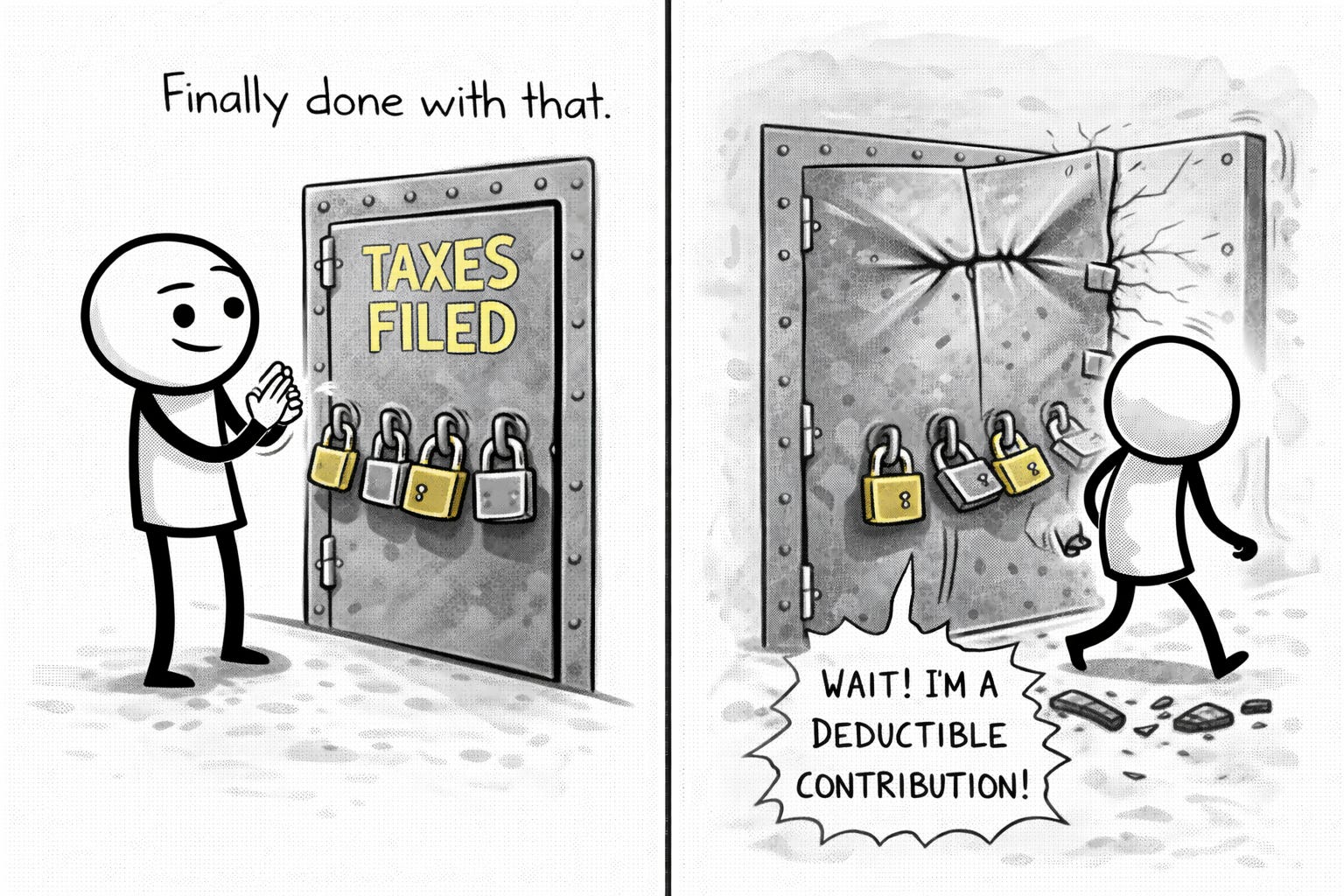
The system treats early filing like a courtesy, not a conclusion.
It accepts your return. It processes it. It gives you a refund or a balance due. And then it just keeps going. Quietly. Indifferently. As if nothing about filing early was meant to signal that the year is wrapped up and done.
That is what the image at the top is pointing at. Filing early feels like crossing a finish line. In reality, it is often just submitting paperwork while several decision windows are still open or already closed without much ceremony.
A lot of people believe filing is the final step.
They assume that once the return is submitted, the year is settled. Any remaining decisions must either be locked in or no longer relevant. After all, the system accepted the return. That feels definitive.
The misconception comes from confusing reporting with resolution.
Filing early closes the reporting loop. It does not necessarily close the decision loop. And in some cases, it does not reopen decisions that were already finalized before the return was filed.
This is how people end up surprised later. They did everything early and still feel like something shifted under their feet.
Here is the rule that makes this confusing.
Different actions in the tax and retirement system run on different clocks.
Calendar year deadlines decide whether an action belongs to one year or the next. Those deadlines usually end on December 31 and do not care when you file.
Tax filing deadlines control when reporting and certain contributions can still occur. Those deadlines can stretch into April or later with an extension.
Correction windows only apply if something was done incorrectly. They do not exist for actions that were never taken.
Filing early interacts with all three clocks, but it only controls one of them.
What happens if something is done later instead depends on which clock applied. Filing early does not stop calendar year rules from being final. It also does not eliminate filing deadline flexibility for actions that are still allowed.
Roth conversions are a good example of where early filing creates false confidence.
A Roth conversion is governed by the calendar year. It either happens by December 31 or it does not. Filing a return in February does not preserve the prior year as an option.
If someone files early and later decides they should have converted income for the prior year, that choice is already closed. Filing did not end it. The calendar did.
Doing it later simply makes it a conversion for the current year with a different tax outcome and different downstream effects.
Early filing does not lock the door. It just makes it easier to see that the door was already closed.
IRA contributions show the opposite behavior.
Traditional and Roth IRA contributions often follow the tax filing deadline. Filing early does not eliminate the ability to make or adjust those contributions as long as eligibility rules are met.
Someone can file in February and still make a prior year IRA contribution in March. The system allows that because the filing deadline governs the contribution, not the calendar year.
Doing it later still works in that case, though it often creates a mismatch that requires amending the return to fix. Filing early didn't finish the job; it just created extra paperwork
This is where people get tripped up. They assume filing early means everything must already be done. In reality, some decisions remain available even after the return is submitted.
Required minimum distributions sit in an uncomfortable middle.
An RMD must be taken by December 31 for most people. Filing early does not change that requirement. If it was missed, the distribution is already late.
Filing early also does not fix the problem. Taking the RMD later stops the penalty from growing, but it does not convert it into an on time distribution.
Here, filing early neither opens nor closes anything. It simply coexists with a decision that was already finalized at year end.
Employer plans add even more nuance.
Some plans allow funding after the year ends. Some depend on when the plan existed. Some depend on business structure.
A SEP IRA may still be opened and funded after filing as long as the business owner is within the filing deadline or extension window. Filing early does not remove that flexibility.
Certain Solo 401(k) contributions may still be possible after filing depending on the business structure and the type of contribution. Others may already be closed if the plan did not exist by year end.
In these cases, filing early feels like finishing, but the system still has open lanes running alongside it.
Doing it later might still be allowed. Or it might simply confirm that the opportunity passed earlier. Filing does not decide which one applies.
A common scenario shows how this plays out.
Someone files their return in early February. They feel organized and ahead of schedule. In March, they learn about a retirement move they could still make. Or they realize a different move they assumed was still available actually is not.
The filing did not cause either outcome. It only created the illusion that everything was settled.
The real decisions were tied to earlier dates that filing never controlled.
This is why filing early can feel emotionally misleading.
It provides closure without completeness.
The system rewards early filing with speed and certainty on reporting, but it does not attach a warning label that says other clocks are still running or already expired.
Once you understand that, the anxiety drops quickly.
The resolution here is not to avoid filing early.
Filing early is often smart. It reduces uncertainty and shortens the feedback loop. The mistake is assuming that filing is the final step for every decision.
If an action is governed by a calendar year deadline, filing early does not reopen it.
If an action is governed by a filing deadline, filing early does not eliminate it.
If a correction window applies, filing early does not create or remove it.
Those rules exist independently of when the return is submitted.
By the time you finish reading, you should not feel confused about whether filing early helped or hurt you. It usually does neither. It just closes the reporting chapter.
The rest of the system keeps moving on its own schedule.
Once you see that behavior clearly, filing early stops feeling like a finish line and starts feeling like what it really is. A checkpoint. Not the end of the road.
I write one of these every day, one retirement rule, explained in plain language and verified against the source. The daily email is free: subscribe here.
Disclaimer
This article is for educational and informational purposes only. It is not tax, legal, or financial advice and does not create an advisor–client relationship. Always consult appropriate professionals regarding your specific situation.