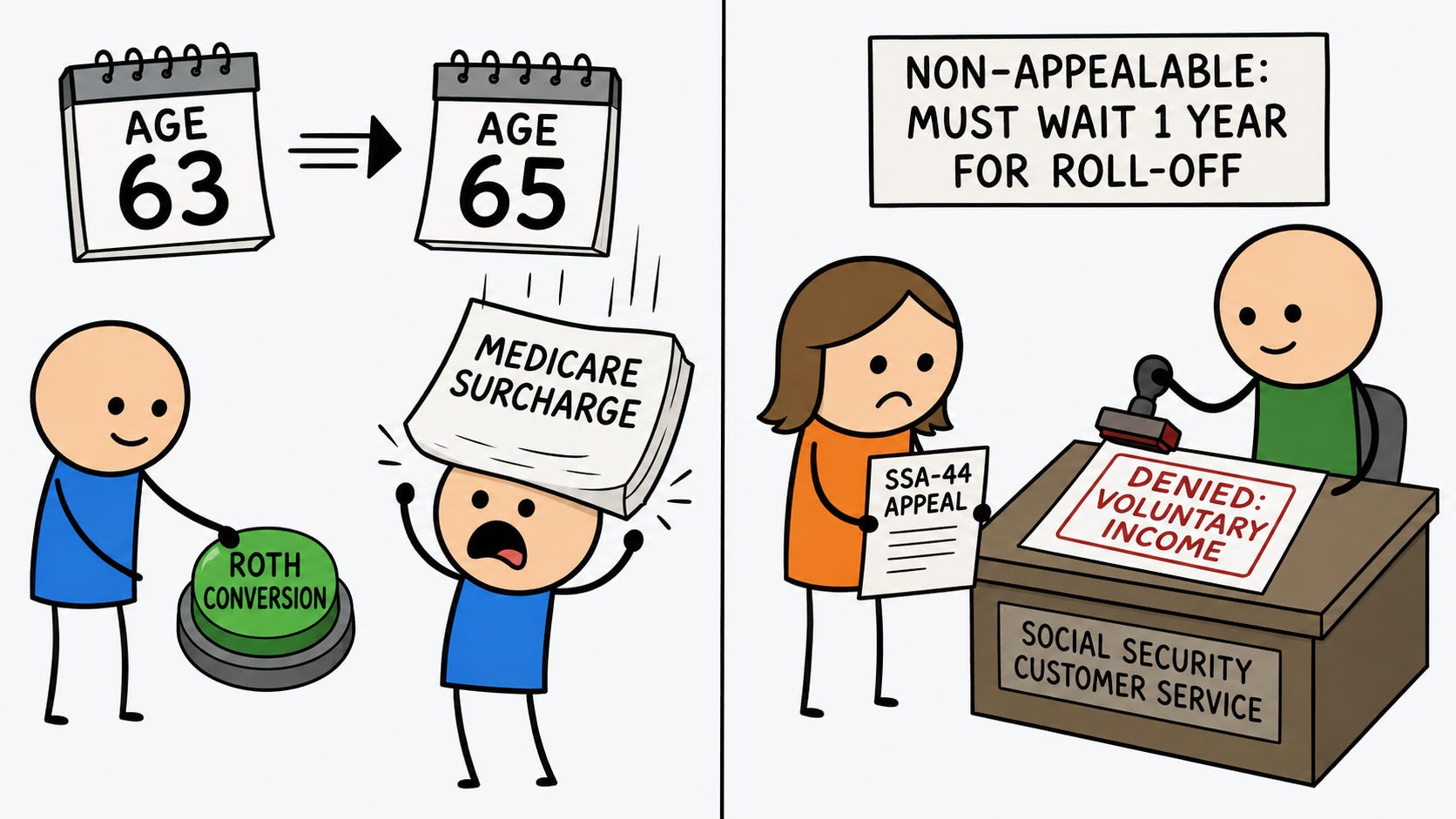
A Roth conversion is a deliberate act of adding income now to save on taxes later. IRMAA is a Medicare surcharge driven by income, measured two years in the past, structured as a series of steps. Put those two facts together and a specific interaction appears, one that catches people who planned their conversion carefully for income taxes but never looked at Medicare. A conversion done in one year can raise Medicare premiums two premium years later, and the conversion itself is not a qualifying life-changing event that allows SSA to simply substitute a lower-income year. Understanding exactly how a conversion feeds into IRMAA, when the effect lands, and why the conversion alone provides no basis for relief is what keeps a smart tax move from carrying a Medicare cost the person never anticipated.
The mechanism starts with what a conversion does to income. The taxable portion of a traditional IRA-to-Roth conversion is included in income for the year of the conversion, which can raise adjusted gross income. IRMAA starts with adjusted gross income and adds tax-exempt interest, so taxable conversion income feeds directly into the number SSA measures. If the traditional IRA includes after-tax basis, however, part of the conversion may be nontaxable. It is the taxable portion of the conversion, not necessarily every dollar moved to the Roth, that increases IRMAA MAGI.
The two-year lookback determines when the effect arrives, and the delay is what makes this easy to miss. Under the normal IRMAA calculation, the premium for a given calendar year is generally based on tax information from two years earlier. So taxable conversion income reported for a given year would normally feed the IRMAA calculation two premium years later. The delay is measured by tax year and premium year, not as a literal twenty-four-month countdown from the date of the conversion. A conversion in January and a conversion the following December of the same year both belong to the same tax year, so both feed the same later premium year. A person sees no Medicare consequence when they convert, and may have entirely forgotten the conversion by the time the higher premium notice arrives two premium years on. The cause and the effect are separated in a way that is long enough that many people never connect them.
The cliff structure is what turns this from a gradual cost into a sharp one. IRMAA does not phase smoothly from one tier to the next. Crossing the first threshold can turn on the entire first IRMAA surcharge. Crossing a later threshold moves the person from one surcharge level to the next, so the additional cost is the difference between those two levels rather than a whole new surcharge from zero. Either way, the surcharge applies to Part B and, if the person has Medicare prescription drug coverage, Part D, and for a married couple where both are on Medicare, it applies to each of them separately. This means the size of a conversion matters with unusual precision. The last dollars of a conversion, the ones that push modified adjusted gross income across a tier boundary, can carry a Medicare cost far out of proportion to the tax savings on those same dollars. Converting a small additional amount to save a little income tax can cost substantially more than that in surcharge if it crosses a threshold.
Now the point that connects this directly to the IRMAA relief rules, and it is the part that stings. An IRA conversion is specifically treated as a nonqualifying one-time income event for the life-changing-event rules. That means a person cannot ask SSA to use a lower-income year simply because a Roth conversion was unusually large, happened only once, or will not repeat. An IRMAA determination still carries normal appeal rights if something about the determination itself is wrong, and a separate qualifying life-changing event, such as retirement or the loss of a pension, can create its own path to a new determination. But the conversion itself is not one of those qualifying events. This is the crucial difference between the retiree hit with a surcharge on their working income, who has a life-changing-event path because retirement qualifies, and the person hit with a surcharge on a conversion, who has no such path on the strength of the conversion alone. The distinction is not whether the income was voluntary, since retirement can be voluntary too. It is whether the event appears on SSA’s list of qualifying life-changing events, and a conversion does not.
If the conversion is the only relevant fact and SSA’s tax information is correct, the conversion itself provides no basis for life-changing-event relief. There is a piece of relief built into the structure, though, and it comes from the same lookback that caused the problem. IRMAA is determined again for each premium year using the tax information applicable to that year, so a single conversion generally raises premiums for only the one premium year that the conversion year governs. It behaves as a one-time income event rather than a permanent penalty, but only if the later year’s income actually comes back down. Once that conversion year is no longer the basis for the determination, the surcharge it caused falls away, provided income has returned to a lower level. If income stays elevated for another reason, the premium may not drop back as expected. A person who converts every year likewise produces a surcharge every year, because each conversion year in turn becomes the basis for a later premium year.
The timing of a person’s age creates a window worth understanding, with an important qualification. Because IRMAA generally applies once a person is on Medicare, and because of the two-year lookback, income earned well before Medicare enrollment typically does not reach a Medicare premium year for someone who enrolls at the standard age of 65. In the common case, the first tax year whose income affects Medicare premiums is around age 63, setting the premium for the year the person turns 65. So conversions done well before that often carry no IRMAA consequence, because the lookback does not reach that far back into the pre-Medicare years. This is a general pattern rather than a guarantee. Someone who becomes entitled to Medicare before 65, such as through disability, can be exposed earlier, and in a married couple with an age gap, the older spouse’s Medicare timeline can reach into income years the younger spouse would not expect. The clean version of the rule holds for the standard case, but the exact timing depends on when Medicare coverage begins and which spouse’s premiums are being determined.
Finally, the longer arc that makes this a genuine tension rather than a simple cost. A conversion raises taxable income now, which can cause a one-time IRMAA increase two premium years later. But the same conversion shrinks the traditional IRA balance, and a smaller traditional balance can produce smaller required distributions once those begin. To the extent those future distributions would otherwise be taxable, they can increase the adjusted gross income that feeds IRMAA. Qualified Roth distributions, by contrast, are excluded from gross income and therefore do not increase IRMAA MAGI. A conversion can therefore create taxable income now while potentially reducing taxable retirement-account income later. Whether that trade comes out ahead depends on the specific numbers, but the mechanical shape of it is a short-term IRMAA cost weighed against a long-term reduction in the taxable income that feeds IRMAA.
Picture a couple, both retired and on Medicare, whose normal income sits just below an IRMAA threshold. They decide to convert a sizable amount from their traditional IRA to a Roth to reduce future required distributions. The taxable portion of the conversion adds enough income to push their modified adjusted gross income over the next IRMAA threshold for that year. They see no immediate Medicare effect. Two premium years later, their Medicare premium notice arrives with a substantial IRMAA increase on Part B and, assuming both spouses also have Medicare prescription drug coverage, Part D, applied separately to each spouse, all stemming from that conversion year. Assuming no separate qualifying life-changing event or tax-data correction changes the determination, the conversion itself gives them no basis to have SSA use a lower-income year. They pay the higher premium for that year, and the following year, once a lower-income tax year becomes the basis for the determination and their income has returned to normal, the surcharge falls away.
Now consider the same couple approaching the decision differently in terms of timing. In the years well before the tax years that feed their Medicare premiums, their conversions did not touch IRMAA, because those income years were too early to reach any Medicare premium year for people enrolling at 65. A conversion in those earlier years raised their income tax but had no Medicare consequence. Once they reached the tax years that feed the Medicare lookback, the same conversions began feeding the IRMAA calculation two premium years forward. The mechanical difference between the earlier conversion and the identical later one is that only the later one reaches a Medicare premium year, purely because of where the two-year lookback lands relative to Medicare enrollment.
The resolution is seeing the conversion and IRMAA as linked through taxable income and the normal two-year lookback. The taxable portion of a conversion can raise modified adjusted gross income in the conversion year, and that income generally feeds the Medicare premium calculation two years later. Crossing the first IRMAA threshold can turn on the first surcharge level, while crossing a later threshold causes a step-up from one IRMAA level to the next. The conversion itself is not a qualifying life-changing event that lets SSA simply substitute a lower-income year, but a one-time conversion generally affects only the premium year governed by that tax return if later MAGI returns to a lower level.
The variables that determine the interaction are the taxable size of the conversion relative to the IRMAA thresholds, the person’s Medicare enrollment timing relative to the lookback, whether the conversion is a one-time event or part of a repeated pattern, whether other income keeps MAGI elevated in later years, and how much the conversion reduces future taxable retirement-account income that would otherwise drive IRMAA. The near-term picture is that a conversion can raise Medicare premiums two premium years later in a way the conversion itself gives no basis to appeal as a life-changing event. The long-term picture is that moving money into a Roth can lower the recurring taxable income that would have driven IRMAA for years. Both are real, and the interaction between a conversion and IRMAA is the point where those two timeframes meet.
I write one of these every day, one retirement rule, explained in plain language and verified against the source. The daily email is free: subscribe here.
Full archive, worksheets, and search live at RetirementNewsRundown.com.
Disclaimer
This article is for educational and informational purposes only. It is not tax, legal, or financial advice and does not create an advisor–client relationship. Always consult appropriate professionals regarding your specific situation.