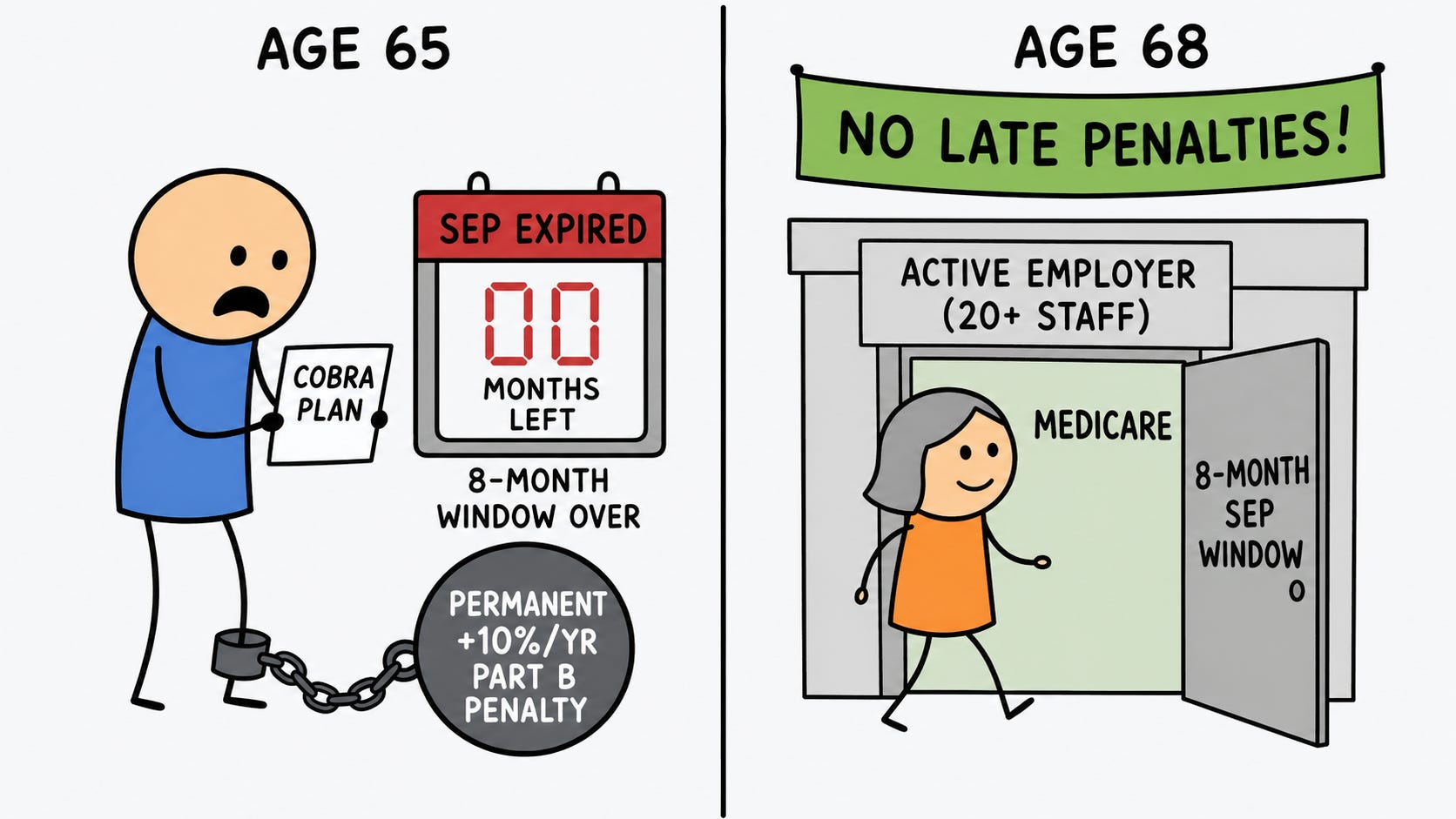
Some Medicare enrollment mistakes create penalties that follow a person for years. The Part B late-enrollment penalty generally stays in the monthly premium for as long as the person has Part B, and the Part D penalty generally continues for as long as the person has Medicare drug coverage. Premium-based Part A works differently and can carry a temporary penalty instead. What makes the Part B and Part D mistakes especially costly is that they often begin with a reasonable-sounding assumption about coverage a person already has. Understanding the enrollment windows, how the penalties work, and which kind of coverage actually protects a person is what prevents a single timing error at 65 from becoming a lasting surcharge.
Medicare enrollment is built around a specific window tied to a person’s 65th birthday. The Initial Enrollment Period runs for seven months, beginning three months before the month a person turns 65, including the birthday month, and ending three months after. For most people, this is when they are supposed to sign up. A person who enrolls during this window pays no late penalty. A person who misses it, without qualifying coverage to protect them, starts accruing one.
If someone misses the Initial Enrollment Period and does not qualify for another enrollment opportunity, the fallback is the General Enrollment Period, which runs from January 1 through March 31 each year. Part B coverage generally begins the month after enrollment. Using the General Enrollment Period does not erase a late-enrollment penalty that has already accrued. This is the slower and more expensive path, existing mainly as a way to get enrolled at all after a missed deadline, not as a way to avoid consequences.
The penalties themselves escalate with the length of the delay. For Part B, the penalty is ten percent of the standard premium for each full twelve-month period a person could have enrolled but did not, counting only months not otherwise excluded because of qualifying coverage. Two full years late means a twenty percent surcharge. Five years late means fifty percent. It is added to the premium for as long as the person has Part B, which for most people means the rest of their life. Only full twelve-month periods count, so a delay of, say, fourteen months counts as one period rather than two, but once a full year passes, the surcharge attaches. Because it is calculated as a percentage of the standard Part B premium, the dollar amount can change when that standard premium changes.
Part D, the prescription drug coverage, has its own separate late penalty with a different structure. If a person goes 63 days or more without creditable drug coverage after becoming eligible, they accrue a penalty of one percent of a national base premium for each full month they went without it. Like the Part B penalty, it generally continues for as long as the person has Medicare drug coverage. A point that surprises healthy people is that this applies even to someone who takes no medications. A person who skips Part D because they have no prescriptions, and who also has no other creditable drug coverage, can still create a late-enrollment penalty. The rule is about maintaining Medicare drug coverage or other creditable prescription coverage, not about whether the person currently takes medication. Because the national base premium can rise or fall from year to year, the dollar amount of this penalty can move up or down with it.
Part A works differently and rarely produces a penalty, because most people receive it premium-free based on their work history. Someone who qualifies for premium-free Part A faces no penalty for delaying it. Only the small number of people who must actually pay a premium for Part A can face a late penalty, and unlike the Part B and Part D penalties, that one is temporary, generally lasting twice the number of years the person delayed. For most retirees, Part A is not where the penalty risk sits.
Now the misunderstanding that causes more expensive Medicare mistakes than any other. Many people believe that as long as they have health coverage of some kind at 65, they are protected from the Part B penalty and can delay enrolling. The protection that actually exists for people working past 65 is group health coverage based on the current employment of the person or their spouse. For Part B Special Enrollment Period and late-penalty purposes, that group health plan can be from an employer of any size. When that employment or coverage ends, the person gets a Special Enrollment Period of eight months to enroll in Part B without penalty.
The familiar twenty-employee threshold that people often cite answers a different question. It determines whether the employer plan or Medicare generally pays first. With twenty or more employees, the active employer plan generally pays first and Medicare second. With a smaller employer, Medicare may be the primary payer even though the current-employment coverage can still preserve a person’s Special Enrollment Period and late-penalty protection. This is an important distinction, because it means delaying Part B while working at a small employer can create a coverage-coordination problem, where Medicare should have been paying first, even in situations where it does not create the same late-penalty problem. The twenty-employee rule is about who pays first, not about whether current-employment coverage protects the enrollment timing.
The coverage that feels like protection but does not preserve these Part B rights is the more important thing to name. COBRA does not count as coverage based on current employment. Retiree health coverage from a former employer does not count. Individual marketplace plans do not count, and for Part B purposes, neither does VA coverage. None of these preserve the ordinary current-employment Special Enrollment Period, because none of them is coverage based on active employment.
This produces a specific and costly error. A person leaves work, is offered COBRA to continue their former employer’s plan, and takes it, assuming that because they still have that insurance they can safely delay Medicare. But COBRA is not current-employment coverage, so it does not preserve the Special Enrollment Period. That eight-month Part B window is measured from when the active employment ended, not from when COBRA eventually runs out. So a person who waits until COBRA expires to enroll has often already missed the Special Enrollment Period and accrued a penalty besides. When current-employment coverage ends, the Medicare enrollment clock needs to be measured from that event rather than from the eventual end of COBRA or retiree coverage.
There is one split worth knowing between the two penalties on this point. While COBRA and retiree coverage do not preserve the ordinary Part B current-employment enrollment rights, their prescription drug coverage may still be creditable for Part D if it is expected to pay, on average, at least as much as standard Medicare drug coverage. So the same plan can fail to protect a person from the Part B penalty while still protecting them from the Part D penalty. Employers are required to send an annual notice stating whether their drug coverage is creditable, and keeping those notices is how a person proves they maintained creditable coverage if a Part D penalty is ever assessed in error.
Picture a person who turns 65 while still working full time and remains covered by a qualifying group health plan based on that current employment. They continue working until 68. When the employment and that group coverage end, they have an eight-month Special Enrollment Period for Part B, and they enroll with no penalty. Prescription drug coverage follows a different clock. If their employer drug coverage was creditable, they generally have a separate, shorter opportunity to join a Medicare drug plan after that coverage ends, and they need to avoid going 63 days or more without Medicare drug coverage or other creditable coverage. The Part B and Part D clocks both relate to the same retirement event, but they are not the same window, and a person who assumes the eight-month Part B window also covers their drug enrollment can accidentally accrue a Part D penalty.
Now picture a person who worked past 65, retires at 68, and takes COBRA to keep the former employer’s plan for another eighteen months. They feel covered, so they do not enroll in Part B. But COBRA is not coverage based on current employment, so their eight-month Part B Special Enrollment Period is measured from the end of their active employment, not from the eventual end of COBRA. If they wait until COBRA expires to enroll, that eight-month window has already closed. They may have to use the next General Enrollment Period, and a permanent Part B late penalty may apply based on the months not excluded from the calculation. They had insurance the whole time, but not the kind that preserved their enrollment timing, and the cost of that misunderstanding can follow them for years.
The resolution is understanding that Medicare enrollment timing is governed by hard windows and that only specific coverage preserves a person’s penalty-free enrollment rights. The Initial Enrollment Period around age 65 is the clean entry point. Delaying without penalty is possible only with a qualifying group health plan based on current employment, and the Special Enrollment Period that follows such employment is measured from when the employment or that coverage ends. COBRA, retiree coverage, and similar plans feel like protection but do not preserve the Part B enrollment window.
The variables that determine whether a person is protected are whether they enroll during the enrollment period that applies to them, whether coverage they are relying on is a qualifying group health plan based on current employment, and whether they act before the applicable Special Enrollment Period expires. Employer size matters greatly for deciding whether Medicare or the employer plan pays first, but it is not itself the test for whether current-employment coverage preserves Part B enrollment rights. Part B and Part D late-enrollment penalties can remain attached to a person’s Medicare costs for years, and their dollar amounts can change as the premiums used to calculate them change. The single most valuable thing to understand is that having some form of health coverage is not the same as having the kind of coverage that lets a person delay, and the difference between the two can be measured in a surcharge that lasts a very long time.
I write one of these every day, one retirement rule, explained in plain language and verified against the source. The daily email is free: subscribe here.
Full archive, worksheets, and search live at RetirementNewsRundown.com.
Disclaimer
This article is for educational and informational purposes only. It is not tax, legal, or financial advice and does not create an advisor–client relationship. Always consult appropriate professionals regarding your specific situation.