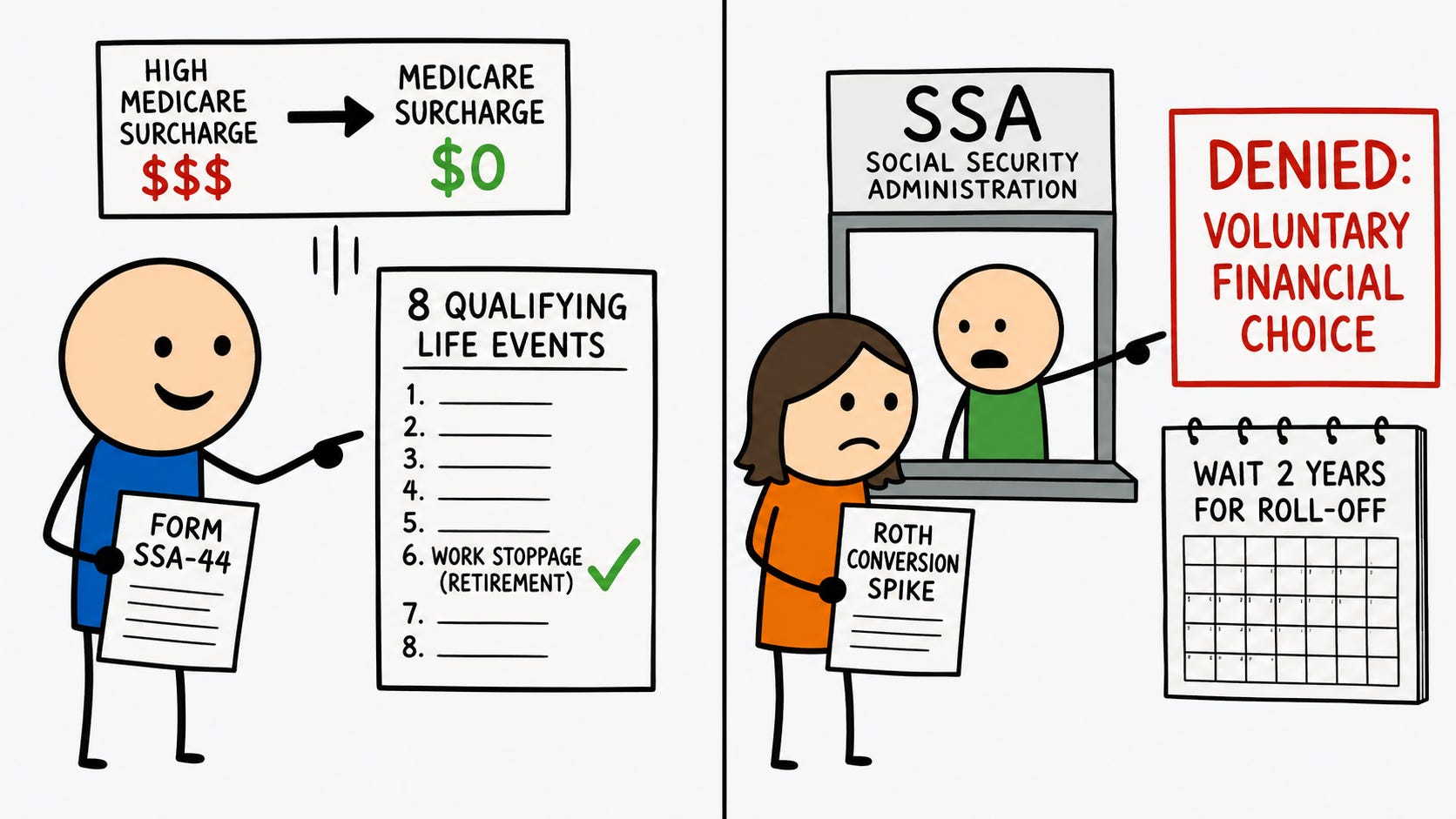
The two-year lookback that sets Medicare premiums produces a particular unfairness. A person whose income dropped, often because they retired, can be charged a high-income surcharge based on a working year they have left behind. There is a way to fix this, but it works only in specific situations, and the situations that qualify are narrower than most people assume. The form is called SSA-44, and understanding exactly what it can and cannot do, which events qualify and which do not, is what separates a successful reduction of a Medicare surcharge from a wasted effort and a denied request.
Start with what the form actually does. IRMAA is normally based on income from two years earlier. Form SSA-44 asks the Social Security Administration to set that older year aside and use a more recent year’s income instead, on the grounds that a qualifying life-changing event reduced the person’s income after the older year. It is technically a request for a new initial determination rather than an appeal in the strict sense. Reconsideration is the formal appeal process for an IRMAA determination and generally carries a sixty-day deadline after receipt of the determination notice. A person can request both in some situations, but when a qualifying life-changing event and newer income information can resolve the problem, the Social Security Administration generally handles it through the new-initial-determination process without requiring a formal appeal.
The heart of the matter is which events qualify, because the list is closed. There are exactly eight life-changing events: marriage, divorce or annulment, the death of a spouse, work stoppage such as retirement or job loss, work reduction such as cut hours, the loss of income-producing property outside the person’s control such as from a disaster or theft, the reduction or loss of employer pension income, and certain employer settlement payments connected to bankruptcy or reorganization. The event must also cause a reduction in income, or a change in filing status, large enough to actually reduce or eliminate the surcharge. Having one of the eight events by itself is not enough if the person would remain in the same surcharge tier afterward. If a person’s income drop fits one of these eight and moves them to a lower tier, they can ask to have a more recent year used. If it does not fit the list, the form does not apply, no matter how much their income fell or how unfair the surcharge feels.
This is where the most common and most costly misunderstanding shows up. A one-time income transaction by itself is not a qualifying life-changing event. If income two years ago was pushed up by a Roth conversion, a taxable property-sale gain, a large capital gain, or a voluntary IRA distribution, that transaction alone does not qualify for SSA-44. These are treated as nonqualifying one-time income events, and the Social Security Administration will reject an SSA-44 that cites them. A business sale requires one extra distinction. The gain from selling a business is not itself a qualifying event, but if the sale is connected with the owner stopping work and income subsequently falls, the work stoppage can qualify. This misunderstanding catches people constantly, because a surcharge driven by a single unusual event feels like it should be appealable. But the form simply does not cover a standalone income spike. The only relief for a one-time voluntary spike is the passage of time, because the annual recalculation will drop the surcharge once that high-income year rolls out of the two-year window on its own. There is nothing to file. There is only waiting for the spike to age out.
The flip side is the situation the form was practically built for, and it completes the picture for retirees. Work stoppage, meaning retirement, is a qualifying event. So the classic scenario, where a person worked through their early sixties, retired, and then got hit with a first-year Medicare surcharge based on their final working year’s income, is exactly what SSA-44 is meant to solve. That person does not have to wait for their retirement-level income to cycle into the lookback. They can file SSA-44, cite the work stoppage, provide their lower income for the more recent year, and have the surcharge recalculated on the income they actually have now. The difference between the Roth conversion and the retirement is not whether one was voluntary, since retirement can certainly be voluntary. The difference is that work stoppage is specifically included on the federal list of qualifying events, while an IRA conversion is specifically treated as a nonqualifying one-time income event.
The process itself is straightforward once a person knows they qualify. They complete Form SSA-44, indicate which of the eight events occurred and the date it happened, and provide their modified adjusted gross income for the more recent year. If the newer tax return already exists, that generally means providing the filed-return information. If it does not, the Social Security Administration can use a good-faith estimate of the income and expected filing status. They also provide the evidence required for the particular event. Work stoppage can be documented with items such as an employer statement or a retirement letter, and when that evidence is unavailable, the Social Security Administration can accept the person’s signed statement made under penalty of perjury. Other events have their own proof, a death certificate for the loss of a spouse, a divorce decree, and so on.
The form is filed with the Social Security Administration once IRMAA has been identified or proposed. A person does not necessarily have to wait for the final determination if a predetermination notice showing the planned surcharge has already been sent. Timing matters more when someone is trying to reach back into a prior premium year. For the current premium year, an approved new determination can generally take effect back to the beginning of the year, or to the start of the person’s applicable Medicare coverage if it began later. Relief for a prior premium year is much more limited and has its own timing rules.
Because the more recent year’s income may still be an estimate at the time of filing, the Social Security Administration can use that estimate to make the new determination and later verify it against the filed return and IRS records. If the final income turns out different, the surcharge can be corrected later, including through a retroactive assessment or a refund. If the new determination lowers the surcharge after excess amounts were already paid, the excess is generally refunded or credited. If the request is denied, the reconsideration appeal is the next avenue, with its own deadline running from the determination notice.
One separate situation is worth distinguishing, because it uses a different path. If the problem is not a life-changing event but the tax information itself, perhaps an amended return changed the number, the IRS data was incorrect, or the Social Security Administration used older tax information because the newer return was not yet available, that is not the SSA-44 life-changing-event remedy. Those circumstances can have their own new-initial-determination procedures, and reconsideration remains the formal appeal route when a person wants the determination itself reviewed. SSA-44 is specifically for the eight qualifying events. A data problem is a different kind of issue with a different remedy.
Picture someone who retired in the spring of a given year after decades of high earnings. The following year they enroll in Medicare, and their first premium notice carries a large surcharge, because it is based on their final full working year, when they were still earning a high salary. Rather than simply wait for the normal two-year lookback to catch up, they request a new initial determination based on the work stoppage. They check work stoppage as the event, give the date they retired, provide their much lower expected income for the more recent year, and attach a letter documenting their retirement. The Social Security Administration recalculates their surcharge based on the lower income, and the inflated premium is reduced or removed. The retirement qualified, so the form worked.
Now picture their neighbor, who two years ago did a large Roth conversion that pushed their income into a surcharge tier for a single year. Their income is otherwise modest. They feel the surcharge is unfair, since the conversion was a one-time event, and they try to file SSA-44 to appeal it. Their request is denied, because a Roth conversion is not one of the eight life-changing events, and standing alone it is treated as a nonqualifying one-time income event. The conversion itself gives them no basis for SSA-44 relief. Assuming the tax information is correct and no separate qualifying event occurs, the normal annual recalculation will eventually move past that conversion year on its own. The form could not help them, not because their situation was not real, but because it was not on the list.
The resolution is understanding SSA-44 as a targeted tool for eight specific life events, not a general appeal of any surcharge that feels unfair. It lets the Social Security Administration use a more recent year’s income when a qualifying event, most commonly retirement, has lowered income enough to reduce or remove the surcharge. It does nothing for a standalone one-time income spike, which has to be waited out through the annual recalculation instead.
The variables that determine whether SSA-44 can help are whether the income drop was caused by one of the eight qualifying events, whether that drop is large enough to actually change the surcharge tier, whether the person can provide the required evidence and their more recent income, and whether they file in a timely way relative to the event and the premium year. The single most useful thing to know is the dividing line, that an event on the federal list such as retirement, a change in marital status, or a pension loss can qualify, while a chosen financial transaction such as a conversion or a sale does not. A retiree charged a surcharge on their working-year income should reach for this form. A person charged a surcharge on a one-time conversion should understand that the form will not help and that time will resolve it on its own.
I write one of these every day, one retirement rule, explained in plain language and verified against the source. The daily email is free: subscribe here.
Full archive, worksheets, and search live at RetirementNewsRundown.com.
Disclaimer
This article is for educational and informational purposes only. It is not tax, legal, or financial advice and does not create an advisor–client relationship. Always consult appropriate professionals regarding your specific situation.