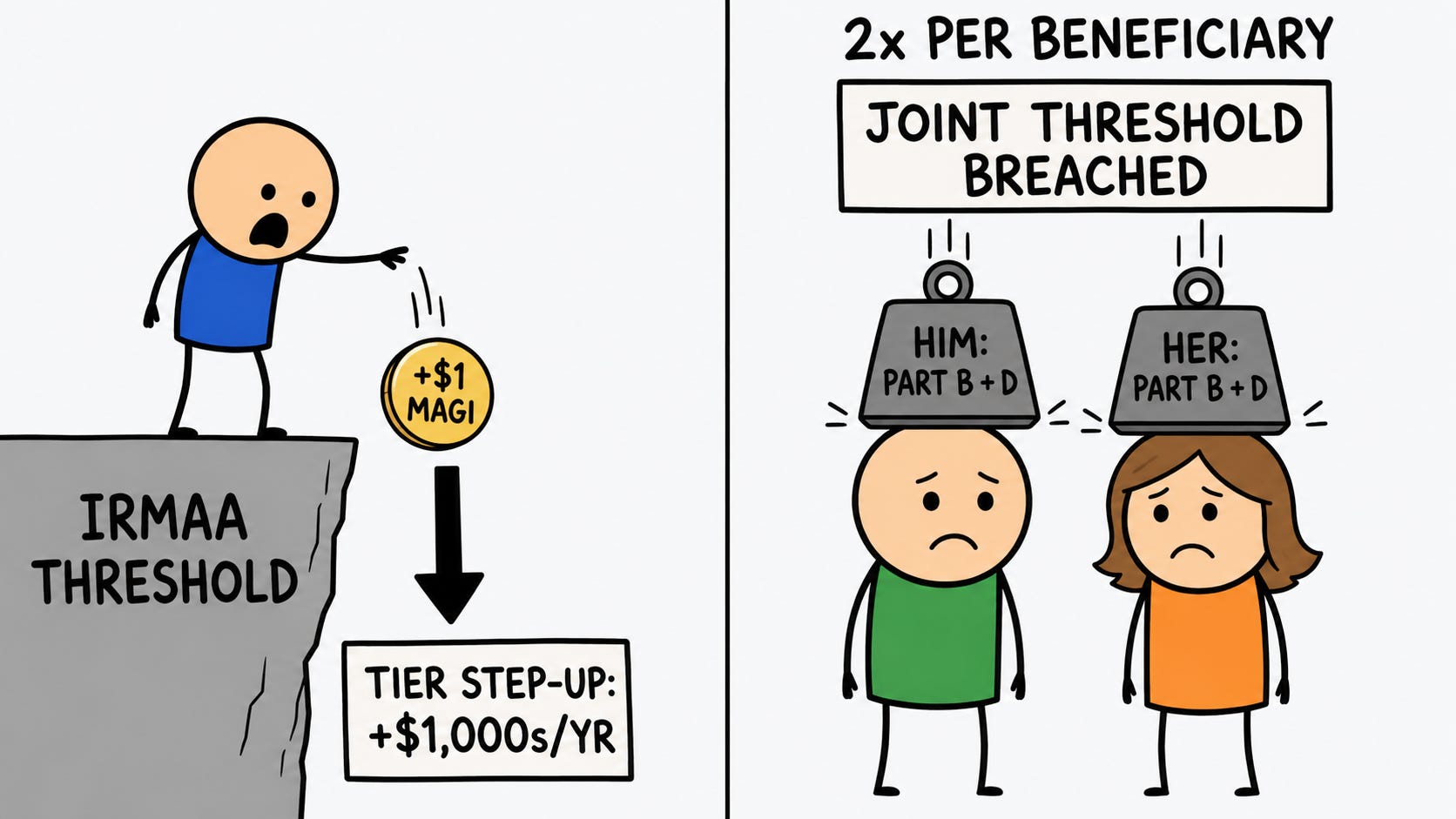
Ordinary income tax brackets are forgiving at the edges. Go one dollar into a higher tax bracket and only that additional dollar is exposed to the higher marginal rate. Everything below stays taxed at the lower rates. IRMAA does not work this way, and that structural difference is what makes its income thresholds so painful. IRMAA is built with hard thresholds. Crossing one by a single dollar moves a person into the next surcharge tier for the whole year, with no gradual phase-in. Understanding how the tier structure differs from ordinary tax math, and how the cost multiplies, is what explains how one dollar of income can cost a household thousands.
Begin with how a normal tax bracket behaves, because the contrast is the whole point. Income tax brackets are marginal. When income crosses into a higher bracket, only the portion above the threshold is taxed at the higher rate. Earning one dollar into a higher bracket costs a few cents of additional tax on that one dollar. The system is designed so that crossing a line is almost painless, because the higher rate touches only the income above the line.
IRMAA operates as a step function instead. There is no gradual phase-in between tiers. Once modified adjusted gross income crosses a threshold, the beneficiary moves into the next IRMAA level. At the first threshold, that means going from no surcharge at all to the full first-tier surcharge. At later thresholds, the person was already paying a surcharge, so the cost of crossing the line is the difference between the old tier and the new one. Either way, a person one dollar over a boundary pays the same monthly surcharge as someone much farther into that same tier. The amount does not scale with how far over the line a person is. A single filer whose income sits one dollar into a tier pays exactly what someone near the top of that same tier pays. Being barely over costs the same as being far over.
This is why the marginal cost of the dollar that crosses the line can be so extreme. At the first threshold, that one dollar can turn on an entire surcharge where there was none. At later thresholds, it triggers a jump from one surcharge level to the next. Either way, that single dollar does not cost a few cents. For someone enrolled in both Part B and Part D, the crossing can add hundreds or well over a thousand dollars across a full year, depending on which boundary is crossed. Expressed as a rate, the cost of that one dollar can amount to a marginal rate in the thousands of percent, because one dollar of additional income produced a full step’s worth of additional cost. No ordinary tax bracket comes close to that kind of penalty on a single dollar, and it exists purely because IRMAA moves in steps rather than as a graduated rate.
The cost can multiply in two ways that compound the step. First, someone enrolled in both Part B and Part D can be hit on both coverages when the same income threshold is crossed, because the two parts use the same income tiers. So the one dollar that pushes such a person over does not trigger one surcharge, it triggers a step on both. Second, IRMAA is assessed per beneficiary. For a married couple filing jointly, if both spouses have Part B and Part D and their joint income crosses a threshold, each spouse faces the Part B and Part D adjustment for the new tier. So a single dollar of household income over a threshold can move both coverages for both spouses, which is how the household increase from one dollar can reach into the thousands for the year.
There is not just one cliff, either. There are several tiers, and the same step-function behavior repeats at each boundary. The total surcharge gets larger as the tiers rise, although the dollar increase from one tier to the next is not identical and does not necessarily grow at every threshold. In fact the jump into the very highest tier can be smaller than some of the middle-tier jumps. A person is not dealing with a single line to stay under but a series of them, each functioning as its own step, each capable of adding another increment the moment it is crossed.
Because the surcharge moves in steps, the only thing that matters within a given tier is which side of the threshold a person’s income lands on. The distance over the line is irrelevant to the amount. One dollar over and one thousand dollars over produce the identical surcharge for that tier. This makes the exact figure of modified adjusted gross income, measured against the exact threshold, the thing that determines the cost. A person whose income lands just under a threshold pays the lower amount. The same person, with one more dollar, pays the next tier’s amount on both parts, and for a couple, for both people. The entire difference turns on that final dollar and which side of the line it falls.
Picture a single retiree whose modified adjusted gross income lands exactly at the first IRMAA threshold. They remain below the first surcharge tier and pay the standard premium with no surcharge. Now give them one additional dollar of income. That dollar moves them into the first surcharge tier. If they have both Part B and Part D for the entire year, they now owe the first-tier adjustment on both coverages for all twelve months. The final dollar did not cost a few cents. It caused an abrupt jump in their annual Medicare cost, purely because it moved them across the threshold. Had they landed one dollar lower, they would have paid nothing extra.
Now make it a married couple filing jointly, both enrolled in Part B and Part D, whose combined income lands one dollar over the applicable joint-filer threshold. Each spouse moves into the new tier. The household therefore absorbs the Part B and Part D increase twice, once for each spouse, for the whole year. Depending on which boundary they crossed, that one additional dollar of household income can increase their combined annual Medicare cost by thousands, all from being one dollar over rather than one dollar under.
The resolution is understanding IRMAA as a step function, where crossing a threshold by any amount moves a person to the next tier’s surcharge, in contrast to the marginal treatment that makes ordinary tax brackets gentle at the edges. The surcharge does not scale with how far over the line income falls. It applies at the tier’s level the moment the line is crossed, on both Part B and Part D for someone with both coverages, and separately for each enrolled spouse.
The variables that determine the cost are where modified adjusted gross income falls relative to each threshold, whether crossing pushes into a higher tier at all, which boundary is being crossed since the jumps differ, and how many enrolled people are in the household, since each is assessed separately. Because the surcharge is all-or-nothing at each threshold rather than graduated, the position of income relative to the line is what matters, not the size of the excess. That is the entire reason a single dollar can cost thousands. In a marginal system, the last dollar is cheap. In IRMAA’s step system, the last dollar before a threshold and the first dollar after it are separated by a full step, felt on both parts, doubled for a couple, and repeated at every tier boundary.
I write one of these every day, one retirement rule, explained in plain language and verified against the source. The daily email is free: subscribe here.
Full archive, worksheets, and search live at RetirementNewsRundown.com.
Disclaimer
This article is for educational and informational purposes only. It is not tax, legal, or financial advice and does not create an advisor–client relationship. Always consult appropriate professionals regarding your specific situation.