The single most confusing thing about Medicare premiums is that they are not based on what a person earns now. They are based on what a person earned two years ago. This two-year lookback is why so many people are blindsided by their first Medicare bill, and why a surcharge can appear in a year when current income is modest. Understanding exactly how the lookback works, which year sets which premium, and the fact that it recalculates every year, turns Medicare premiums from an unpredictable surprise into something a person can see coming well in advance.
The mechanic is a straight two-year offset. The premium a person pays in a given year is determined by the tax return filed for the year two years earlier. This year’s Medicare premiums are set by the return from two years ago. Next year’s will be set by last year’s return. The year after that will be set by this year’s return. Income does not affect the premium in the same year it is earned. It affects the premium two years later. If the two-year-prior return is not yet available when the determination is made, the Social Security Administration uses the return from three years prior temporarily, then adjusts once the more recent return is processed.
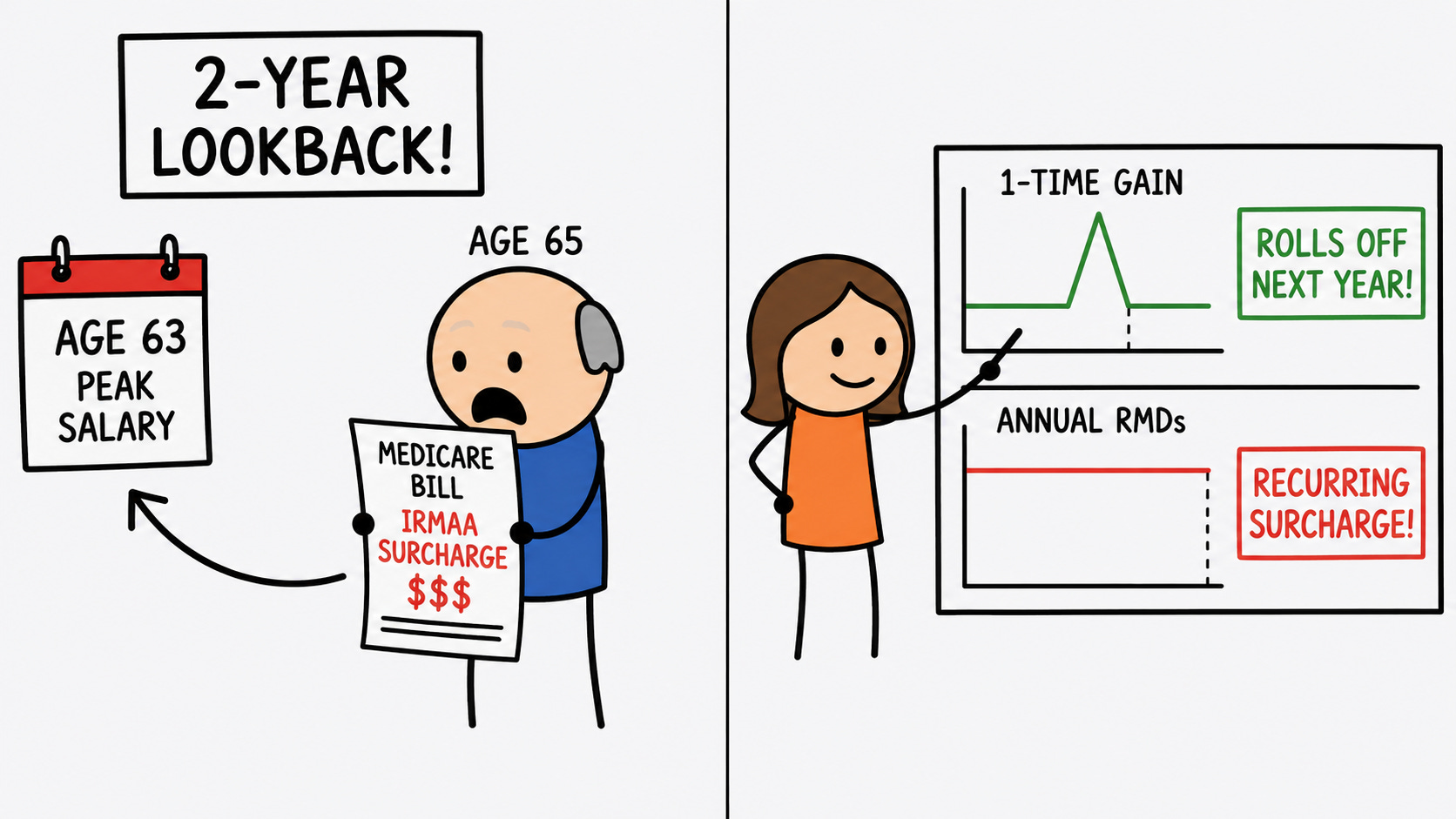
This offset produces a specific and widely missed consequence for people first enrolling in Medicare. Medicare eligibility begins at 65, and the first premium is set by the return from two years earlier, which is generally the year the person was 63. For many people, age 63 is still a working year, often near the peak of their career and their earnings. So a person works through 63, retires at 64 or 65, watches their income drop to retirement levels, and then receives their first Medicare bill, which is based not on their new lower retirement income but on the higher income they earned at 63 while still working. The surcharge reflects a version of their finances that no longer exists. This is the classic first-year Medicare surprise, and it happens because the lookback reaches back into the working years to set the premium for the first retired years.
The reach of the lookback means income decisions start affecting Medicare premiums earlier than people realize. Because the premium at 65 is set by income at 63, the decisions that determine that first surcharge are made two years before a person is even on Medicare. A large one-time event in that window, selling a home or a business, realizing a big capital gain, taking a large distribution, sets the premium that will arrive two years later. Someone who does not know about the lookback can make a perfectly reasonable financial decision at 63, having no idea it will raise their Medicare cost at 65. The lookback invisibly connects the early sixties to the Medicare years in a way that is easy to miss unless a person knows to look for it.
Now the feature that most reduces the anxiety around all of this, and it is genuinely reassuring because people assume the opposite. IRMAA is recalculated every single year. Each year, the Social Security Administration looks at the most recent return the IRS has provided and redetermines the surcharge from scratch. This means a surcharge caused by a one-time spike in income lasts only as long as that high-income year sits in the two-year window. A person who had one unusually high year, from a home sale or a severance payment or a single large transaction, pays the surcharge for the premium year that high-income return governs, and then the surcharge falls away once a normal-income return moves into the lookback position. IRMAA is not a permanent penalty. It follows income up and it follows income back down, on a delay. Many people believe that crossing into a surcharge once means paying it forever, and that is simply not how it works for one-time events.
There is an important exception to that reassurance, and it is worth stating plainly so no one relies on the wrong version. The roll-off applies to one-time income. It does not apply to permanent, recurring income. The clearest example is required minimum distributions. Once a person reaches the age when required distributions begin, that income is mandatory and recurring every year, so if it is large enough to push them into a surcharge tier, it can keep them there year after year, because it does not roll out of the lookback the way a one-time event does. The lookback delays the effect, but recurring income produces a recurring surcharge. So the comforting rule that a spike rolls off is true for genuine one-time events and not true for income that repeats.
Changes in a person’s life circumstances can also shift the picture, and one situation deserves particular mention because the lookback interacts painfully with it. When one spouse in a married couple dies, the survivor’s filing status generally changes over time from married filing jointly to single, and the single-filer income thresholds for IRMAA are much lower and narrower. But the lookback still uses a return from a year when the couple filed jointly. So a surviving spouse can find the joint modified adjusted gross income from that earlier return being measured against the lower single thresholds, which can produce a surcharge at exactly the time a household has lost income and a member. The loss of a spouse is one of the qualifying life-changing events that can be raised with the Social Security Administration to have a more recent, lower income considered, so this situation is not necessarily one a survivor is simply stuck with. Marriage and divorce similarly change filing status and thresholds, and each can move a person into or out of a surcharge tier through the same interaction of the lookback and the brackets.
Picture someone who spent decades as a high earner and retired at 64. At 63, their final full working year, they earned a substantial salary. At 65 they enroll in Medicare, now living on Social Security and modest portfolio withdrawals, a fraction of their old income. Their first Medicare premium notice arrives with a large surcharge, because it is based on their age-63 return, the year they were still earning that big salary. They are paying a high-income surcharge on retirement-level income, purely because the lookback reached back into their last working year. The following year, once a lower-income retirement return moves into the two-year window, their surcharge drops substantially. The high first-year premium was a delayed echo of their working income, not a reflection of their actual retirement finances.
Now picture the opposite kind of person, one with a very large traditional IRA who did nothing to reduce it before required distributions began. Their required distributions are large and mandatory, and they arrive every year. Two years after those distributions start, the resulting income shows up in the IRMAA lookback and pushes them into a surcharge tier. Because the distributions recur every year, the surcharge recurs every year too. For this person there is no roll-off, because the income that triggered the surcharge is not a one-time event but a permanent feature of their retirement, repeating annually and keeping them in the tier.
The resolution is understanding the lookback as a two-year delay that connects a specific past year to a specific premium year, and knowing that it recalculates annually rather than locking in permanently. This year’s income sets the premium two years out. The income at 63 generally sets the first Medicare premium at 65. A one-time spike raises the premium for the year its return governs and then rolls off, while recurring income produces a recurring surcharge.
The variables that determine what the lookback does to a person are which year’s income is being used, whether the income in that year was unusually high or typical, whether any high income was a one-time event or a permanent recurring source, and how a change in filing status, such as marriage, divorce, or the loss of a spouse, interacts with the delay. Because the lookback reaches back two years, the income that sets a premium is generally already determined by the time the premium arrives, which means the surcharge for a given year can often be known in advance once that year’s return is filed. The premium is not a mystery. It is a delayed reflection of a specific past return, and seeing which return governs which year is what makes it predictable rather than surprising.
I write one of these every day, one retirement rule, explained in plain language and verified against the source. The daily email is free: subscribe here.
Full archive, worksheets, and search live at RetirementNewsRundown.com.
Disclaimer
This article is for educational and informational purposes only. It is not tax, legal, or financial advice and does not create an advisor–client relationship. Always consult appropriate professionals regarding your specific situation.