A retiree signs up for Medicare expecting to pay the standard premium everyone talks about, and then a notice arrives saying they owe considerably more. The extra amount is called IRMAA, and it catches people off guard because nothing about enrolling in Medicare warns them it is coming. It is not a penalty for doing anything wrong. It is an income-based surcharge that raises Medicare premiums for people whose income sits above certain thresholds. Understanding how IRMAA is structured, what income triggers it, and the ways it costs more than people expect is the foundation for everything else about managing Medicare premiums in retirement.
IRMAA stands for the income-related monthly adjustment amount, and the plain description is that it is a surcharge added on top of the standard Medicare premiums for higher-income beneficiaries. Most people on Medicare Part B pay a base premium, which is set each year and can change annually, though some people pay more or less than the standard amount because of separate rules. People whose income is above the first threshold pay their premium plus an IRMAA surcharge, and the surcharge grows as income rises. The way to think about it is not as a tax on the income itself but as a reduction in the subsidy. Medicare heavily subsidizes the premiums for most enrollees, who pay only roughly a quarter of the true cost. IRMAA reduces that subsidy for higher earners, so they cover a larger share of the actual cost, rising in steps to a much larger share at the top tiers, which is why the surcharge climbs steeply at higher income levels.
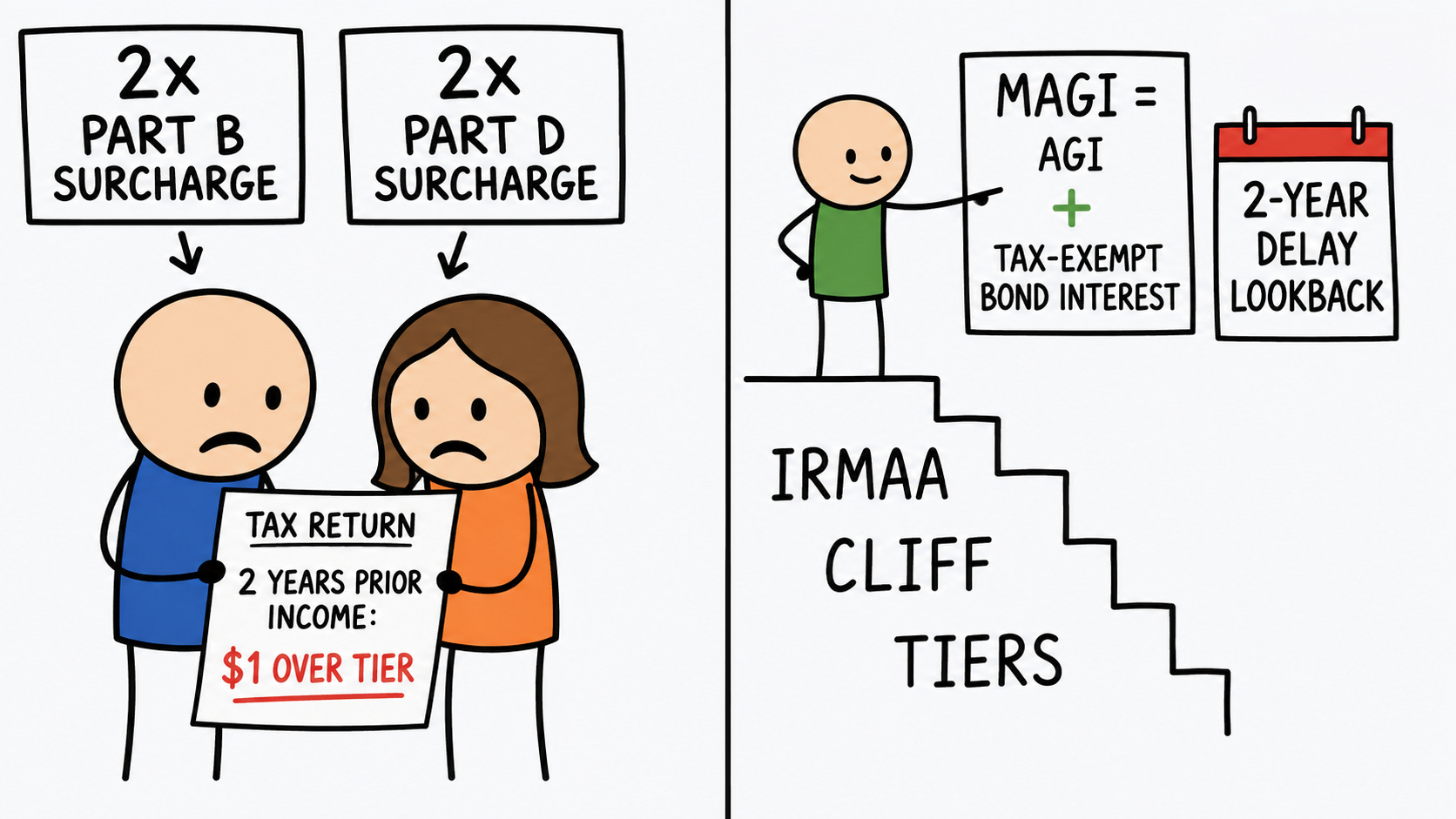
The income figure that determines IRMAA is a specific and narrow version of modified adjusted gross income. For IRMAA, it is adjusted gross income plus tax-exempt interest, and essentially nothing else added back. This is narrower than some other modified adjusted gross income definitions used elsewhere in the tax code, but the tax-exempt interest piece matters, because it means municipal bond interest, which is free of income tax, still counts toward IRMAA. A person who shifted into municipal bonds expecting to lower every income-based figure will find that those bonds do not reduce their IRMAA, because the interest gets added back specifically for this calculation.
Two structural features of IRMAA deserve their own attention and each has its own detailed treatment, but they belong in the foundation. First, IRMAA is based on income from two years earlier, not the current year. The premium a person pays this year is generally determined by the tax return from two years prior. If that return is not yet available, the Social Security Administration may use the return from three years prior until the more recent one is processed. This lookback is why IRMAA so often surprises people, because a high-income event from two years ago can raise premiums in a year when current income is much lower. Second, the surcharge tiers are cliffs, not gradual slopes. Crossing a threshold by even a single dollar moves a person into the next tier for the entire year, with no phase-in. Both of these features shape IRMAA planning heavily and each is worth understanding in depth on its own.
Now the feature people most often miss, which is that IRMAA applies to both Part B and Part D. Most discussion of IRMAA focuses on the Part B surcharge, because Part B is the larger premium. But there is a separate IRMAA surcharge on Part D, the prescription drug coverage, and it uses the same income tiers. A person over the threshold pays a surcharge on their Part B premium and a second surcharge on their Part D coverage. The Part D surcharge is smaller in dollar terms, but it is real and it is separate, and it is collected differently, which people find confusing. The Part B surcharge is generally deducted from a person’s Social Security benefit or billed by Medicare, while the Part D surcharge is billed separately rather than paid to the drug plan directly.
The feature that does the most damage to married couples is that IRMAA is assessed per person, not per household. When a married couple files jointly, IRMAA looks at their combined income to determine the tier, but then the surcharge is applied to each spouse individually. If both spouses are on Medicare and the couple’s joint income puts them in a surcharge tier, each spouse pays that tier’s surcharge, on both Part B and Part D. The household is effectively paying the surcharge twice, once for each person. This means that for a couple both on Medicare, crossing an income threshold can raise their combined premiums by roughly double what a single person in the same tier would pay, because the same surcharge lands on each of them.
There is also a filing status point that runs the opposite of what people expect. A married couple that files separately, having lived together at any point during the year, faces a much harsher IRMAA schedule than a couple filing jointly. The separate-filer brackets are compressed, jumping toward the top surcharge tiers at a far lower income level, with none of the middle-tier cushioning that joint filers get. So filing separately, which people sometimes consider for other reasons, usually makes IRMAA worse rather than better.
Finally, the mechanics of how IRMAA gets assigned. The Social Security Administration receives income data from the IRS, determines which tier a person falls into based on the applicable prior-year return, and sends a determination notice stating the surcharge. A person who believes the determination is wrong, or whose income has dropped because of a qualifying life event, can challenge it through a specific process, which is its own topic. But absent that, the surcharge is set by that notice and collected automatically.
Picture a married couple, both newly on Medicare, whose income two years ago was high enough to land them in a surcharge tier. When their Medicare premiums are set, each of them pays the standard Part B premium plus the IRMAA surcharge for their tier, and each of them also pays the Part D surcharge for that tier. That is four surcharge amounts across the household, two on Part B and two on Part D, because each spouse is assessed individually even though the tier was determined by their joint income. A single person with the exact same income would pay only one Part B surcharge and one Part D surcharge. The couple pays roughly double, purely because both of them are enrolled.
Now consider the income that put them there. Suppose two years ago they sold a rental property, producing a large one-time capital gain that pushed their income well into a surcharge tier. Their income this year is back to normal, modest retirement income. But because IRMAA looks back two years, this year’s premiums are based on that earlier high-income year. They are paying surcharges now on income they no longer have, because the property sale two years ago set the figure that governs today’s premiums. The surcharge will fall back down once the high-income year rolls out of the two-year window, but for now they are living with the delayed consequence of a one-time event.
The resolution is understanding IRMAA as a per-person, income-based surcharge on both Part B and Part D, driven by a narrow modified adjusted gross income figure from two years earlier, structured as cliffs rather than slopes. It is not a penalty and not avoidable simply by paying attention at enrollment, because the income that triggers it was earned two years before the premiums are set.
The variables that determine what a person pays are their modified adjusted gross income from the applicable prior year, including tax-exempt interest that gets added back, their filing status, and whether one or both spouses are enrolled in Medicare, since the per-person assessment doubles the cost for couples. Because IRMAA reaches back two years and moves in cliffs, the income decisions that set it are made well before the premiums arrive, which is why understanding the structure matters long before a person is actually on Medicare. The surcharge itself is straightforward once seen clearly. What makes it costly is the combination of the two-year delay, the cliff thresholds, and the per-person doubling, each of which shapes the total in ways a person only feels once the premium notice arrives.
I write one of these every day, one retirement rule, explained in plain language and verified against the source. The daily email is free: subscribe here.
Full archive, worksheets, and search live at RetirementNewsRundown.com.
Disclaimer
This article is for educational and informational purposes only. It is not tax, legal, or financial advice and does not create an advisor–client relationship. Always consult appropriate professionals regarding your specific situation.