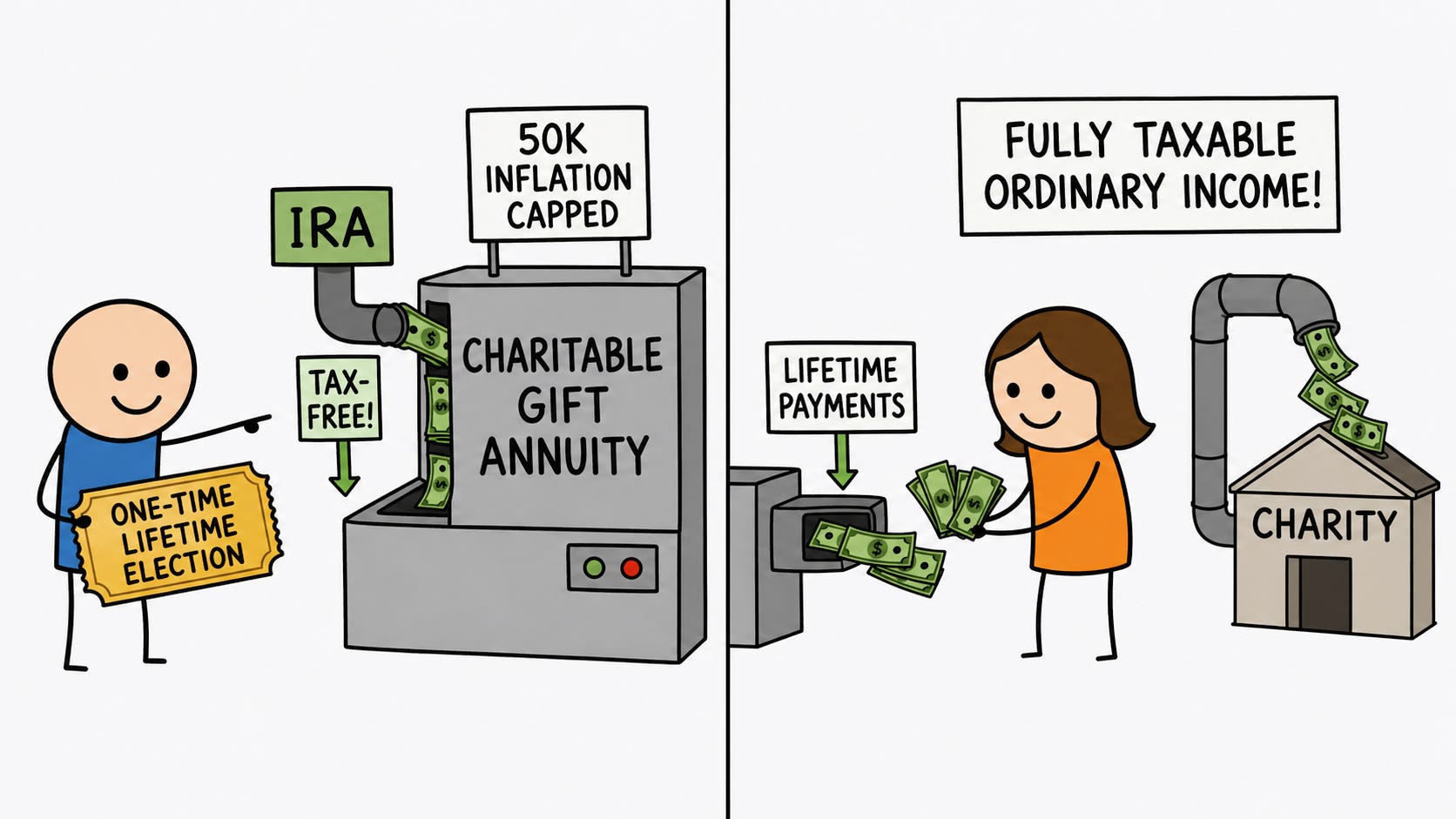
Every qualified charitable distribution covered so far has one thing in common. The money leaves the IRA and goes to a charity, and the donor never sees it again. A provision added by recent legislation created a narrow and unusual exception to that pattern, one that lets a person route a QCD into an arrangement that pays income back to them for life while still delivering the remainder to charity. It is a one-time opportunity, tightly capped and hedged with conditions, and it is the one situation where QCD money can flow into something other than a direct gift to an operating charity. Understanding how it works, and what it costs, rounds out the full picture of what a QCD can do.
The provision allows a single, once-in-a-lifetime election to make a QCD into what is called a split-interest entity. A split-interest entity divides its interest between two parties, an income beneficiary who receives payments and a charity that receives whatever remains at the end. The donor funds it with IRA money as a QCD, receives income from it for life, and the charity keeps the remainder when the arrangement ends. It is a way to turn a chunk of IRA money into a lifetime income stream with a charitable outcome, using the QCD machinery to get the money in without recognizing it as income.
Three types of entity qualify. A charitable remainder annuity trust pays the donor a fixed dollar amount each year. A charitable remainder unitrust pays a variable amount based on a percentage of the trust’s value, so the payments move with the trust’s investments. And an immediate charitable gift annuity is a contract with the charity itself, where the charity agrees to pay the donor a set amount for life in exchange for the gift. All three share the same basic shape, income to the donor now, remainder to the charity later.
The conditions on this election are strict, and they are what make it a specialized tool rather than a routine one. The most important is that it is a one-time, lifetime election. A person can use it in exactly one tax year, one time, ever. Once it is used in any amount, it is exhausted permanently. Someone who uses only part of the available amount cannot come back in a later year to use the rest. This is not an annual option like the ordinary QCD. It is a single lifetime shot.
The amount is capped, and the cap works in a way people misread. The election is limited to a set dollar amount that started at fifty thousand dollars and has been indexed for inflation since. That capped amount does not sit on top of the annual QCD limit. It counts inside it. So a person who uses the full split-interest amount in a given year has used that much of their annual QCD ceiling, with the remainder of the annual limit still available for ordinary QCDs to operating charities that same year. The split-interest election is a carve-out within the annual limit, not an addition to it.
Several other conditions apply, and they differ by vehicle. The entity must be funded exclusively by the QCD, meaning it cannot be mixed with other money, and no additional contributions can be added to it later. The only permissible income beneficiaries are the donor and the donor’s spouse, so it cannot be used to create an income stream for children or anyone else, though the spouse can be named to continue receiving payments after the donor. For the two trust types, the trust must pay out at least five percent of its value annually, and it must be structured so that the projected charitable remainder meets the tax code’s minimum. For a charitable gift annuity, the rules are different, the annuity must be immediate, generally beginning payments within one year, and must pay a fixed rate the charity is willing to offer, rather than being held to the same five percent trust figure. These requirements keep the vehicle narrowly aimed at providing lifetime income to the donor or couple, with a genuine charitable remainder.
Now the tax mechanics, which contain the central tradeoff. The money going in gets the QCD treatment. It is excluded from income, and it counts toward the required distribution for the year it is made, exactly like an ordinary QCD. But the payments that come back to the donor are fully taxable. Every dollar of income the donor receives from the trust or annuity is taxed as ordinary income, with none of the partial tax-free treatment that other annuities sometimes carry. This makes sense given how the money went in. Because the QCD entered the entity tax-free, the payments coming out are fully taxed rather than partly returned as untaxed principal. The donor also cannot take any charitable deduction for the gift, because the money was already excluded from income going in. The benefit is the income exclusion on the way in and the required-distribution credit, not a deduction and not tax-favored payments.
The same charity restrictions that apply to ordinary QCDs apply here too. The remainder still has to benefit a qualified charity, and the arrangement cannot be used to route money to the kinds of recipients that are excluded from QCDs generally. The split-interest election widens where a QCD can go, but only to these specific income-producing charitable vehicles, not to donor advised funds or the other excluded recipients.
Picture a retiree who is over 70.5, has a large IRA, gives to charity, and would also value an income stream for the rest of her life. She makes the one-time election, directing the capped amount from her IRA into an immediate charitable gift annuity with a charity she supports. That transfer is excluded from her income and counts toward her required distribution for the year. In return, the charity agrees to pay her a fixed amount every year for the rest of her life. When she dies, the charity keeps what remains. She has converted a portion of her IRA into lifetime income and a charitable gift in a single move, and the money went in without being taxed.
Two tradeoffs come with it. Every annuity payment she receives is fully taxable to her as ordinary income, because she got the money into the annuity tax-free and the payments coming back carry the full tax. And the payments are backed by the charity’s own financial strength rather than by any insurance guaranty system, so they depend on the charity remaining solvent over her lifetime, which is a reason the choice of charity matters. Because she has now used her one-time election, she cannot do this again in any future year. She still has the rest of her annual QCD limit available for ordinary gifts to charities this year, since the split-interest amount counted inside that annual limit rather than on top of it, but the special election itself is spent for life.
The resolution is understanding this as a specialized, one-time tool rather than a routine QCD move. It lets a person over 70.5 convert a capped amount of IRA money into a lifetime income stream with a charitable remainder, getting the income exclusion and the required-distribution credit going in, in exchange for fully taxable payments coming back and the permanent use of a once-in-a-lifetime election.
The variables that determine whether this fits a given person are whether they want a lifetime income stream in the first place, whether they are comfortable using their single lifetime election on it, whether they accept that the payments will be fully taxable ordinary income and backed by the charity’s own solvency, and whether the capped amount is meaningful enough relative to their situation to be worth the complexity of setting up a trust or annuity. For most people, the ordinary QCD to an operating charity is the simpler and more flexible tool. This one-time split-interest election exists for the narrower case of a person who specifically wants to pair a charitable remainder with lifetime income, and who is willing to spend their single lifetime election to arrange it. It is the outer edge of what the QCD rules allow, useful to know about even though comparatively few people will use it.
I write one of these every day, one retirement rule, explained in plain language and verified against the source. The daily email is free: subscribe here.
Full archive, worksheets, and search live at RetirementNewsRundown.com.
Disclaimer
This article is for educational and informational purposes only. It is not tax, legal, or financial advice and does not create an advisor–client relationship. Always consult appropriate professionals regarding your specific situation.