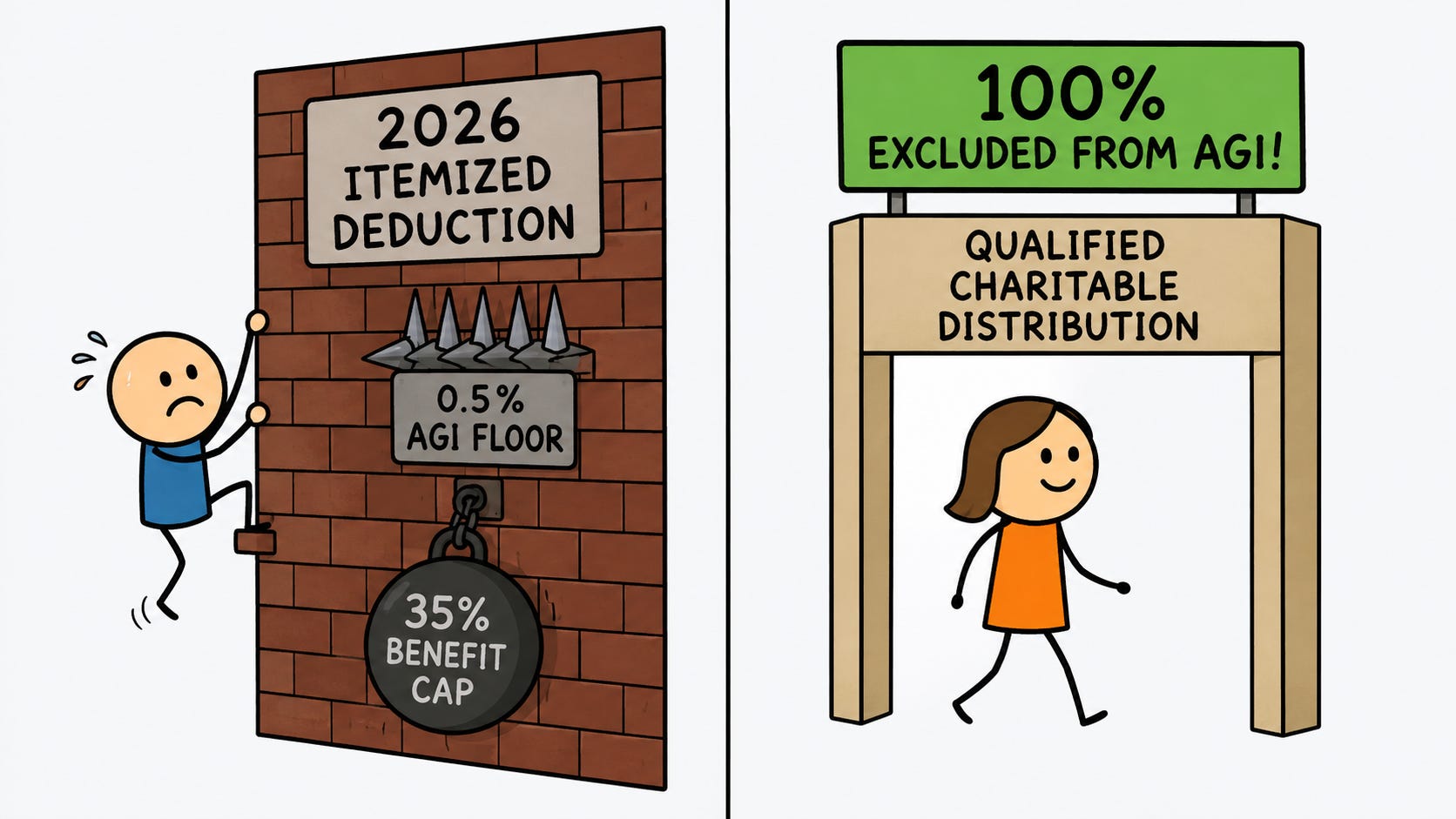
For years the question of how to give to charity tax-efficiently had a fairly simple answer, and for people over a certain age it usually pointed to a qualified charitable distribution. The One Big Beautiful Bill Act, with charitable provisions effective in 2026, reshaped the comparison by adding new hurdles to the itemized deduction and a small new benefit for people who do not itemize. The result is that the choice between a QCD and a charitable deduction now turns on more moving parts than it used to. Understanding the mechanical difference between these paths, and the specific ways the new rules treat each one, is what lets a person see which route actually delivers the benefit for their situation.
The foundational difference is one this platform has covered before, but it is the anchor for everything else, so it bears restating precisely. A QCD is an exclusion from income. The money moves from an IRA to a charity and never enters adjusted gross income at all. A charitable deduction, by contrast, is subtracted after adjusted gross income is already set, reducing taxable income but not adjusted gross income. That single structural difference is why the two paths behave so differently under the tax rules, and the 2026 changes widened the gap between them.
Start with the itemized charitable deduction, the traditional route for people who itemize. It has always required a person to itemize and to clear the standard deduction before any charitable giving produced a benefit. The 2026 rules added two new obstacles on top of that. The first is a floor. Only charitable giving above one half of one percent of a person’s adjusted gross income now counts toward an itemized deduction. For someone with substantial income, the first slice of their giving each year produces no deduction at all, because it sits below the floor. The second is a cap at the top. For taxpayers in the highest bracket, the tax benefit of itemized deductions generally, not charitable ones alone, is limited to a thirty five percent rate rather than their full marginal rate. A dollar deducted is worth thirty five cents to them rather than the thirty seven it would have been worth before. Neither of these obstacles is enormous on its own, but both chip away at the value of giving through the itemized deduction.
Now the qualified charitable distribution, and here is where the mechanics turn decisively. Because a QCD is an exclusion and never enters adjusted gross income, it is not subject to either of those new obstacles. The half-percent floor applies to itemized deductions, and a QCD is not a deduction, so the floor does not touch it. The top-bracket cap applies to itemized deductions, and again, a QCD is not one, so the cap does not reach it. A QCD also does not require itemizing at all, so a person who takes the standard deduction still gets its full benefit. On top of that, the QCD keeps money out of adjusted gross income, which continues to help with the taxation of Social Security, Medicare premium surcharges, and the net investment income tax, none of which a deduction affects. The 2026 changes made the itemized deduction modestly worse while leaving the QCD income-exclusion rules untouched, which is why the QCD stands out more than it did before.
There is also a new, smaller path for people who take the standard deduction and do not qualify for or use a QCD. Beginning in 2026, a standard deduction filer can take an above-the-line deduction for cash gifts to public charities, up to one thousand dollars for a single filer and two thousand for a married couple filing jointly. It is capped at those modest amounts and applies only to cash gifts to qualifying public charities, not to donor advised funds or private foundations. For a person who gives small amounts and cannot do a QCD, this restores a bit of tax benefit that had been unavailable to non-itemizers. It is useful but limited, and it does not approach what a QCD can do for someone who qualifies.
One area remains where a non-QCD approach has a genuine advantage the QCD cannot match, and it is worth naming so the comparison is fair. Donating appreciated securities, stock that has grown in value, directly to charity accomplishes two things a QCD does not. It avoids the capital gains tax that would be owed if the stock were sold, and it produces a charitable deduction for the full current value of the stock if the person itemizes. A QCD is cash out of an IRA, so it cannot capture the capital gains avoidance that giving appreciated stock does. This route has its own conditions. It requires itemizing to claim the deduction, the deductible amount is subject to the percentage-of-adjusted-gross-income ceilings that apply to property gifts, the giving is still subject to the same half-percent floor, and larger noncash gifts carry their own substantiation and appraisal requirements. Even so, for a person sitting on highly appreciated stock, giving the stock itself can be the more efficient move, because the capital gains savings are a separate benefit the QCD does not offer.
Putting the paths side by side, the mechanical picture for 2026 comes into focus. For a person who is at least 70.5, has a traditional IRA, and gives to charity, the QCD is usually the most efficient route, because it sidesteps the floor, the cap, and the standard-deduction problem all at once, while also lowering adjusted gross income. The itemized deduction becomes the necessary tool for people who are under 70.5 and cannot do a QCD, for giving that exceeds the QCD annual limit, and for gifts of appreciated property where the capital gains avoidance matters. The small non-itemizer deduction fills a narrow gap for standard-deduction filers giving modest cash amounts. Each path has a place, but the QCD’s structural advantages grew under the new rules rather than shrinking.
Picture a retiree who is 74, takes the standard deduction, and gives fifteen thousand dollars a year to her church, all in cash. Under the itemized route she gets nothing, because she does not itemize. The new non-itemizer deduction would let her deduct only up to the small capped amount for a single filer, a tiny fraction of a fifteen thousand dollar gift, and it applies to cash gifts only. If she instead makes the fifteen thousand dollar gift as a QCD from her IRA, the entire amount is excluded from her income, it counts toward her required distribution, and it lowers her adjusted gross income, which can reduce the taxation of her Social Security and keep her Medicare premiums down. The two approaches are not combined on the same dollars, so this is a choice between them, and for her the QCD is the only route that produces a meaningful benefit at all.
Now change the person. Consider a 60 year old, too young for a QCD, who wants to give a large gift and happens to hold stock that has appreciated substantially. She cannot do a QCD. But by donating the appreciated stock directly to the charity, she avoids the capital gains tax she would owe if she sold it, and she gets a deduction for the stock’s full value if she itemizes, subject to the percentage-of-income ceilings and the half-percent floor. For her, the appreciated-stock gift is the efficient path, precisely because it captures a capital gains benefit that neither a QCD nor a cash gift offers, and because at her age the QCD is not available anyway.
The resolution is matching the giving method to the person’s age, what they are giving, and where their income sits. A QCD is an exclusion that avoids the new floor, the new cap, and the itemizing requirement, and lowers adjusted gross income, which makes it the strongest route for a charitably inclined person 70.5 or older with a traditional IRA. An itemized deduction is a below-the-line subtraction that now faces a floor and a top-bracket cap, and remains the tool for younger givers, larger gifts, and especially appreciated property, where it captures a capital gains benefit a QCD cannot. The small non-itemizer deduction offers a modest benefit to standard-deduction filers making cash gifts. For those who itemize and give regularly, timing several years of gifts into one year, sometimes through a donor advised fund, can lift a year’s giving above the floor and preserve more of the deduction, though a donor advised fund cannot receive a QCD.
The variables that decide which path wins are the person’s age relative to 70.5, whether they have a traditional IRA to give from, whether they itemize or take the standard deduction, whether they are giving cash or appreciated property, and where their income falls against the thresholds that a lower adjusted gross income helps with. For most charitably inclined retirees over 70.5, the QCD now stands further ahead than it once did, because the 2026 rules added friction to the deduction while leaving the exclusion clean. But the right answer still depends on the specific facts, and appreciated stock in particular remains a case where the deduction route can win.
I write one of these every day, one retirement rule, explained in plain language and verified against the source. The daily email is free: subscribe here.
Full archive, worksheets, and search live at RetirementNewsRundown.com.
Disclaimer
This article is for educational and informational purposes only. It is not tax, legal, or financial advice and does not create an advisor–client relationship. Always consult appropriate professionals regarding your specific situation.