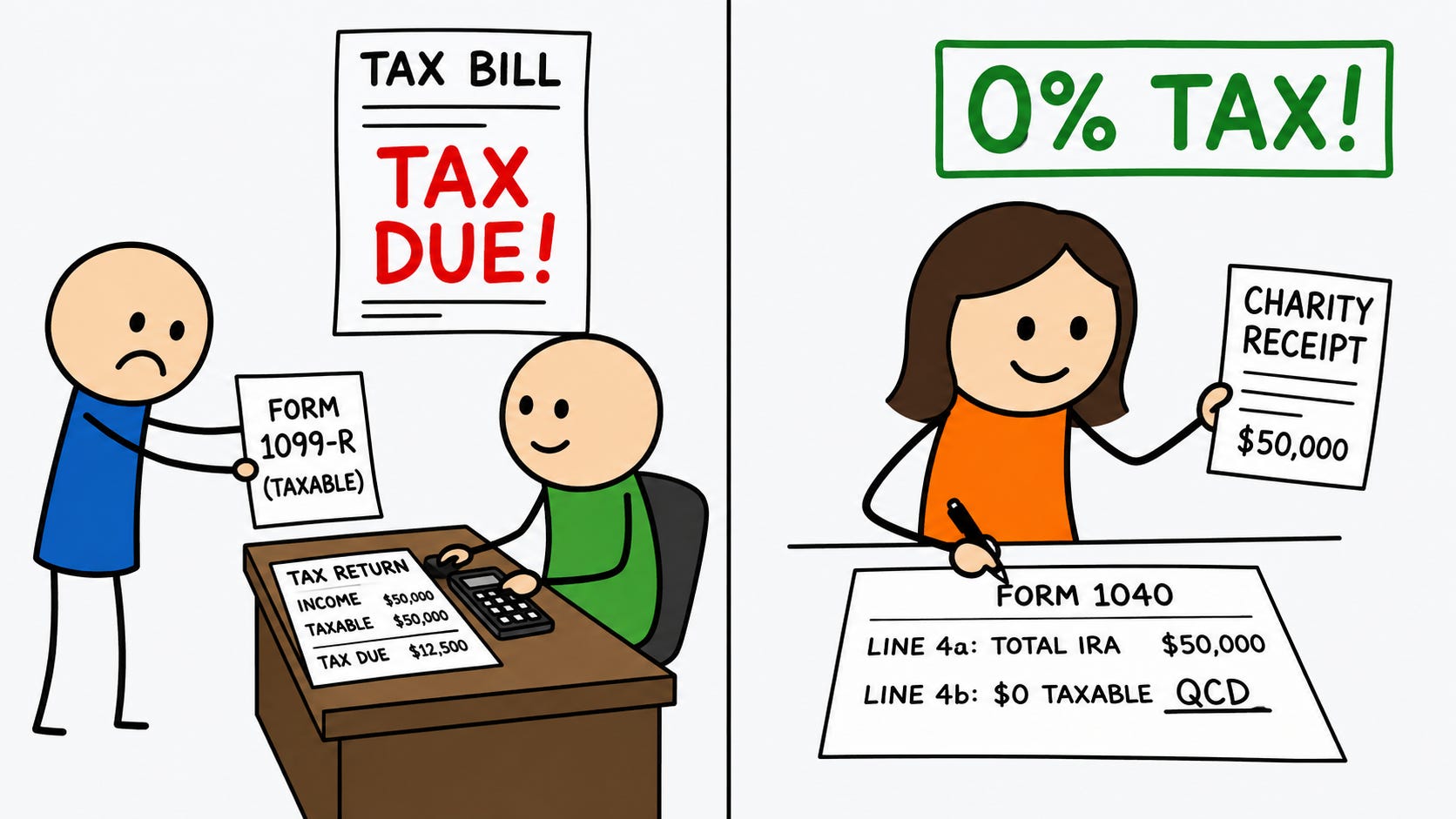
A person can do everything right on a qualified charitable distribution, meet the age requirement, use an eligible charity, have the money transferred directly, and still lose the entire tax benefit at the last step. The reason is that the tax form the custodian sends does not, by itself, exclude the distribution from income. The exclusion is not applied automatically anywhere in the process. It only happens if the distribution is reported correctly on the tax return, by the taxpayer or their preparer. Getting this final step wrong means paying tax on money that was supposed to be tax-free, which is why the reporting mechanics deserve as much attention as the QCD itself.
Start with what the custodian sends. After any distribution from an IRA, including a QCD, the custodian issues a Form 1099-R. That form reports the full amount of the distribution in its gross distribution box. The box for the taxable amount often shows the full distribution as well, or is left with the box indicating that the taxable amount was not determined, because the custodian is not the one deciding how much of the distribution is actually taxable. For a long time, the form had no way to indicate that a distribution was a QCD at all. It simply showed the money leaving the IRA, usually with a normal distribution code, exactly as it would for any ordinary withdrawal.
The IRS has since introduced a specific code, Code Y, that a custodian can place on the form to identify a QCD. Its use is optional rather than required, but major custodians have indicated they will begin using it on 2026 forms, so a person may well see it going forward. Two things are worth understanding about that code. First, because it is optional, a person still cannot count on it appearing, and its absence does not disqualify anything. Second, and more important, even when the code is present, it does not do the work of excluding the QCD from income. The code is a flag, not a calculation. Whether or not it appears, the responsibility for actually excluding the QCD falls on the taxpayer’s own return.
This is the heart of the matter. The QCD exclusion is never applied at the custodian’s reporting level. The 1099-R shows the full distribution, and it is up to the taxpayer to tell the IRS, on their Form 1040, that part or all of it was a QCD and therefore not taxable. If the return simply copies the 1099-R and treats the whole amount as taxable, the exclusion is lost, and the person pays tax on money that qualified to be tax-free.
The reporting itself is not complicated once a person knows the steps. On the Form 1040, the full amount of the IRA distribution from the 1099-R goes on the line for total IRA distributions. Then, on the line for the taxable amount, the person enters only the portion that is actually taxable, meaning the total minus the QCD. If someone took fifty thousand dollars total and twenty thousand of it was a QCD, the full fifty thousand goes on the total line and thirty thousand goes on the taxable line. If the entire distribution was a QCD, the taxable line is zero. The gap between the two lines is the QCD amount excluded from income.
Then comes the step people forget, and it matters more than it looks. The person marks the return to identify the QCD, which on recent forms has meant writing the letters QCD next to the taxable amount line. The exact mechanics of how the QCD is flagged on the return can change from year to year as the form is revised, so the current year’s Form 1040 instructions are the place to confirm exactly how to note it. However it is done that year, the purpose is the same. It is how the IRS reconciles why the total distribution and the taxable amount do not match. Without that notation, the IRS sees a distribution reported as larger than the taxable amount claimed, with no explanation, and that mismatch can trigger an automated notice proposing additional tax. Even when the custodian did include the optional code on the 1099-R, marking the return is still the safe practice, because it removes any ambiguity.
Documentation is the other half of doing this correctly, and it is the same substantiation any charitable gift requires. The person needs a written acknowledgment from the charity confirming the amount, the date, and that no goods or services were received in exchange for the gift. This last point is not a formality. If the donor received anything of value in return, tickets to an event, a meal, an auction item, the distribution fails to qualify as a QCD. The written acknowledgment is the proof that the gift was fully charitable, and it should be obtained before filing and kept with the tax records, along with the custodian’s record showing the money went directly to the charity. For gifts of two hundred fifty dollars or more, this contemporaneous acknowledgment is required, and a QCD is essentially always going to clear that amount.
A few reporting mistakes recur often enough to name. The most costly is simply entering the full distribution as taxable, which throws away the exclusion. The opposite error is double dipping, excluding the QCD from income on the 1040 and also deducting the same gift on the itemized deduction schedule, which is not allowed, since the money was already left out of income and cannot be deducted again. And taking the distribution personally and then donating it, rather than having it transferred directly, disqualifies it as a QCD regardless of how it is reported. If a person discovers they reported a QCD as taxable in a past year, the situation can generally be corrected by filing an amended return, subject to the normal time limits for amending and claiming a refund, so the specific deadline is worth confirming for the year in question.
Picture a retiree who directed twenty thousand dollars from her IRA to her church as a QCD and took no other distribution that year. In January she receives a 1099-R showing a twenty thousand dollar distribution, with a normal distribution code and nothing that by itself excludes it from tax. She hands it to her tax preparer along with the rest of her documents.
If the preparer enters it as shown and treats it as fully taxable, the whole twenty thousand becomes taxable income, and the entire QCD benefit is lost. The preparer may have no way to know it was a QCD unless she says so. To report it correctly, she tells the preparer it was a QCD, so that the twenty thousand goes on the total distribution line, zero goes on the taxable line, and the return is marked to identify the QCD. With her charity acknowledgment letter in hand as backup, the distribution is properly excluded, and she owes no tax on it. The difference between paying tax on twenty thousand dollars and paying nothing came down entirely to whether the reporting reflected the QCD, which depended on her telling the preparer it happened.
The resolution is treating the reporting as the step that actually delivers the QCD benefit, not an afterthought. The custodian’s form will show the full distribution, and even the new optional code does not exclude anything by itself. The exclusion only becomes real when the return reports the full amount on the total line, the taxable amount minus the QCD on the taxable line, and the QCD identified beside it, backed by a written acknowledgment from the charity.
The variables that determine whether the benefit is captured are whether the taxpayer or preparer knows a QCD occurred, whether the return separates the total distribution from the taxable amount correctly, whether the QCD is marked to head off an IRS mismatch, and whether the charity acknowledgment is on hand to substantiate it. The most important practical takeaway is that a QCD is not self-executing on the tax form. A person who makes a perfect QCD and then lets it be reported as an ordinary taxable distribution has given the money away and paid the tax anyway. Telling the preparer, or entering it correctly in the software, is what turns the QCD from an intention into the tax-free result it was meant to be.
I write one of these every day, one retirement rule, explained in plain language and verified against the source. The daily email is free: subscribe here.
Full archive, worksheets, and search live at RetirementNewsRundown.com.
Disclaimer
This article is for educational and informational purposes only. It is not tax, legal, or financial advice and does not create an advisor–client relationship. Always consult appropriate professionals regarding your specific situation.