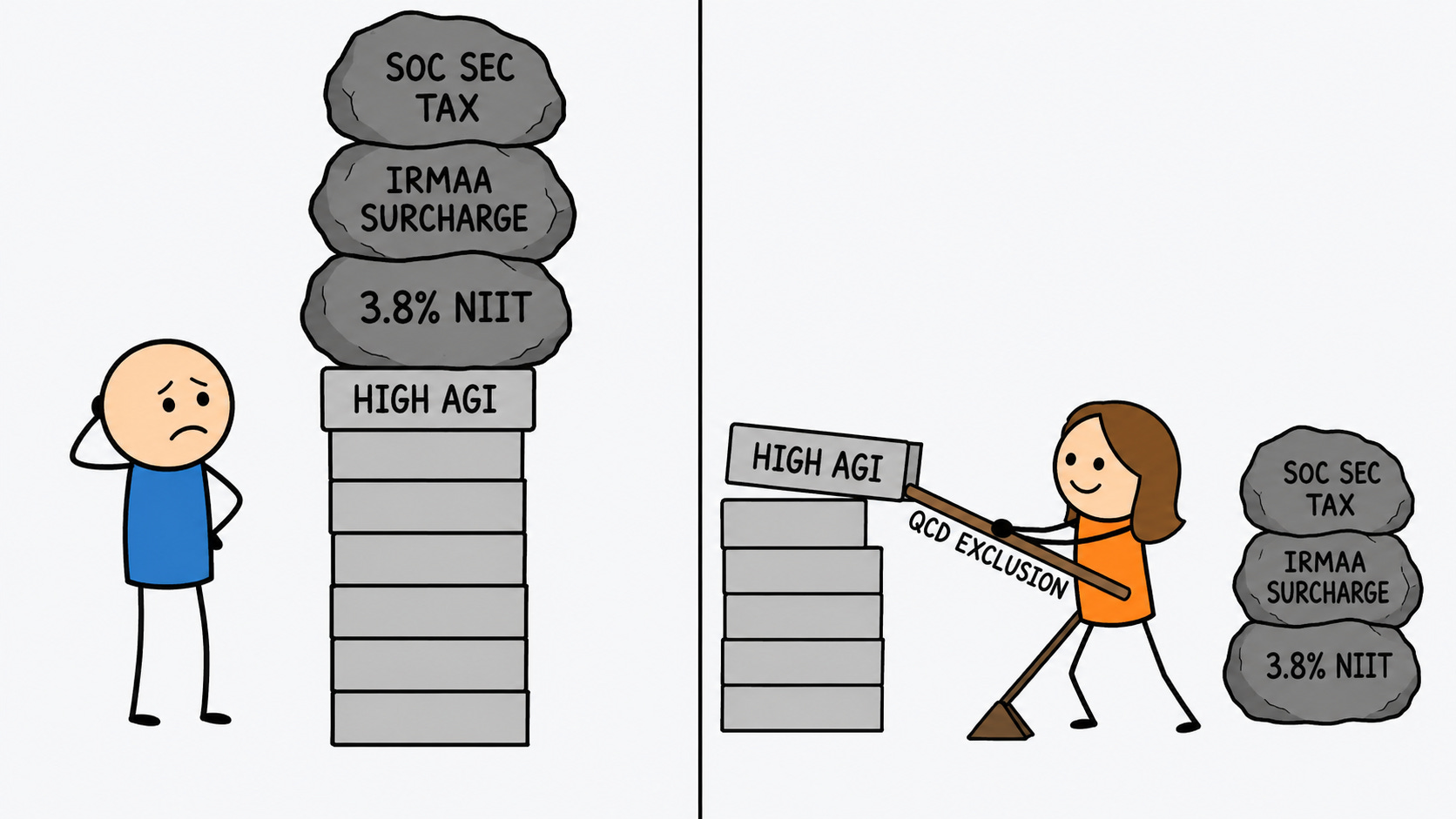
The real power of a qualified charitable distribution is not the charitable gift itself. It is where the QCD sits in the tax calculation. A QCD keeps money out of a specific number called adjusted gross income, and that number turns out to be the anchor for a whole chain of other tax consequences that most people never connect to their charitable giving. Because a QCD lowers that anchor number while a charitable deduction does not, the QCD reaches places a normal donation cannot touch. Understanding this is what separates people who see a QCD as just a nice way to give from people who understand why it can be worth far more than the gift amount suggests.
The key idea is the difference between an exclusion and a deduction, and where each one lands in the tax return. Adjusted gross income, or AGI, is calculated first. It is the total of a person’s income before the standard deduction or itemized deductions are subtracted. Those deductions come later, below AGI, to arrive at taxable income. This ordering matters enormously, because a long list of other tax rules are keyed to AGI, or to a modified version of AGI, rather than to taxable income. They look at the number before those deductions, not after.
A charitable deduction, the kind a person takes for donating cash, is subtracted below AGI. It reduces taxable income, but it does nothing to AGI itself. A QCD works differently. Because the QCD money is excluded from income entirely, it never enters AGI in the first place. The distinction sounds technical, but it is the whole point. A deduction lowers the number at the bottom. A QCD lowers the number at the top. And the number at the top is the one that feeds everything else.
Consider what is keyed to AGI or to a modified version of it. The taxability of Social Security benefits depends on a figure called provisional income, which is built from AGI plus tax-exempt interest plus half of a person’s Social Security benefits. Medicare premium surcharges, known as IRMAA, are based on a modified adjusted gross income that starts from AGI and adds back tax-exempt interest. The net investment income tax threshold is based on its own modified adjusted gross income. These are not all the same formula. Each starts from AGI and then adds back different items, so they are relatives rather than twins. But they share the crucial feature that they build from AGI, not from taxable income after deductions. So a charitable deduction, sitting below AGI, is invisible to all of them. A QCD, by keeping money out of AGI, lowers the starting point that every one of them is built from.
Take Social Security taxation first. A regular IRA distribution or required distribution adds to AGI, which raises provisional income, which can push more of a person’s Social Security benefits into the taxable column, up to the maximum share that can be taxed. A QCD satisfies the same charitable intent and can satisfy the required distribution, but because it never enters AGI, it does not raise provisional income at all. The person’s Social Security stays taxed at whatever level it was, rather than being pushed higher by a distribution. A retiree who would have seen a required distribution drag more of their Social Security into taxation can, by routing that distribution to charity as a QCD, avoid that second effect entirely.
Now Medicare. IRMAA surcharges add to Medicare Part B and Part D premiums once income crosses certain thresholds, and those thresholds work as cliffs, where crossing by even a small amount moves a person into a higher surcharge tier for the year. The income figure IRMAA uses is a modified adjusted gross income that begins with AGI and adds back tax-exempt interest, so a person holding tax-exempt bonds should know that interest still counts here even though a QCD can hold the IRA distribution out of the figure. IRMAA is calculated on income from two years earlier, so the income in one year sets the Medicare premiums two years later. A taxable required distribution raises the income figure that IRMAA looks at, and can push a person over a threshold, raising their Medicare premiums two years out. A QCD keeps that distribution out of the calculation, which can keep a person under a threshold they would otherwise have crossed. Because the surcharge tiers are cliffs, staying just under one can be worth far more than the tax on the distribution itself, and the effect shows up two years later rather than immediately.
The net investment income tax follows the same pattern. It applies once a person’s modified adjusted gross income crosses a fixed threshold, and a QCD that keeps income lower preserves room under that threshold, while a taxable distribution eats into it. The mechanism is identical. The QCD keeps the income figure down, and the tax that keys off that figure is held at bay.
This is why the exclusion is so much more valuable than a deduction for the people these thresholds affect. A person who takes the standard deduction gets little to nothing from a cash donation on their tax return beyond the limited amount now allowed, and even a person who itemizes gets only the taxable-income reduction, with no effect on Social Security taxation, IRMAA, or the net investment income tax. The QCD delivers the charitable gift and keeps the distribution out of AGI, which cascades into all of those income-based calculations. The gift is the same size either way. The QCD simply operates at the level of the tax return where the most other things are decided.
One additional point applies at the state level. Most states begin their own tax calculation from federal AGI, so a QCD that is excluded from federal AGI is usually excluded from the state starting point as well, carrying the benefit into state tax. Some states do not tax retirement distributions or Social Security to begin with, and a few have their own quirks, so the size of the state effect varies. For most people, though, the federal AGI exclusion flows through to the state return.
Picture a retiree who has a required distribution to take and also gives to charity each year. Suppose she takes her full required distribution as a normal taxable withdrawal, then writes a check to her charity from the proceeds and, because she itemizes, deducts the gift. The full required distribution landed in her AGI. That raised her provisional income, pushing more of her Social Security into taxation, and it raised the income figure that will set her Medicare premiums two years from now, possibly across an IRMAA threshold. Her charitable deduction reduced her taxable income, but it did nothing to reverse any of those AGI-driven effects, because the deduction sits below AGI where those calculations cannot see it.
Now run the same giving through a QCD. She directs the gift straight from her IRA to the charity as a QCD, satisfying that much of her required distribution. That amount never enters her AGI. Her provisional income is lower, so less of her Social Security is taxed. The income figure that sets her future Medicare premiums is lower, so she may stay under the IRMAA threshold she would otherwise have crossed. She gave exactly the same amount to exactly the same charity. By changing only the path the money took, she avoided a cascade of income-driven costs that the cash-donation-plus-deduction approach left fully in place.
The resolution is understanding that a QCD is powerful because of where it sits in the tax return, not just because it is charitable. It keeps the distribution out of AGI, the number that provisional income, IRMAA, and the net investment income tax are all built from, while a charitable deduction sits below AGI and cannot reach any of them. That single structural difference is why a QCD can be worth substantially more than the tax value of an equivalent deduction.
The variables that determine how much a QCD helps a given person are whether their income is near any of these income-based thresholds, specifically whether more of their Social Security could be pushed into taxation, whether they are near an IRMAA cliff, and whether they are near the net investment income tax threshold. A person nowhere near any of these thresholds gets the basic income exclusion and little more. A person sitting close to one or more of them can find the QCD worth far more than its face value, because keeping the distribution out of AGI keeps them on the favorable side of lines that a taxable distribution would have pushed them across. The gift is the same. The QCD is what keeps it from raising three other taxes on the way out.
I write one of these every day, one retirement rule, explained in plain language and verified against the source. The daily email is free: subscribe here.
Full archive, worksheets, and search live at RetirementNewsRundown.com.
Disclaimer
This article is for educational and informational purposes only. It is not tax, legal, or financial advice and does not create an advisor–client relationship. Always consult appropriate professionals regarding your specific situation.