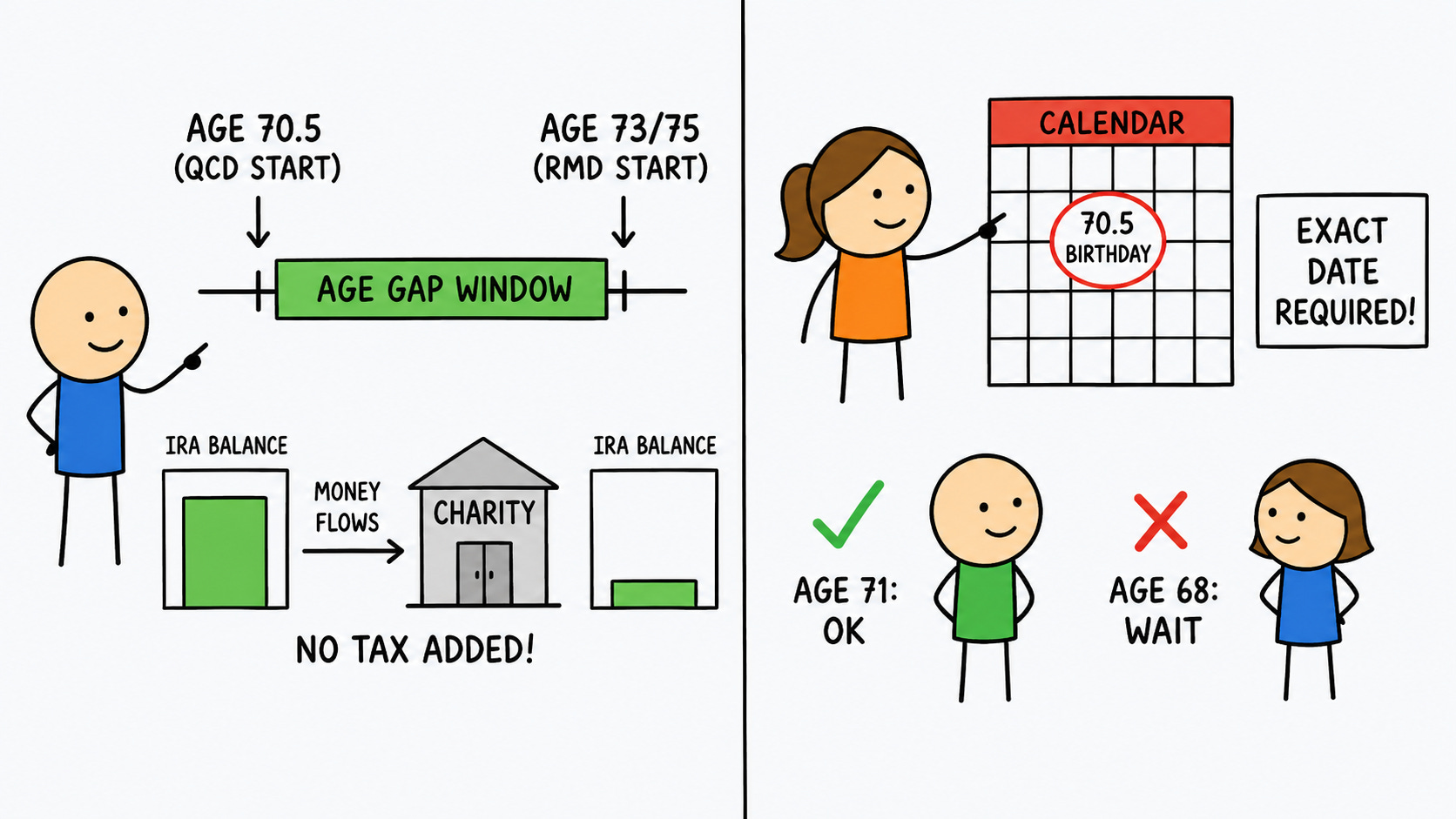
There is a mismatch in the retirement rules that creates a genuine planning window, and most people never notice it because they assume two ages that used to be the same still are. The age at which a person can start making qualified charitable distributions from an IRA is 70.5. The age at which required minimum distributions begin is now 73 or 75, depending on birth year. Those two numbers used to be identical. They are not anymore, and the gap between them is a stretch of years during which a person can make tax-free charitable gifts from an IRA while having no requirement to take anything out. Understanding that window, and what it makes possible, is worth real money to a charitably inclined retiree.
Start with why the gap exists, because it was not designed on purpose so much as it emerged. The qualified charitable distribution has been available starting at age 70.5 since the provision was created, and that age has never changed. Required minimum distributions, on the other hand, used to also begin at 70.5, so for years the two lined up perfectly. A person became eligible to make QCDs and required to take distributions at the same moment. Then the required distribution age was raised, first to 72 and then to 73 for people born between 1951 and 1959, and 75 for people born in 1960 or later. Each time the required distribution age moved up, the QCD age stayed at 70.5. The result is a gap that did not exist before, a window of roughly two to four years between when a person can begin making QCDs and when they are first forced to take a distribution.
The first thing this means is simple and often missed. A person does not need to have a required distribution in order to make a QCD. Many people assume the QCD is only a tool for satisfying a required distribution, so they wait until required distributions begin to think about it. But QCD eligibility is tied only to being 70.5 or older, not to having a required distribution. Someone who is 71, retired, and not yet subject to required distributions can already make QCDs. The charitable gift comes straight out of the IRA and is excluded from income, exactly as it would be later, even though nothing is being required of them yet.
The deeper value of the window is what those pre-distribution QCDs do to the account itself. Required distributions are calculated each year based on the IRA balance at the end of the prior year. A larger balance produces a larger required distribution, which produces more forced taxable income once the required distributions begin. QCDs made during the gap years reduce the IRA balance before that clock starts. Every dollar given to charity through a QCD at 71 or 72 is a dollar no longer in the account at the end of that year, which means it is not part of the balance the first required distribution is calculated against. A person who is going to give to charity anyway, and who does so through QCDs during the gap, arrives at their first required distribution year with a smaller IRA and therefore a smaller required distribution than they would have had otherwise. The giving they intended to do doubles as a way to shrink the account that will later generate mandatory taxable income.
Two precise details matter for anyone trying to use this window. The 70.5 age is measured to the exact date, not the calendar year. A person must have actually reached 70.5 on the day the distribution is made. This is different from the required distribution rules, which work on the year a person turns the relevant age. A QCD attempted even a day before someone turns 70.5 does not qualify. The second detail is that the age applies to each person individually. In a married couple, each spouse’s eligibility depends on their own age. If one spouse is 71 and the other is 68, only the 71 year old can make a QCD, because the younger spouse has not reached the threshold yet, regardless of the couple’s combined situation.
Once required distributions do begin at 73 or 75, the QCD does not lose its value, it simply takes on a second function. From that point forward, a QCD both stays excluded from income and counts toward satisfying the required distribution for the year. So the same gift that was purely a balance-reducing, income-free transfer during the gap years becomes, in the required distribution years, a way to satisfy the mandatory distribution without the taxable income it would normally create. The tool is the same across both phases. What changes is whether there is a required distribution for it to also satisfy.
Picture someone who is 71, retired, charitably inclined, and holding a large traditional IRA. They are not yet required to take any distribution, and they assume there is nothing tax-advantaged to do with their IRA until required distributions begin at 73. So they give to their favorite causes out of their checking account and leave the IRA alone to grow.
Now change their approach to use the window. Starting at 71, they direct their annual charitable gifts out of the IRA as QCDs instead of writing checks from the bank. Each year of the gap, those gifts leave the IRA excluded from income, and each year the IRA balance is smaller at year-end than it would have been. By the time they reach 73 and required distributions begin, the balance the first required distribution is calculated against has been reduced by several years of QCDs. Their first required distribution is smaller as a direct result, which means less forced taxable income for that year and going forward. They gave the same amount to the same charities either way. Routing it through the IRA during the gap years is what reduced the future required distributions.
Now consider the couple where one spouse is 71 and the other is 68. The older spouse can begin using QCDs from their own IRA immediately. The younger spouse cannot make a QCD from their own IRA yet, no matter how the couple would prefer to arrange it, because QCD eligibility follows each person’s own age. The couple can use the strategy on the older spouse’s IRA now and add the younger spouse’s IRA to it only once that spouse also reaches 70.5.
The resolution is recognizing the QCD age and the required distribution age as two separate numbers that no longer coincide, and seeing the years between them as usable. QCD eligibility begins at 70.5. Required distributions begin at 73 or 75. In the gap, a person can make QCDs with no required distribution to satisfy, which lets the giving reduce the IRA balance before the required distributions are ever calculated. Once required distributions begin, the same QCD also satisfies them without adding taxable income.
The variables that decide whether the window is useful to a given person are whether they have reached 70.5 on the actual date, whether they intend to give to charity at all, how large their traditional IRA is and therefore how much future required distributions are worth reducing, and, for a couple, each spouse’s own age against the 70.5 line. For a charitably inclined person in the gap years, the window turns ordinary giving into a way to lower the taxable distributions the IRA will later be forced to produce. The gift was going to happen anyway. The age gap is what lets it do a second job on the way out.
I write one of these every day, one retirement rule, explained in plain language and verified against the source. The daily email is free: subscribe here.
Full archive, worksheets, and search live at RetirementNewsRundown.com.
Disclaimer
This article is for educational and informational purposes only. It is not tax, legal, or financial advice and does not create an advisor–client relationship. Always consult appropriate professionals regarding your specific situation.