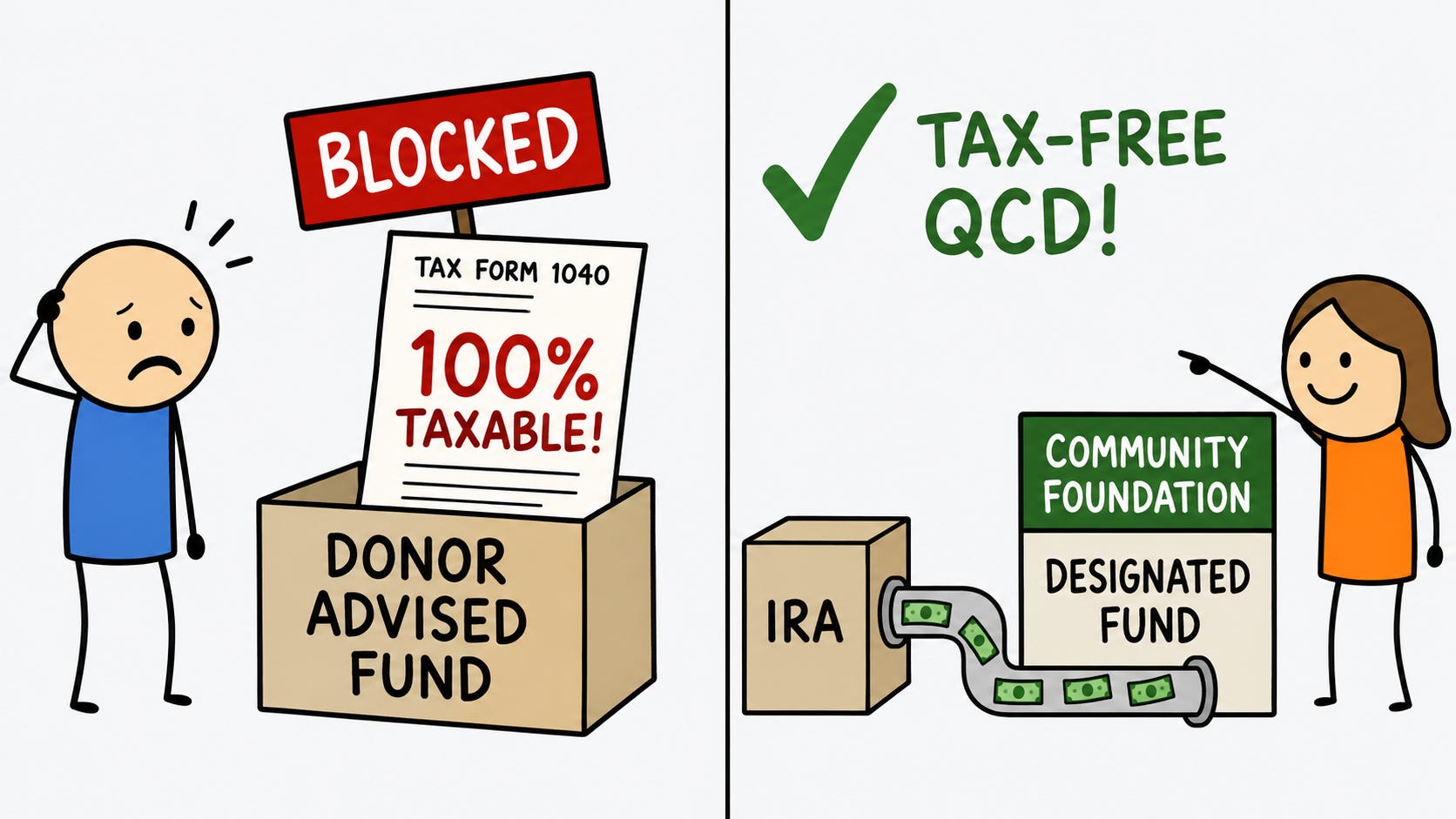
A retiree who has a donor advised fund and has learned about qualified charitable distributions makes a reasonable assumption. The donor advised fund is a charity. The QCD goes to charity. So a QCD to the donor advised fund should work, and it should let them move IRA money into the fund tax-free. It does not work. Donor advised funds are specifically excluded from receiving QCDs, and a distribution sent to one loses its tax-free treatment entirely. Understanding why the exclusion exists, and what qualifies instead, is what keeps a well-intentioned gift from turning into an unexpected tax bill.
The rule itself is direct. A QCD cannot go to a donor advised fund. It also cannot go to a private non-operating foundation or to a supporting organization. All three are excluded from QCD eligibility, even though all three are legitimate charities that can receive ordinary tax-deductible donations. This is exactly why the exclusion confuses people. A person can donate cash or appreciated stock to a donor advised fund and claim a deduction for it, so the fund is clearly a qualified charity in the ordinary sense. But being eligible to receive a deductible gift and being eligible to receive a QCD are two different things, and the donor advised fund clears the first bar while failing the second.
The reason comes down to what a QCD is meant to accomplish. A QCD hands the donor a significant tax benefit, the complete exclusion of the distribution from income. In exchange for that benefit, the money is expected to reach a working charity that will actually use it. A donor advised fund does not fit that expectation. When money goes into a donor advised fund, the donor retains advisory privileges over how and when it is eventually granted out. The money can sit invested in the fund for years before any of it reaches an operating charity, and the donor keeps influence over where it goes. Congress excluded donor advised funds precisely because of that retained control and that potential for the money to park. The QCD is supposed to be an outright gift with no ongoing benefit or control for the donor, and the advisory structure of a donor advised fund is the opposite of that.
Here is the nuance that most people miss, and it is the genuinely useful part. The exclusion is about the type of fund, not the institution that houses it. Community foundations, which are common QCD recipients, offer several different kinds of funds. A donor advised fund is only one of them. A community foundation also offers designated funds, where the donor names the specific charities to be supported up front and does not retain ongoing advisory control, and field of interest funds, which support a cause area like education or the environment. Those fund types can receive QCDs, because the donor is not retaining the advisory privileges that disqualify a donor advised fund. So the same community foundation that cannot accept a QCD into a donor advised fund can often accept one into a designated fund or a field of interest fund. The disqualifying feature is the ongoing advisory control, not the community foundation itself.
This distinction matters for a donor who liked the donor advised fund for its organizing benefit. Someone who used a donor advised fund to consolidate their giving to several favorite charities can often accomplish much of the same thing with a designated fund, naming those charities, and still qualify for the QCD. They give up the ability to change their mind and redirect the money later, which is the advisory privilege, but in exchange they get the QCD treatment the donor advised fund cannot offer.
There is a related point on private foundations worth a line, because it follows the same logic. A private foundation that simply makes grants to other charities is excluded, for reasons similar to the donor advised fund. But a private operating foundation, one that actively runs its own charitable programs like a museum or a research facility, does qualify, because it is doing the charitable work directly rather than holding money and directing it elsewhere. The theme across all of these is the same. The QCD wants the money going to an organization that does the charitable work, not to an intermediary the donor still controls.
The stakes for getting this wrong are not small. If an IRA custodian sends a distribution to a donor advised fund thinking it is a QCD, the exclusion does not apply, and the entire amount becomes taxable income to the owner, exactly like an ordinary IRA withdrawal. Instead of a tax-free gift, the person has a fully taxable distribution and possibly a higher tax bill and higher Medicare premiums as a result. The mistake does not just fail to help. It actively costs money.
One separate exception exists but does not change the donor advised fund rule. Recent legislation created a one-time ability to direct a QCD into a specific kind of split-interest charitable arrangement, which is its own distinct topic. That arrangement is not a donor advised fund, and it does not open any door to using a QCD for a donor advised fund. The donor advised fund exclusion stands regardless.
Picture a retiree who has given for years through a donor advised fund at her community foundation, using it to organize gifts to a dozen charities she cares about. She learns about QCDs and their tax advantage and asks her custodian to send her annual IRA distribution to her donor advised fund. If that transfer goes through as a QCD, it fails. The donor advised fund cannot receive a QCD, so the distribution is taxable to her, and she has lost the entire benefit she was trying to capture.
Now give her the better path. Her community foundation offers designated funds. Instead of sending the QCD to her donor advised fund, she directs it to a designated fund that names the specific charities she already knows she wants to support. That designated fund can receive the QCD, so the distribution is excluded from her income, counts toward her required distribution, and still flows to her chosen charities through the foundation. She gave up the ability to redirect the money on a whim, but she kept the tax benefit and still supported the causes she cares about. The institution was the same the whole time. Only the type of fund changed.
The resolution is understanding that the donor advised fund exclusion is about donor control, not about whether the recipient is a real charity. A QCD requires the money to reach a working charity without the donor retaining advisory privileges over its future grants, and that requirement is what rules out donor advised funds, grant-making private foundations, and supporting organizations, all of which are otherwise perfectly good charities.
The variables that determine whether a QCD recipient qualifies are whether the donor keeps advisory control over the money after it arrives, and whether the recipient is doing charitable work directly or holding the money to distribute later. A donor advised fund fails on both counts. A designated fund, a field of interest fund, an operating charity, or a private operating foundation passes. For a retiree who wants both the QCD tax treatment and some of the organizing convenience of a donor advised fund, the designated fund at a community foundation is often the answer that satisfies both, because it delivers the giving structure without the advisory control that disqualifies the QCD.
I write one of these every day, one retirement rule, explained in plain language and verified against the source. The daily email is free: subscribe here.
Full archive, worksheets, and search live at RetirementNewsRundown.com.
Disclaimer
This article is for educational and informational purposes only. It is not tax, legal, or financial advice and does not create an advisor–client relationship. Always consult appropriate professionals regarding your specific situation.