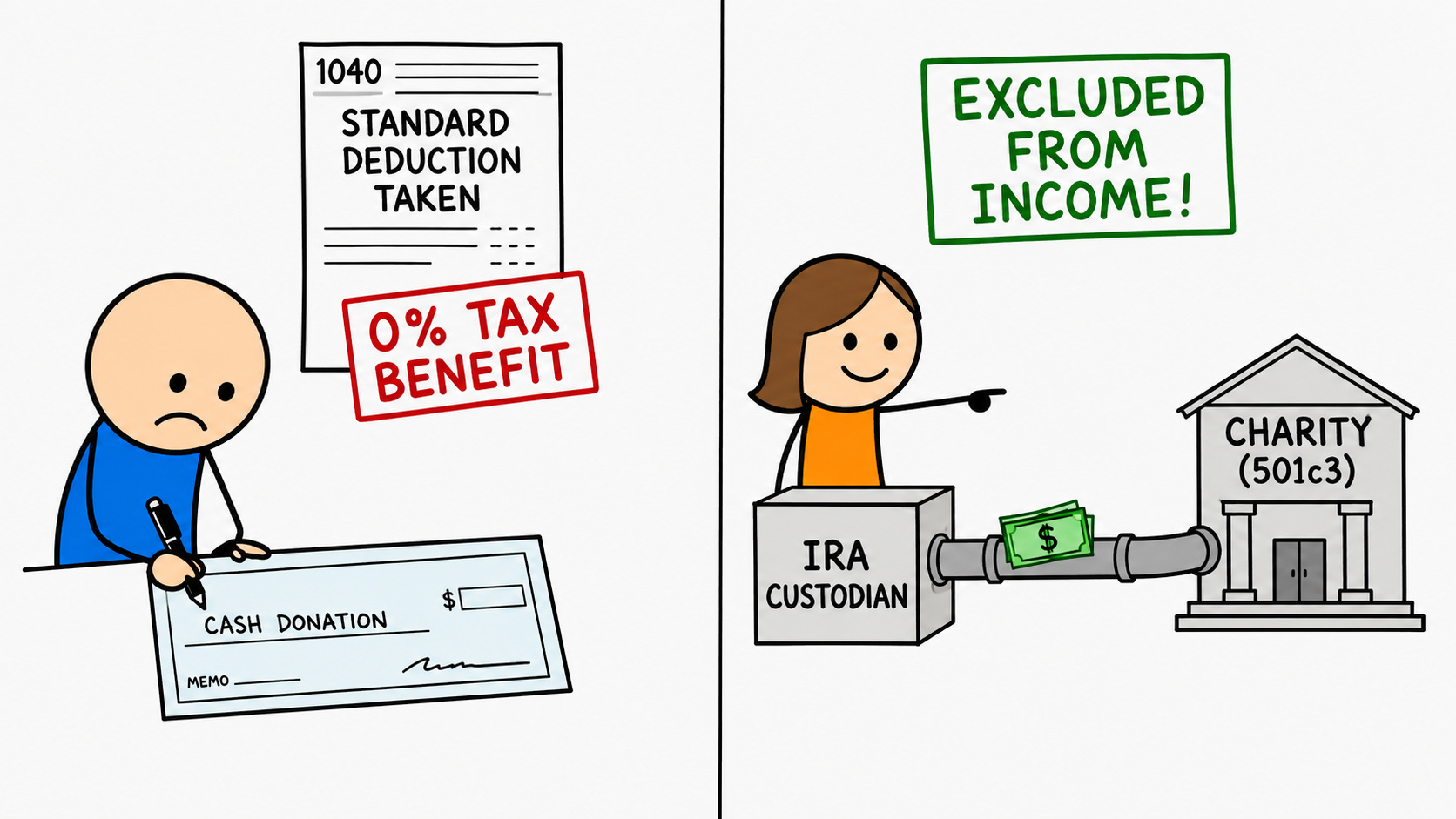
A retiree who gives to charity and also has money in a traditional IRA is often sitting on a better way to give than the one they are using. Most people donate cash and, if they itemize, take a deduction for it. Beginning in 2026, people who take the standard deduction can also receive a limited deduction for certain cash gifts. But that deduction is capped, and it works differently from a qualified charitable distribution. A QCD keeps qualifying IRA money out of income entirely rather than deducting the gift later. Understanding how it works reveals why it often beats writing a check.
A qualified charitable distribution, or QCD, is a direct transfer of money from a traditional IRA to a qualified charity. The defining feature, the one that makes it powerful, is how it is treated for taxes. A QCD is excluded from the owner’s gross income entirely. It is not a deduction. This distinction is the whole point, so it is worth being precise about. A deduction reduces taxable income later on the return, and for a standard-deduction filer it is now capped at a small amount. An exclusion never enters income in the first place. The QCD money leaves the IRA and goes to charity without ever showing up as taxable income to the owner, and without any cap tied to itemizing. Because the money stays out of income entirely, the benefit is not limited the way a capped cash deduction is, and it also lowers the income figure that drives other taxes, which a deduction taken later on the return does not do in the same way.
To use a QCD, a person has to meet an age requirement, and it is a specific one that surprises people. The IRA owner must be at least 70.5 years old on the date the distribution is made. This is not the same as the age when required distributions begin, which is 73 for some current retirees and eventually rises to 75 for younger cohorts. The QCD age of 70.5 did not move when the required distribution age went up. The result is a window of several years during which a person is old enough to make QCDs but not yet required to take distributions at all. Someone who is charitably inclined can begin using QCDs years before their required distributions start.
There is an annual limit on how much a person can move through QCDs, and it is now adjusted for inflation each year. The limit started at one hundred thousand dollars and has been indexed upward since, so the current ceiling is somewhat higher and rises over time. The limit is per person, not per household, which means each spouse who has their own IRA and meets the age requirement can make their own QCD up to the full limit from their own account. A married couple where both qualify has double the individual capacity between them.
The connection to required distributions is where the QCD earns much of its value. A QCD counts toward the required minimum distribution for the year. So instead of taking a required distribution as taxable income, a person can direct that amount, or part of it, straight to charity as a QCD, and it satisfies the requirement without adding to their taxable income. The required distribution still gets met. It simply gets met with money that is never taxed rather than money that is.
That benefit depends on getting the timing right. Ordinary IRA withdrawals taken earlier in the year count toward the required distribution first. A later QCD can still satisfy whatever portion of the required distribution remains, but it cannot reach backward and turn an ordinary taxable withdrawal into a tax-free QCD. So if a person takes part of their required distribution as a normal taxable withdrawal in the spring and then makes a QCD in the fall, the QCD still counts toward any part of the requirement not yet met, and it is still excluded from income up to the limit, but it does nothing to the tax on the withdrawal they already took. Taking the QCD before the full required distribution has already been withdrawn preserves the ability to use the charitable transfer against that year’s requirement.
Two mechanical requirements have to be satisfied for the distribution to qualify. The money has to be paid directly from the IRA to the charity. A check made payable to the IRA owner does not qualify merely because the owner later gives the money away. The custodian can, however, issue a check made payable directly to the charity and let the IRA owner deliver that check, which still counts as a direct payment. And the recipient has to be an organization eligible to receive a QCD. Not every charitable vehicle qualifies, so donor-advised funds and certain other arrangements require separate attention, which is its own important topic.
One more detail affects people who are still working and contributing to an IRA past 70.5. Deductible IRA contributions made after that age reduce the amount a person can later exclude as a QCD, a rule designed to prevent getting a deduction going in and an exclusion coming out on the same dollars. It mostly affects the smaller group of older workers still funding a traditional IRA, but it is worth knowing if that describes the person.
Picture a retiree in her mid-seventies who takes the standard deduction and gives ten thousand dollars a year to her church. Under her current approach, she writes a check from her bank account. As a standard-deduction filer she can now take only a small capped deduction for that cash gift. Separately, she has a required distribution from her traditional IRA that she takes as taxable income each year.
Now she switches to a QCD. Before taking any other withdrawal from her IRA for the year, she directs ten thousand dollars from the IRA straight to her church as a QCD. That ten thousand counts toward her required distribution, so she has satisfied that much of the requirement, and the ten thousand never enters her taxable income. The same gift she was already making now lowers her taxable income by the full amount and keeps her AGI down, purely because it moved from being a check out of her bank account to being a direct transfer out of her IRA. Nothing about the charity or the amount changed. Only the mechanism did.
Now picture a different retiree who is 71, not yet subject to required distributions, and charitably inclined. He assumes he cannot do anything tax-advantaged with his IRA giving until required distributions begin. But because the QCD age is 70.5, he can already make QCDs. He starts directing his annual gifts out of his IRA now, lowering his taxable income years before his required distributions would have started, using a window many people do not realize is open.
The resolution is understanding that a QCD is fundamentally different from donating cash and deducting it, because it is an exclusion rather than a deduction. That single difference is why the benefit is not capped the way a standard-deduction filer’s cash deduction is, why it lowers the income figure that drives other taxes, and why it is often the better way for an older IRA owner to give.
The variables that determine whether a QCD helps a given person are whether they are at least 70.5, whether they have a traditional IRA to give from, whether they were going to give to a qualifying charity anyway, and whether they get the timing right so the QCD counts against any required distribution. For a retiree over 70.5 who gives to charity and holds a traditional IRA, the QCD converts giving they were already doing into a real tax advantage. The gift is the same. The path the money takes is what changes the outcome.
I write one of these every day, one retirement rule, explained in plain language and verified against the source. The daily email is free: subscribe here.
Full archive, worksheets, and search live at RetirementNewsRundown.com.
Disclaimer
This article is for educational and informational purposes only. It is not tax, legal, or financial advice and does not create an advisor–client relationship. Always consult appropriate professionals regarding your specific situation.