Someone reads about the backdoor Roth, follows the steps exactly, makes a nondeductible contribution to a traditional IRA, converts it to Roth, and expects to owe no tax because the money going in was already taxed. Then the tax bill arrives and most of that conversion is taxable anyway. Nothing went wrong with the steps. What went wrong is a rule that governs every IRA conversion, and it defeats the assumption that a person can convert only their after-tax dollars while leaving their pre-tax dollars untouched. That rule is the pro-rata rule, and understanding it is the difference between a clean tax-free backdoor Roth and an expensive surprise.
The core of the pro-rata rule is aggregation. For the purpose of figuring the taxable portion of any conversion or distribution, the IRS does not look at the single account the money came from. It treats all of a person’s traditional IRAs, traditional SEP IRAs, and traditional SIMPLE IRAs as one combined pool. It does not matter that the nondeductible contribution sits in its own separate account. Every one of those IRAs is thrown into a single bucket, and the conversion is treated as coming proportionally from all the money in that bucket, both the after-tax basis and the pre-tax dollars.
This is why a person cannot isolate their after-tax money. The already-taxed contribution and any pre-tax balances are blended together, and any conversion pulls a proportional slice of each. The formula is a ratio. The nontaxable share of a conversion equals the total after-tax basis divided by the total value of all the person’s traditional, traditional SEP, and traditional SIMPLE IRAs. Whatever fraction of the whole pool is after-tax basis is the fraction of the conversion that comes out tax-free. The rest is taxable.
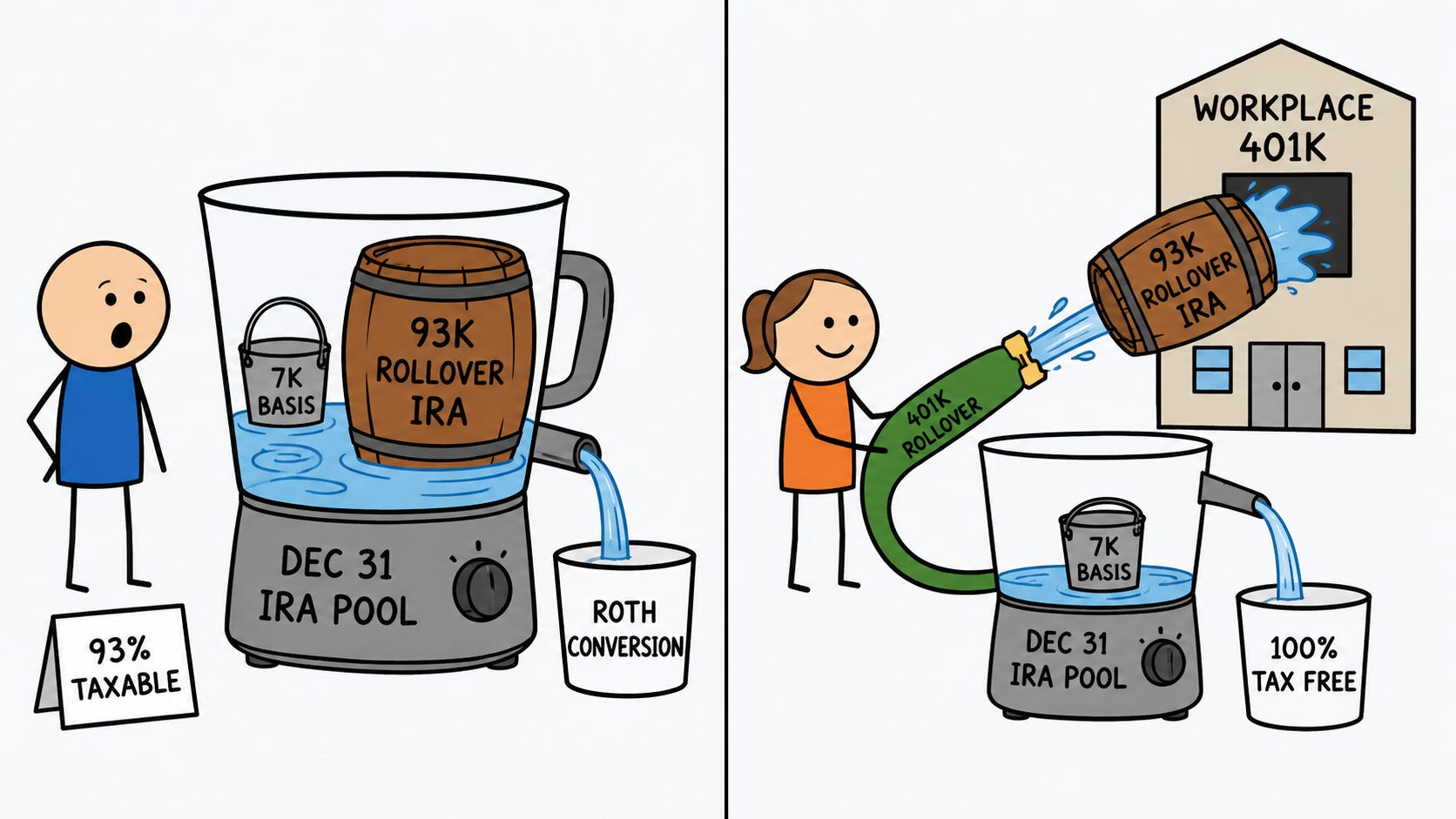
An example makes the damage concrete. Suppose a person makes a nondeductible contribution of seven thousand dollars, and that is the only after-tax money they have. But they also have a rollover IRA from an old 401(k) holding ninety three thousand dollars of pre-tax money. Their total IRA pool is one hundred thousand dollars, of which seven thousand, or seven percent, is after-tax basis. When they convert seven thousand dollars, only seven percent of that conversion comes out tax-free, which is about four hundred ninety dollars. The other roughly six thousand five hundred dollars is taxable, even though they thought they were converting nothing but their own already-taxed contribution. The pre-tax rollover IRA sitting alongside the contribution is what turned a supposedly tax-free move into a mostly taxable one.
The basis is not lost in that scenario, which is worth understanding. The portion of the after-tax basis that did not get used stays in the remaining IRA and carries forward, tracked on the reporting form, to reduce the tax on future distributions. But it is stuck being recovered slowly over years of future withdrawals rather than cleanly all at once, which is not what the person wanted when they set out to do a simple backdoor Roth.
Now the timing detail that catches people even when they think they have done everything right. The December 31 balance matters even if the conversion happened months earlier. The pro-rata calculation takes the year-end value of the person’s traditional IRA pool and combines it with the year’s relevant distributions and conversions when determining the taxable percentage. This means a conversion that looked perfectly clean in January can be affected by pre-tax IRA money that appears later in the same year. If a person converts early with no remaining IRA balance, then rolls a large 401(k) into a traditional IRA before December 31, that new year-end balance enters the calculation and can make most of the earlier conversion taxable. The conversion did not change. The year-end snapshot did.
There is a way to keep the pool clean, and it runs the opposite direction from what people expect. Instead of trying to move the after-tax money somewhere, a person can move the pre-tax money out of the IRA pool entirely by rolling it into an employer plan like a 401(k). Employer plans are not part of the pro-rata pool, so pre-tax IRA money rolled into a 401(k) disappears from the calculation. This empties the IRA pool of pre-tax dollars and leaves primarily or entirely the after-tax basis, which then converts cleanly. Two conditions apply. The employer plan has to accept incoming rollovers, which not all do. And special restrictions can apply to certain money, including SIMPLE IRA balances that generally cannot move into a qualified plan until an initial two-year participation period has passed. Most important, this cleanup has to be finished by December 31 of the conversion year. The IRA contribution deadline is generally the tax-filing deadline for that contribution year, without extensions, but the pro-rata calculation cares about the IRA value sitting there on December 31 of the conversion year.
One more feature of the pool surprises people. Traditional SEP IRAs and traditional SIMPLE IRAs count, which means a forgotten old SEP IRA from a past side business or a SIMPLE IRA from a former job can sit in the pool and dilute the conversion. The pool is also measured per person, so a spouse’s IRAs are not included in the calculation, and each spouse’s pool stands on its own.
Picture two people who each make the same seven thousand dollar nondeductible contribution and convert it. The first person has no other IRA money anywhere. Their pool is just the seven thousand they contributed, which is one hundred percent after-tax basis. Their conversion comes out entirely tax-free, exactly as the backdoor Roth is supposed to work.
The second person is identical except for one old rollover IRA full of pre-tax money that they have not thought about in years. That single account changes everything. Because their pool now contains a large pre-tax balance alongside the small contribution, the pro-rata rule makes most of their conversion taxable, and they walk away with an unexpected tax bill and leftover basis stuck in the account. Same contribution, same conversion, completely different result, driven entirely by what else was in the pool on December 31.
Now give that second person a fix. Before year-end, they roll the old pre-tax rollover IRA into their current employer’s 401(k), which accepts roll-ins. On December 31, their IRA pool holds only the after-tax contribution. Their conversion now comes out tax-free, just like the first person’s. The pre-tax money did not vanish. It moved into the 401(k), where the pro-rata rule cannot see it.
The resolution is understanding that a backdoor Roth is only as clean as the entire IRA pool behind it, not just the contribution itself. The pro-rata rule aggregates every traditional, traditional SEP, and traditional SIMPLE IRA a person owns, blends the after-tax basis with the pre-tax dollars, and taxes any conversion in proportion to how much of the whole pool is pre-tax. A person cannot convert only their after-tax money, no matter which account it sits in.
The variables that decide the outcome are the total after-tax basis, the total pre-tax balance across all traditional, traditional SEP, and traditional SIMPLE IRAs, and the value of that pool on December 31 of the conversion year. One available lever is moving eligible pre-tax IRA money into an employer plan that accepts incoming rollovers before year-end. Employer plans sit outside the IRA pro-rata calculation, so properly moving the pre-tax balance there can leave the IRA pool containing primarily or entirely basis. The plan has to accept the rollover, and special restrictions can apply to SIMPLE IRA money. Anyone considering a backdoor Roth should look at their entire IRA picture first, because the contribution is the easy part and the pool is what determines the tax.
I write one of these every day, one retirement rule, explained in plain language and verified against the source. The daily email is free: subscribe here.
Full archive, worksheets, and search live at RetirementNewsRundown.com.
Disclaimer
This article is for educational and informational purposes only. It is not tax, legal, or financial advice and does not create an advisor–client relationship. Always consult appropriate professionals regarding your specific situation.