A high earner who wants to put money into a Roth IRA runs into a wall. Roth IRAs have an income limit, and above it, direct contributions are not allowed. For years this meant that the people with the most income were simply shut out of the Roth. But there is a legal path around that wall, built from two ordinary transactions that each carry no income limit at all. Put them together in sequence and a high earner ends up with money in a Roth despite being over the contribution limit. This is the backdoor Roth, and understanding why it works and where it goes wrong is what separates a clean tax-free result from a surprise tax bill.
The strategy exists because of a gap between two different sets of rules. The first rule is that contributing to a traditional IRA has no income limit. A high earner can contribute to a traditional IRA regardless of income, provided they have enough taxable compensation and stay within the annual IRA contribution limit. Income determines whether the contribution is deductible, not whether the account can receive it. When income is too high for a deduction, the result is a nondeductible contribution. The second rule is that converting a traditional IRA to a Roth IRA also has no income limit. That limit was removed years ago, so anyone at any income can convert.
The backdoor Roth simply uses both rules in order. Step one is to make a nondeductible contribution to a traditional IRA. Because the contribution is nondeductible, it is made with money that has already been taxed, which creates what is called basis in the account. Step two is to convert that traditional IRA to a Roth IRA. If the person has no other pre-tax traditional IRA money and the contribution has produced little or no gain, converting the balance can create little or no taxable income. The person now has money sitting in a Roth IRA, having entered through the traditional IRA door and then converted, rather than through the front door of a direct Roth contribution that their income would have blocked.
The tax result in the clean case depends above all on how much the money grew between the contribution and the conversion. The already-taxed contribution converts without additional tax. Any gain that exists in the traditional IRA when the conversion occurs is generally taxable. Converting promptly reduces the window for gains to appear, which is why the common guidance is to convert soon after contributing rather than letting the money sit. There is no legal requirement to wait between the steps. Current law permits both transactions, and current IRS guidance does not prescribe a waiting period between the nondeductible contribution and the conversion.
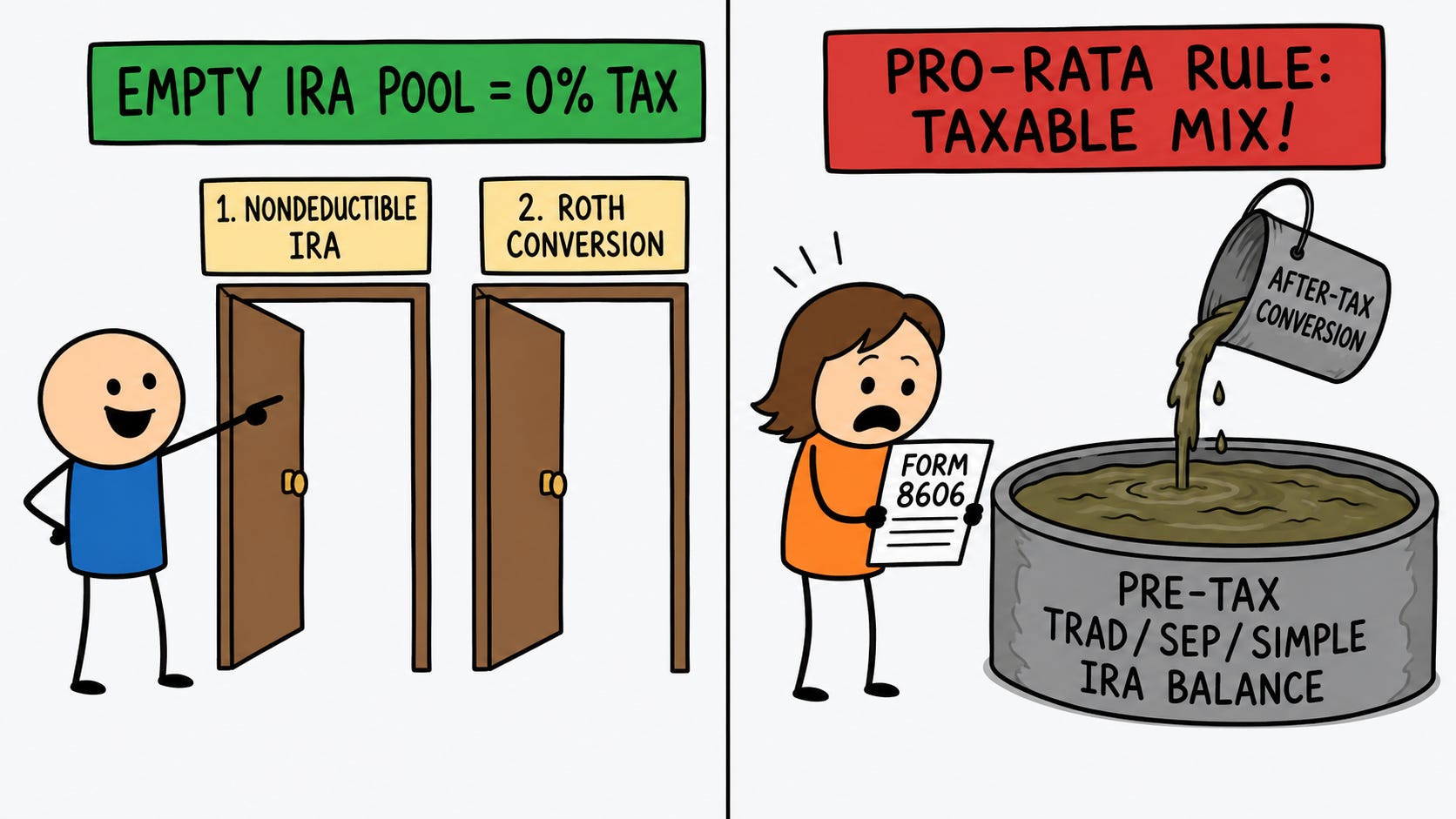
Now the complication that determines whether the backdoor Roth is clean or messy, and it is the single most important thing to understand before attempting one. The tax code does not let a person cherry-pick only their after-tax dollars to convert. When figuring the taxable portion of any conversion, the IRS aggregates all of the person’s traditional IRA money and treats it as one combined pool. The conversion is then considered to come proportionally from the pre-tax and after-tax money across that entire pool. This is the pro-rata rule, and it is its own detailed topic, but the headline is simple. If a person has other pre-tax money sitting in any traditional IRA, SEP IRA, or SIMPLE IRA, they cannot convert their new nondeductible contribution tax-free. A proportional share of the conversion becomes taxable, based on how much of their total IRA money is pre-tax versus after-tax. The backdoor Roth is cleanest for someone who has no other pre-tax IRA money at all, so the only thing in the pool is the nondeductible contribution they just made.
The year-end measurement matters here. The pro-rata calculation looks at the value remaining in the person’s traditional IRA, traditional SEP IRA, and traditional SIMPLE IRA accounts on December 31 of the year the conversion occurred, along with that year’s distributions and conversions. Two features of this rule shape who can do it cleanly. Money held inside an employer plan, like a 401(k) or 403(b), is not counted in the pro-rata pool. This is why some people move pre-tax IRA money into a 401(k) before doing a backdoor Roth, though that works only if the employer plan accepts incoming rollovers and the move is completed before the December 31 measurement date. And the aggregation is measured per person, so one spouse’s IRAs do not get pulled into the other spouse’s calculation. Each spouse can run their own backdoor Roth based only on their own IRA balances.
One reporting step is not optional. The nondeductible contribution and the conversion both have to be reported on a specific IRS form, which documents the nondeductible contribution, carries the basis forward, and calculates the taxable portion of the conversion. Failing to file it does not magically make the basis disappear, but it leaves the tax return without the required record, can lead to the conversion being reported incorrectly or challenged, and may trigger a filing penalty. The form is its own topic worth handling carefully.
The two steps can also fall on different tax-year clocks, which surprises people. The nondeductible contribution can generally be made through the tax-filing deadline for that contribution year, without extensions. The conversion is reported for the calendar year in which it actually occurs, and cannot be designated for a prior year. So a contribution made in March and designated for the prior year, followed by a conversion that same March, can require one reporting form for the prior-year contribution and another for the current-year conversion.
One last distinction avoids confusion. This IRA-based backdoor Roth is a different thing from the mega backdoor Roth, which is a separate strategy run through after-tax contributions inside a 401(k). They share a family resemblance and a name, but the mega version runs inside an employer plan and follows its own rules. The backdoor Roth described here is the IRA version.
Consider a high earner whose income is well above the Roth contribution limit, who has enough compensation to make a full IRA contribution, and who has never had a traditional IRA, a SEP IRA, or a SIMPLE IRA. Their IRA pool is empty. They open a traditional IRA and make a nondeductible contribution, leaving the money in cash so it does not grow. A few days later, once the contribution has settled, they convert the entire balance to a Roth IRA. Because the contribution was already taxed and there were essentially no earnings in those few days, the conversion creates little or no additional tax. They file the required form to document the nondeductible contribution and the conversion. The money is now in their Roth. This is the clean backdoor Roth the strategy is known for.
Now change one fact. Suppose this person also has a large traditional IRA from an old 401(k) rollover, full of pre-tax money, still sitting there at year end. Their IRA pool is no longer empty. When they make the new nondeductible contribution and convert it, the pro-rata rule looks at the entire pool, which is mostly pre-tax. Only a small fraction of the conversion counts as coming from the new after-tax contribution, and the rest is treated as coming from the pre-tax money, which is taxable. The conversion that would have been tax-free with an empty pool is now largely a taxable event. Nothing about the new contribution changed. The old pre-tax balance sitting alongside it, and still there on December 31, is what made the conversion expensive.
The resolution is seeing the backdoor Roth as two permitted steps joined together, a nondeductible traditional contribution and a conversion, both of which are open to any income level. It works because contributing to a traditional IRA and converting to Roth each carry no income limit, even though a direct Roth contribution does. The tax outcome hinges on two things, how much the money grew before conversion, and whether the person has other pre-tax IRA money that pulls the pro-rata rule into play.
The variables that decide whether a backdoor Roth is worth doing are whether the person is actually over the direct Roth limit, whether they have the compensation to contribute, whether their traditional, SEP, and SIMPLE IRA pool is empty or holds pre-tax money at year end, how quickly they convert, and whether they file the reporting form that documents the basis. For someone over the income limit with no other pre-tax IRA money, it is a clean way into the Roth. For someone with a large pre-tax IRA balance, the pro-rata rule can turn it into a taxable event, which is why the state of the IRA pool matters as much as the two steps themselves.
I write one of these every day, one retirement rule, explained in plain language and verified against the source. The daily email is free: subscribe here.
Full archive, worksheets, and search live at RetirementNewsRundown.com.
Disclaimer
This article is for educational and informational purposes only. It is not tax, legal, or financial advice and does not create an advisor–client relationship. Always consult appropriate professionals regarding your specific situation.