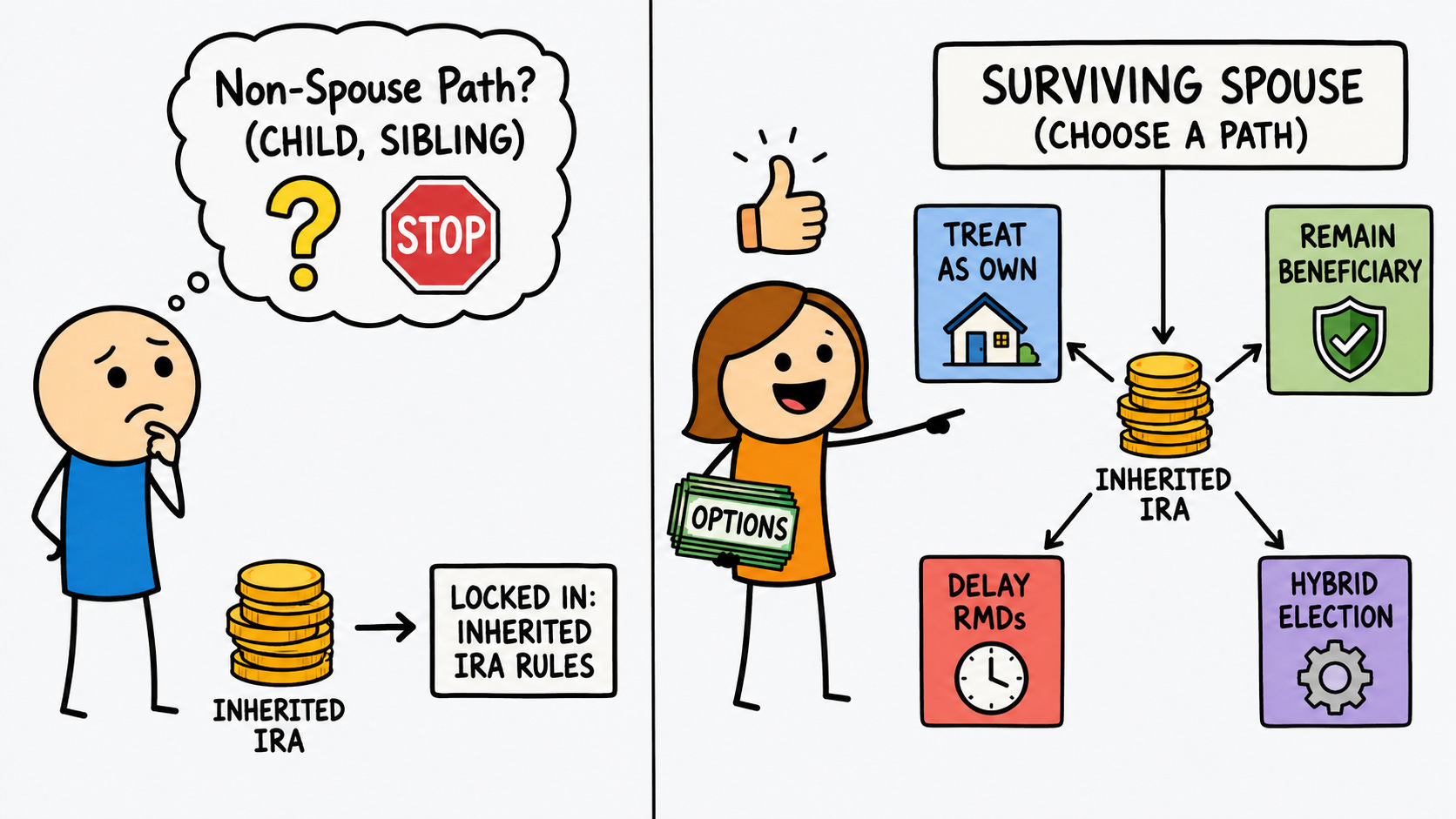
When someone inherits an IRA, the rules that follow depend heavily on who they are to the person who died. A child, a sibling, a friend, and a spouse do not get the same choices. Among all the individual beneficiaries, the surviving spouse stands apart, because a spouse has options that no other beneficiary is allowed to use. Understanding what those options are, and when each one helps, is what separates a surviving spouse who makes a deliberate choice from one who unknowingly gives up flexibility that was theirs alone.
The option that belongs to spouses and no one else is treating the inherited IRA as their own. A surviving spouse who is the sole beneficiary and has an unlimited right to withdraw the assets can redesignate the inherited IRA as their own, at which point it stops being an inherited account entirely and becomes theirs. A spouse may also roll eligible distributions from the deceased spouse’s IRA into their own IRA, though required distributions can never be rolled over. No other type of beneficiary can take ownership this way. A child who inherits an IRA is stuck with an inherited IRA and its rules. A spouse, when they are the sole beneficiary, can convert the situation into simple ownership.
When a spouse treats the account as their own, several things follow. Required distributions then follow the rules that apply to the surviving spouse’s own IRA, based on their own age. Whether that produces a better result than remaining a beneficiary depends on both spouses’ ages, the deceased spouse’s required beginning date, and the distribution method being used, so ownership is not automatically the lighter distribution path. The spouse can name their own new beneficiaries, starting a fresh chain of inheritance. They can contribute to the account if they have eligible income. After treating an inherited traditional IRA as their own, a surviving spouse may also convert some or all of it to a Roth. A non-spouse beneficiary cannot convert an inherited traditional IRA into a personally owned Roth IRA, although different direct-rollover rules can apply when a non-spouse inherits an employer plan. In exchange for the owner benefits, the ordinary owner rules apply, including the ten percent early withdrawal penalty on taxable distributions taken before age 59.5 unless another exception applies.
That penalty is exactly why the second option exists and why a spouse would ever decline to take ownership. A surviving spouse can instead choose to remain a beneficiary and keep the account as an inherited IRA. The reason comes down to age. Distributions from an inherited IRA taken after the owner’s death are generally exempt from the ten percent early distribution tax at any age. So a surviving spouse who is under 59.5 and needs to draw on the money is often better served keeping it as an inherited account, because taxable distributions from their own IRA that young would generally be subject to the ten percent additional tax unless another exception applies, while distributions from the inherited IRA are not. The younger surviving spouse who needs income is the classic case for staying a beneficiary rather than taking ownership.
The third option is a timing advantage available only to spouses. If the deceased spouse died before reaching their required beginning date, and the surviving spouse is the sole designated beneficiary, then the surviving spouse who remains a beneficiary can generally delay required distributions until the year the deceased spouse would have reached the applicable RMD age. The required beginning date itself is not merely an age. For an IRA owner it is generally April 1 of the year following the year the person reaches the applicable age. For a surviving spouse whose late husband or wife was younger, this delay can push the start of required distributions years into the future. No other beneficiary gets to borrow the deceased’s timeline this way.
The fourth advantage is subtler but meaningful over time. A surviving spouse who remains the sole beneficiary and takes life expectancy distributions redetermines their life expectancy every year, returning to the table at their current age. Every other eligible beneficiary who uses life expectancy locks in a factor once and simply subtracts one from it each year. The spouse’s annual redetermination generally preserves a longer calculation period than the fixed subtraction method, keeping required amounts spread out. It is a spouse-only feature of how the distribution is figured year to year.
The fifth advantage ties the others together, and it is flexibility across time. There is no absolute deadline forcing a surviving spouse to decide immediately and permanently. A spouse can remain a beneficiary now and move eligible amounts into their own IRA later. This is what makes the younger surviving spouse’s path so clean. They can keep the account as an inherited IRA while under 59.5, drawing on it penalty-free if they need to, and later take ownership. The decision is not always frictionless, though. Required distributions cannot be rolled over, and a spouse who waits until after their own RMD age may have to account for required amounts before the rest becomes rollover-eligible, so delaying the decision is not consequence-free. Even so, the choice is not locked at the moment of inheritance.
There is also a newer spouse-only election, added by recent legislation for deaths after 2023, that can let a surviving spouse who remains a beneficiary be treated like the deceased owner for specified required distribution calculations. It can produce more favorable figures in certain situations, particularly when the deceased spouse died after their required beginning date. The statute is effective, but portions of the implementing guidance remain proposed rather than final, so this election should be checked against the latest rules before it is used.
Picture a surviving spouse in their early fifties whose spouse has died, leaving a large IRA. The surviving spouse needs to draw some income from the account over the next several years. If they immediately take ownership, taxable distributions they take before 59.5 would generally be subject to the ten percent additional tax. So instead they keep it as an inherited IRA, take the distributions they need without that penalty, and wait. Once they reach 59.5, they move the remaining balance into their own IRA. From that point forward the account is theirs, with required distributions based on their own age and the freedom to name new beneficiaries. They used the beneficiary option and the ownership option in sequence, taking the strengths of each at the moment each one mattered.
Now picture a surviving spouse who is already past their own RMD age but inherits an IRA from a younger spouse who died before reaching their required beginning date. Rolling the account into the survivor’s own IRA could cause owner required distributions to begin immediately. Remaining a beneficiary may instead allow the survivor to delay required distributions until the year the younger deceased spouse would have reached the applicable RMD age. In this case, keeping the inherited structure may provide the better timing result even though the survivor is well past 59.5. The right option flips depending on the surviving spouse’s age, their need for the money, and the age of the spouse who died relative to their required beginning date.
The resolution is recognizing that the surviving spouse is the only beneficiary who holds a full menu of choices rather than a single assigned path. The spouse can take ownership when they are the sole beneficiary, remain a beneficiary for penalty-free access, delay required distributions until the deceased would have reached RMD age, redetermine life expectancy annually, or begin as a beneficiary and move to ownership later. No other beneficiary can do most of these things, and none can do all of them.
The variables that decide which option serves a given surviving spouse are their own age relative to 59.5 and to their RMD age, whether they need to draw on the money soon, whether the deceased spouse had reached their required beginning date, and whether a later rollover would require outstanding distributions to be removed first. A younger surviving spouse who needs income often leans toward remaining a beneficiary, at least until 59.5. A surviving spouse whose younger deceased spouse died before RBD may find that remaining a beneficiary delays distributions the longest, even past their own RMD age. The point is not that one choice is always right. It is that the surviving spouse alone gets to choose at all, and choosing deliberately rather than by default is how they keep the flexibility the rules reserved specifically for them.
I write one of these every day, one retirement rule, explained in plain language and verified against the source. The daily email is free: subscribe here.
Full archive, worksheets, and search live at RetirementNewsRundown.com.
Disclaimer
This article is for educational and informational purposes only. It is not tax, legal, or financial advice and does not create an advisor–client relationship. Always consult appropriate professionals regarding your specific situation.