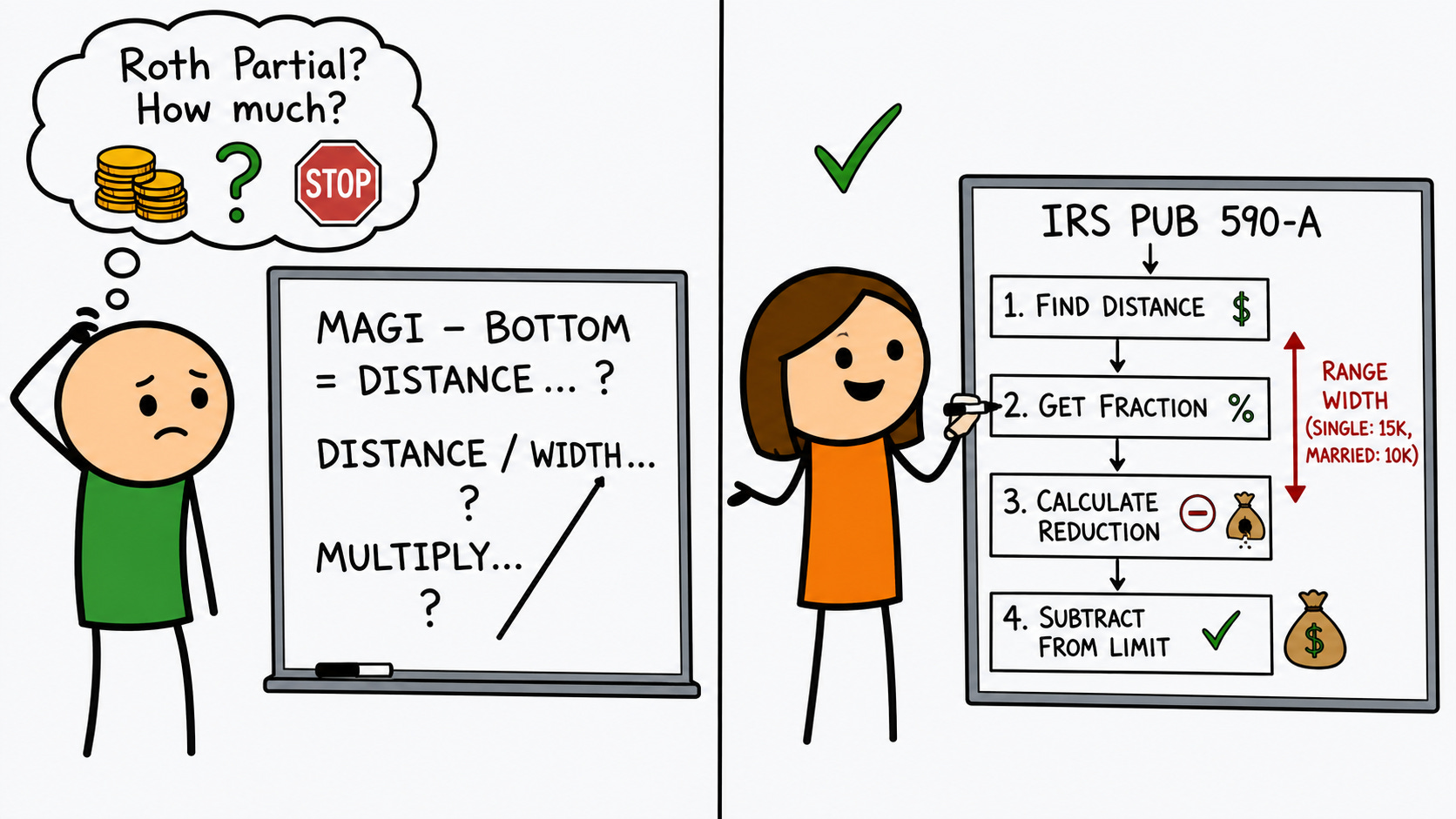
When a person’s income lands inside the Roth IRA phase-out range, they are allowed to contribute something, just not the full amount. The problem is that almost no one knows how to figure out what that something actually is. People assume it is a rough proportion, or they guess, or they give up and contribute nothing. There is a precise formula the IRS uses, and it is not complicated once the steps are laid out. Running it correctly is the difference between contributing the right reduced amount and either leaving room on the table or overcontributing and owing a penalty.
The calculation comes from a worksheet in IRS Publication 590-A. Before starting, a person needs two numbers, their modified adjusted gross income and the bottom of their phase-out range for their filing status. The bottom of the range is the income level where the phase-out begins, below which a full contribution is allowed.
Step one is to measure how far into the range the income has reached. Subtract the bottom of the phase-out range from the modified adjusted gross income. The result is how far past the starting line the person’s income sits.
Step two is to divide that distance by the width of the phase-out range. This is where filing status matters, because the range is not the same width for everyone. For a single filer or head of household, the range is fifteen thousand dollars wide. For a married couple filing jointly, it is ten thousand dollars wide. A person married filing separately who lived apart from their spouse for the entire year uses the fifteen-thousand-dollar width, while one who lived with their spouse at any point during the year faces a far harsher range that runs from zero to only ten thousand dollars, which blocks most direct Roth contributions. Dividing the distance from step one by the correct width produces a decimal, a fraction between zero and one that represents how far through the phase-out the person has traveled. Someone near the bottom of the range gets a small fraction. Someone near the top gets a fraction close to one.
Step three converts that fraction into a dollar reduction, but it starts from the right number. The starting limit is the lesser of the person’s annual IRA limit, including any catch-up for those who have reached the catch-up age, or the taxable compensation they have available to support the contribution. A person cannot contribute more than they earned, so if their compensation is below the annual limit, compensation is the starting point. Multiply that starting limit by the fraction from step two. The result is the amount that gets phased out.
Step four produces the income-reduced figure. Subtract the phased-out amount from the starting limit. An equivalent way to think about it is that the reduced limit equals the starting limit multiplied by one minus the fraction, which arrives at the same number.
Two rules then finish the income-based part of the calculation, and these are the parts people most often get wrong. First, the result is rounded up to the nearest ten dollars, not down and not to the nearest dollar. Second, there is a floor. If the income-based calculation produces an amount greater than zero but less than two hundred dollars, that portion of the worksheet raises it to two hundred dollars. The allowed contribution does not shrink below two hundred while a person remains inside the phase-out range. It only drops to zero once the income reaches or passes the top of the range.
One final step applies if the person also contributed to a traditional IRA for the same year, because traditional and Roth contributions share a single annual limit. Subtract any traditional IRA contributions from the person’s overall annual IRA limit to find the room that remains. The allowable Roth contribution is the lower of that remaining room or the amount the phase-out formula produced. This also means the two-hundred-dollar floor cannot manufacture room that does not otherwise exist. If taxable compensation or a traditional IRA contribution has already left less than two hundred dollars of the overall limit available, the final Roth contribution can be lower than two hundred despite the floor.
One detail about the income figure itself prevents a common error. The modified adjusted gross income used for this Roth contribution calculation subtracts income from a Roth conversion, and a qualified plan rollover converted to a Roth is treated the same way. A person who does a large conversion in the same year does not have that conversion count against their contribution phase-out. The conversion remains taxable and still counts for other income tax calculations, but it does not shrink the contribution this formula allows.
Walk through a single filer whose income sits partway into the phase-out range, who has enough compensation to support a full contribution and has made no traditional IRA contribution this year. Suppose their modified adjusted gross income is five thousand dollars above the bottom of their range. Step one gives five thousand. Step two divides that by the fifteen-thousand-dollar width for a single filer, producing a fraction of one-third, roughly point three. Step three multiplies that fraction by their starting limit, which phases out about a third of it. Step four subtracts that third, leaving roughly two-thirds of the limit as their allowed contribution, which they round up to the nearest ten dollars. If this person were fifty or older, every step would use their catch-up-inclusive limit instead, producing a larger allowed amount.
Now move the same person near the top of the range, where their income is only a small distance below the upper edge. The fraction is now close to one, so almost the entire limit phases out, and the formula might produce something like ninety dollars. Here the floor takes over. Because they are still inside the range and the formula gave a positive number under two hundred, the worksheet raises it to two hundred dollars rather than ninety, provided their compensation and any other IRA contributions leave at least that much room. Only when their income reaches the top of the range does the allowed contribution finally become zero.
The resolution is treating the reduced contribution as a specific number to compute rather than a vague fraction to estimate. Subtract the bottom of the range from the income, divide by the range width for the filing status, multiply by the starting limit to find what phases out, and subtract that from the starting limit. Then round up to the nearest ten, apply the two-hundred-dollar floor if the income-based result lands between zero and two hundred, and finally reduce the answer by any traditional IRA contributions already made for the year.
The variables that determine the answer are the person’s modified adjusted gross income, their filing status, which sets the width of the range, their starting limit as the lesser of the annual limit or their compensation, and any traditional IRA contributions competing for the same room. A married couple runs this calculation separately for each spouse, each using their own limit, which is why two spouses in the same phase-out can end up allowed slightly different amounts. Getting the number right matters in both directions. Contributing less than the formula allows leaves tax-advantaged room unused, and contributing more than it allows creates an excess contribution that carries its own penalty until corrected. The formula removes the guesswork, and it is the same worksheet the IRS itself uses to check the figure.
I write one of these every day, one retirement rule, explained in plain language and verified against the source. The daily email is free: subscribe here.
Full archive, worksheets, and search live at RetirementNewsRundown.com.
Disclaimer
This article is for educational and informational purposes only. It is not tax, legal, or financial advice and does not create an advisor–client relationship. Always consult appropriate professionals regarding your specific situation.