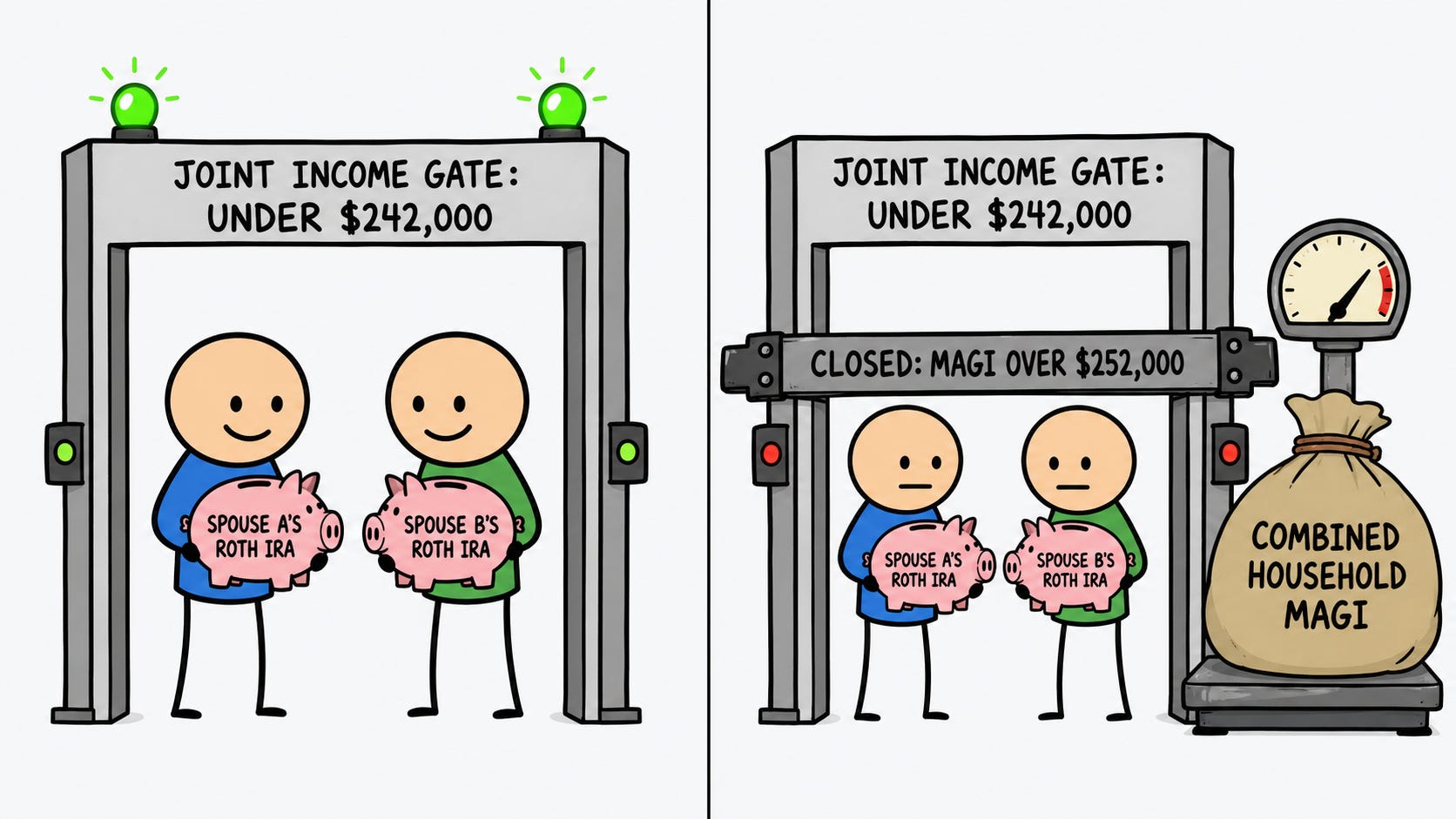
The short answer is yes. A married couple can have two Roth IRAs, one for each spouse, and both spouses can contribute in the same year. But the way that works is not simply two separate accounts running on two separate tracks. The two contributions are governed by a single household income test that applies to both spouses at the same time, and that shared test is where the real mechanics are. Understanding that each spouse gets their own account and their own limit, but that one joint income figure decides eligibility for both of them together, is what separates a couple who funds both Roth’s cleanly from one that accidentally overcontributes.
Begin with the part that is genuinely individual. An IRA is always owned by one person. There is no such thing as a joint IRA, and no joint Roth IRA, even for a married couple that shares everything else. Each spouse who contributes has their own separate Roth IRA in their own name. So a married couple maximizing this has two accounts, and each spouse can contribute up to the standard annual limit into their own account. That individual limit covers all of that spouse’s regular contributions across their traditional and Roth IRAs combined, so a spouse who already put part of their limit into a traditional IRA cannot then contribute a full separate amount to a Roth. If a spouse has reached the catch-up age, they add the catch-up based on their own age, independent of the other spouse. A couple where both spouses qualify can contribute up to two individual annual limits, assuming neither has already used part of their limit elsewhere.
The compensation requirement is where the household starts to matter. To contribute, the couple needs enough taxable compensation to cover both contributions combined. If both spouses work, their earnings together support both accounts. If only one spouse works, the couple can still fund both Roths through the spousal contribution rule, which lets the working spouse’s compensation support the non-working spouse’s contribution, as long as they file jointly. Either way, the combined contributions cannot exceed the couple’s combined taxable compensation for the year.
Now the part that surprises people, and the reason this is not just two independent accounts. Roth IRAs carry an income limit on whether a person is even allowed to contribute, and for a married couple filing jointly, that limit is measured against one number, the couple’s joint modified adjusted gross income. That single figure governs both spouses’ Roth eligibility at the same time. It is not tested separately for each spouse against their own income. The household has one income test, and it opens or closes the door for both people together.
This produces three outcomes. If the couple’s joint modified adjusted gross income is below the threshold, both spouses can each contribute the full amount to their own Roth. If it falls inside the phase-out range, the same phase-out formula applies to both spouses, but each one calculates a reduced limit from their own individual maximum, so the resulting dollar amounts can differ if one qualifies for a catch-up or has already contributed elsewhere. If it climbs above the top of the range, neither spouse can contribute directly to a Roth at all, no matter how the income is split between them. A household where one spouse earns almost everything and the other earns almost nothing is tested exactly the same way as one where the earnings are even, because only the joint total matters. The income does not have to belong to a particular spouse for it to close the door on that spouse’s Roth.
The filing status underneath all of this matters more than it appears. The favorable joint income thresholds apply to a couple filing jointly. Married filing separately usually creates a much harsher result when the spouses lived together at any point during the year. In that situation, the Roth phase-out runs from zero to only a small amount of modified income, effectively blocking most direct Roth contributions. A different rule applies to married taxpayers who lived apart for the entire year, who use the same Roth income range that applies to single filers. And spouses filing separately cannot use the spousal compensation provision, so each would need enough of their own compensation to support their contribution. So the clean answer that each spouse can contribute to a Roth really depends on filing jointly.
Consider a married couple, both working, whose joint income sits comfortably below the phase-out threshold. Each of them opens a Roth IRA in their own name and contributes the full annual amount. There are two accounts, two full contributions, and because their joint income is under the line, both are allowed in full. This is the clean case the short answer describes, and it is common.
Now consider a more surprising situation. Two people who are each single contribute the full amount to their own Roth IRAs early in the year, each qualifying easily on their individual incomes. Later that year they marry. Roth eligibility is determined for the tax year, not permanently locked in on the day the contribution enters the account. Because marital status on December 31 generally controls filing status for the entire year, a late-year marriage means those earlier contributions get tested under the couple’s joint modified adjusted gross income. If that joint figure lands above the Roth threshold, the contributions they each made while single can become excess contributions for the year. Neither of them did anything wrong at the moment they contributed, but marrying changed which income test applied. This is the sharpest illustration of the principle, that eligibility follows the household, not the individual paycheck, once a couple files jointly.
An excess contribution left in the Roth is generally subject to a penalty for each year it remains unresolved. Depending on the facts, the correction may involve removing the excess and its attributable earnings, recharacterizing the contribution to a traditional IRA, or applying the excess against contribution room in a later year, each its own procedure. The point for planning is simpler. A couple should look at their expected joint income before both spouses fund their Roths, because that joint number, not either individual income, decides what each of them is allowed to do.
The resolution is holding two facts together that feel like they should conflict but do not. Each spouse has their own Roth IRA and their own contribution limit, fully individual. And the eligibility to use those limits is decided by one joint income figure that applies to both spouses at once. The accounts are separate. The income gate is shared.
The variables that decide what a couple can actually do are whether they file jointly, whether their combined compensation covers both contributions, and where their joint modified adjusted gross income falls against the phase-out range that governs both of them. A couple under the threshold can each contribute in full. A couple inside the range can each contribute a reduced amount calculated from their own limit. A couple over the top is looking at other approaches rather than a direct Roth contribution. The question can each spouse contribute to a Roth has a yes at its center, but the honest version is that each spouse can contribute to their own Roth up to the point their shared income allows, because the household is tested as one even though the accounts are owned as two.
I write one of these every day, one retirement rule, explained in plain language and verified against the source. The daily email is free: subscribe here.
Full archive, worksheets, and search live at RetirementNewsRundown.com.
Disclaimer
This article is for educational and informational purposes only. It is not tax, legal, or financial advice and does not create an advisor–client relationship. Always consult appropriate professionals regarding your specific situation.