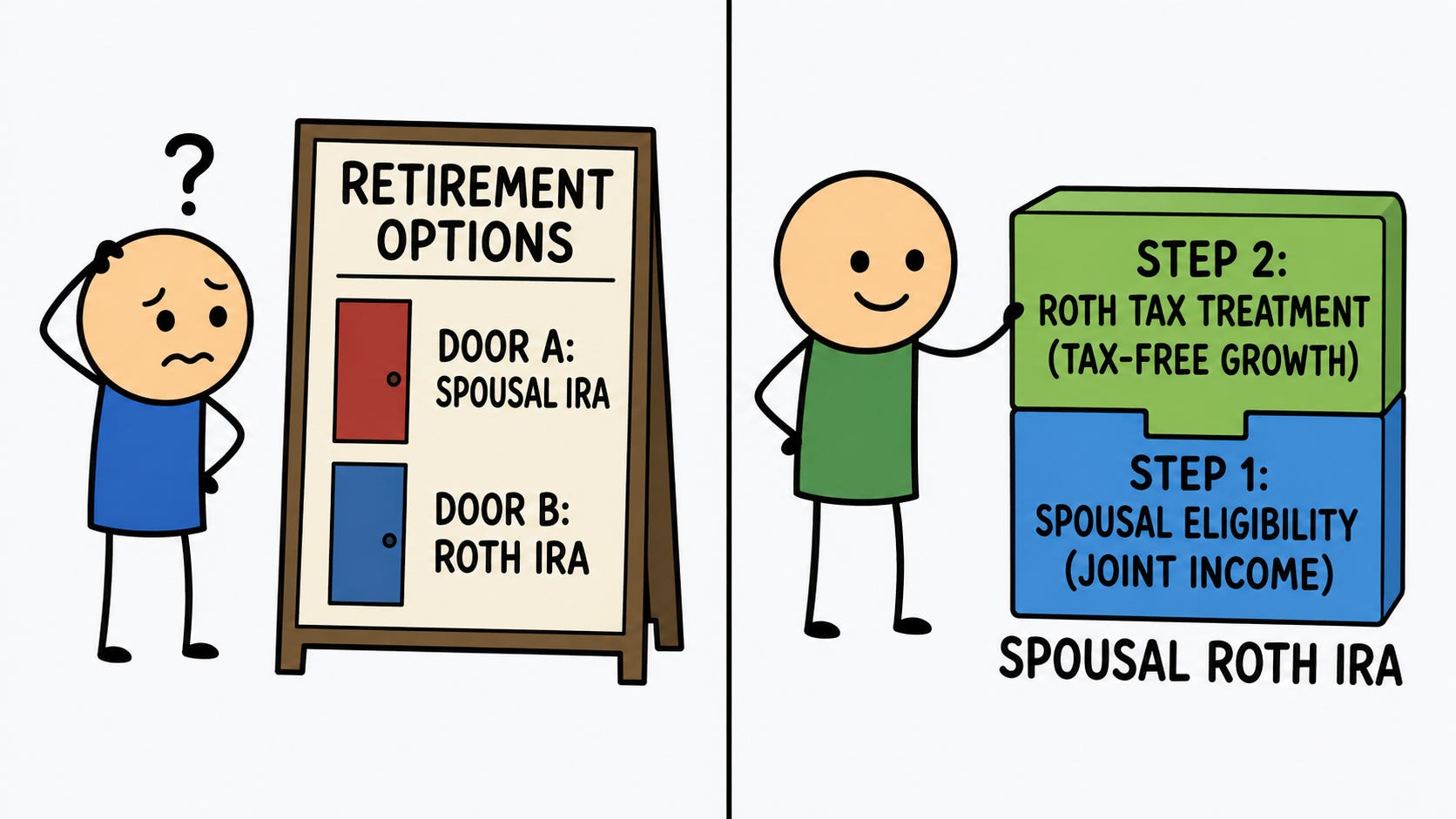
People searching for the difference between a spousal IRA and a Roth IRA are asking a question that contains a hidden mistake, and clearing up that mistake is the whole point. The two terms are not competing choices. They are not two doors a person picks between. A spousal IRA and a Roth IRA sit on completely different axes, and once that becomes clear, the real decision underneath the question comes into focus. Comparing them directly is a bit like comparing a driver’s license to a pickup truck. One describes who is permitted to do something, and the other describes what the thing actually is.
Start with what each term actually answers. The word spousal, in spousal IRA, answers a question about eligibility. It describes who is allowed to contribute and where the permission comes from. Normally a person needs their own earned income to fund an IRA. The spousal provision lets a married couple filing jointly use their combined taxable compensation to fund an IRA for the spouse who has little or no income of their own. So spousal is a statement about how a contribution becomes allowed. It says nothing about how the account is taxed.
The word Roth answers a completely different question, one about tax treatment. A Roth IRA is funded with money that has already been taxed, grows without current taxation, and pays out qualified withdrawals tax-free in retirement. Its counterpart is the traditional IRA. A traditional IRA contribution may be deductible, depending on income and workplace-plan coverage. Earnings grow tax-deferred, and later distributions are generally taxable except to the extent the owner has after-tax basis. So traditional versus Roth is a statement about when the taxes are paid. It says nothing about who is eligible to contribute.
Because the two words answer different questions, they are not alternatives to each other. A non-working spouse can contribute to a Roth IRA under the spousal contribution rule. The account is a Roth in its tax treatment, and the spousal rule is what made the contribution allowed. People commonly call that a spousal Roth IRA, but the account itself is simply a Roth IRA in that spouse’s name. The two ideas stack on top of each other rather than ruling each other out. There is no such thing as choosing a spousal IRA instead of a Roth IRA, because the spousal part and the Roth part are describing two separate features of the same account.
Once that is clear, the question a person is really trying to ask usually turns out to be one of two things. The first is whether a spousal IRA is some separate kind of account from a Roth. It is not. A spousal IRA is not a special product or a distinct account type at all. It is a regular IRA, opened in the non-working spouse’s own name, that happens to be funded using the couple’s combined taxable compensation under the spousal rule. That regular IRA can be traditional or Roth like any other.
The second, and more useful, question hiding inside the search is this. When a non-working spouse funds an IRA under the spousal rule, should that IRA be traditional or Roth? That is a real decision, and it is the same traditional-versus-Roth decision any contributor faces, with a couple of mechanics that specifically shape the answer for a married couple.
If the spousal contribution goes into a traditional IRA, there is no income limit on making the contribution itself, but whether it is deductible can phase out based on the couple’s income when a spouse is covered by a workplace retirement plan. There is a more generous deductibility phase-out for a spouse who is not personally covered by a plan while the other spouse is. If the spousal contribution goes into a Roth IRA, there is no deduction, but there is an income ceiling on whether the contribution can be made at all, phasing out over a range of the couple’s joint income. Above that range, a direct Roth contribution is not permitted, and a couple over the line would be looking at other approaches rather than a direct Roth contribution. One shared rule applies across both, the annual contribution limit for that spouse covers their traditional and Roth contributions combined, so a dollar placed in one reduces the room in the other for the year.
Picture a married couple where one spouse earns a salary and the other has stepped back from work. They read about a spousal IRA and separately about a Roth IRA and start trying to decide between the two, treating it as an either-or choice. That framing stalls them, because the two things are not on the same menu.
Once the couple sees the structure clearly, the decision reorganizes itself into two simple layers. The first layer is settled by their situation. Because they file jointly and one of them earns enough taxable compensation to cover both contributions, the non-working spouse can fund an IRA under the spousal rule. That is the eligibility question, and it is answered. The second layer is the actual choice, whether that IRA should be traditional or Roth. That comes down to the ordinary considerations of when they would rather pay the tax, along with whether their joint income sits under the Roth contribution ceiling and how the traditional deduction phase-out applies given their workplace plan coverage. The non-working spouse ends up with, for example, a Roth IRA funded under the spousal rule, an account that is spousal in how it was funded and Roth in how it is taxed, both at once.
The resolution is seeing that spousal and Roth are two different dimensions of an IRA, not two products to choose between. Spousal describes how a married couple established eligibility to contribute for the lower-earning spouse. Roth describes how the account is taxed. A regular IRA funded for the spouse can be described on both dimensions at once: the spousal rule explains why the contribution is permitted, while traditional or Roth identifies the account’s tax treatment.
The variables that actually decide a couple’s situation are, on the eligibility dimension, whether they file jointly and have enough combined taxable compensation to support both spouses’ contributions, and on the tax dimension, whether they prefer the traditional or Roth treatment given their income, their workplace plan coverage, and where their joint income falls against the Roth contribution ceiling. A person who came in asking spousal IRA versus Roth IRA can leave with a cleaner pair of questions. Are we eligible to make a spousal contribution, and if so, should the account be traditional or Roth? Those two questions, asked in that order, replace a comparison that never quite made sense with the decision that was actually underneath it.
I write one of these every day, one retirement rule, explained in plain language and verified against the source. The daily email is free: subscribe here.
Full archive, worksheets, and search live at RetirementNewsRundown.com.
Disclaimer
This article is for educational and informational purposes only. It is not tax, legal, or financial advice and does not create an advisor–client relationship. Always consult appropriate professionals regarding your specific situation.