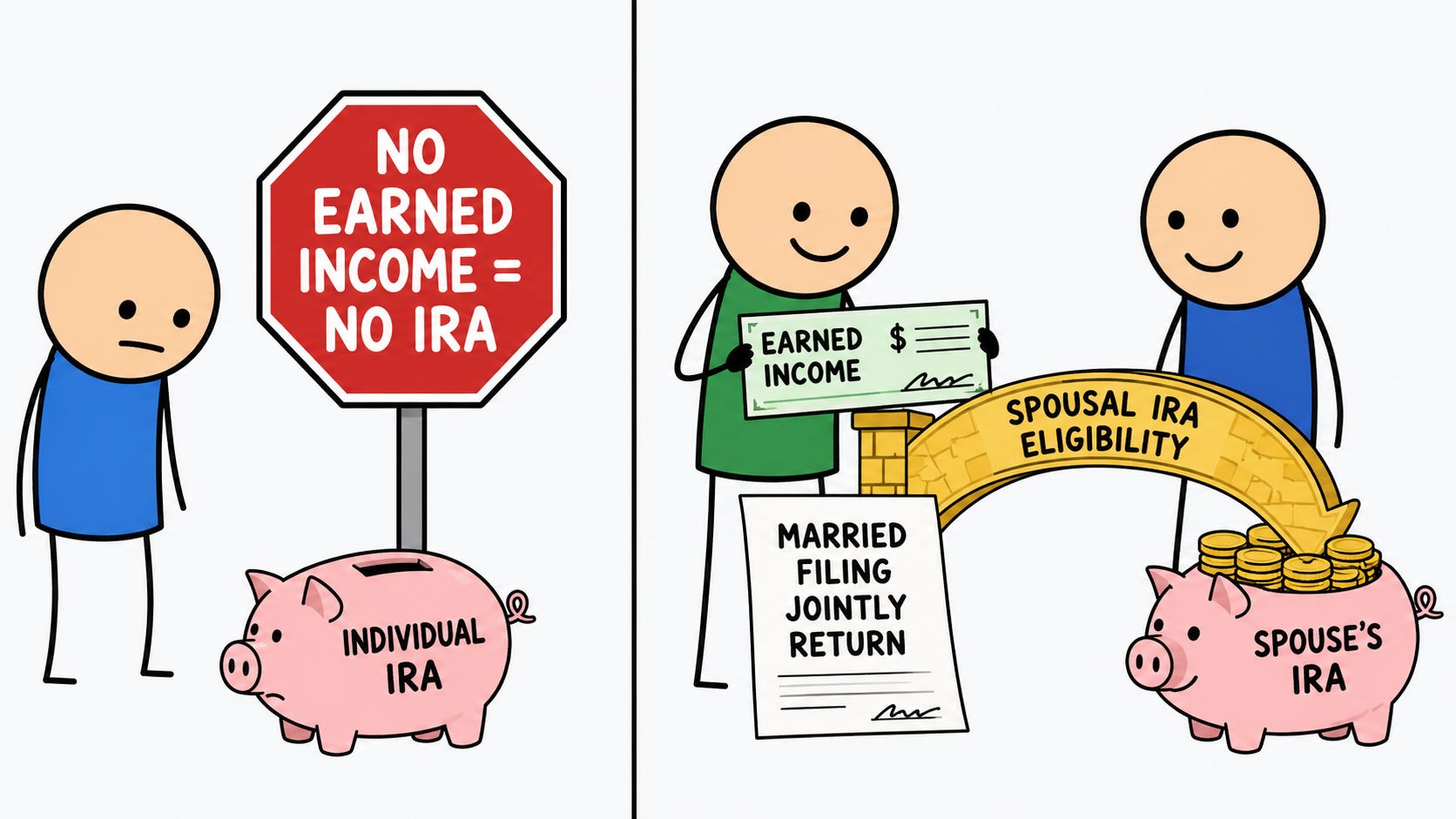
The rule that usually governs IRA contributions is simple and strict. To put money into an IRA, a person needs their own taxable compensation, meaning earnings from work. Someone with no job and no earned income of their own generally cannot fund an IRA at all, no matter how much household wealth exists around them. This is exactly the position a stay-at-home parent, a spouse who left work to care for family, or a spouse between careers finds themselves in. There is an exception written specifically for married couples, and it is one of the most useful and least understood provisions in retirement saving. It lets one spouse’s earnings open the door for the other spouse to fund an IRA of their own.
The exception is commonly called the spousal IRA, though that name is slightly misleading. There is no special account type called a spousal IRA, and there is no such thing as a joint IRA. What actually happens is that a spouse with little or no compensation contributes to a regular IRA held in their own name, and the eligibility for that contribution is drawn from the couple’s combined compensation rather than that spouse’s own earnings alone. The account is opened and maintained in the non-working spouse’s own name. It is not jointly owned, and the working spouse does not control it merely because their compensation supported the contribution. Divorce and marital-property rules can still affect the account, but for IRA purposes it belongs to the spouse whose name is on it.
Several conditions define whether this works. The first is the filing status. The couple must file their taxes as married filing jointly. A couple that files married filing separately cannot use this provision at all, which is one of several places where filing separately closes off retirement options. The joint return is what links one spouse’s compensation to the other spouse’s contribution.
The second condition is the compensation ceiling. The total contributed to both spouses’ IRAs cannot exceed the couple’s combined compensation for the year. In a one-earner household, that usually means the working spouse’s compensation supplies the entire ceiling. If both spouses earn something, their compensation is combined for this calculation. This is also why the rule is not limited to a spouse who earns exactly zero. It applies whenever the spouses have unequal compensation, so a spouse who earned a small amount but not enough to support a full contribution can still make one, as long as the couple’s combined compensation covers both spouses’ contributions.
The third condition trips up more couples than any other, and it is what counts as compensation in the first place. The eligibility is built on qualifying compensation, which usually means wages, salary, and self-employment income, though certain other amounts such as commissions, professional fees, and some taxable fellowship or stipend income can also count. It does not include investment income, ordinary rental income, pension payments, Social Security, or distributions from retirement accounts. A couple living comfortably on a large investment portfolio or on retirement withdrawals, with no one earning qualifying compensation, may have nothing to base a contribution on and therefore no ability to fund an IRA despite feeling financially secure. The rule looks for qualifying compensation from work or another specifically recognized source, not simply for income, cash flow, or household wealth.
Beyond those conditions, the ordinary IRA rules still apply to each spouse individually. Each spouse’s contribution is capped at the standard annual IRA limit, and each spouse who has reached the catch-up age can add the catch-up amount based on their own age. The two contributions are separate, each into its own account, each subject to its own limit. The couple’s combined earnings do not let them pour extra into one spouse’s account beyond that spouse’s individual limit. What the earnings do is make each spouse’s own separate contribution possible.
The contribution can go into a traditional IRA or a Roth IRA, and the choice carries the same tradeoffs it would for any other contributor, with two mechanical points worth knowing. A traditional IRA contribution has no income limit on whether it can be made, but whether it is deductible can phase out based on the couple’s income if a spouse is covered by a workplace retirement plan. There is a more generous deductibility phase-out for a spouse who is not personally covered by a workplace plan when the other spouse is, which often preserves a deduction for the non-working spouse that the covered spouse would not get. A Roth IRA, by contrast, carries an income cap on whether the contribution can be made at all, phasing out over a range of joint income, above which a direct Roth contribution is not permitted.
Picture a married couple where one spouse works full time and the other left the workforce years ago to raise their children. For all those years the non-working spouse assumed they simply could not save in an IRA, because they had no income of their own. That assumption cost them years of potential contributions.
Once they understand the provision, the picture changes. Because they file jointly and the working spouse earns well above the combined contribution maximum, the non-working spouse opens an IRA in their own name and contributes the full annual amount, funded from the household’s income. The working spouse continues funding their own IRA separately. The couple has now doubled the IRA savings the household puts away each year, and half of it is building in an account that belongs solely to the spouse who does not earn a paycheck. If that non-working spouse has reached the catch-up age, they can add the catch-up amount to their own contribution as well, based on their own age rather than the working spouse’s.
Now change the couple’s situation to one where neither spouse works and they live entirely on investment income and withdrawals from accounts built years ago. Despite their comfort, neither of them has qualifying compensation this year. Under the rule, there is nothing to base an IRA contribution on, and neither spouse can contribute, because investment income and retirement distributions are not the kind of income the provision requires. The same couple, in an earlier year when one of them still drew a salary, could have funded both IRAs easily.
The resolution is recognizing the spousal IRA for what it is, a way for a married couple to base one spouse’s own IRA contribution on the couple’s combined earnings, not a joint account and not a special product. The pieces that have to be present are a joint tax return, enough combined qualifying compensation to cover the contributions, and respect for each spouse’s individual contribution limit in their own separately owned account.
The variables that decide whether a couple can use it are their filing status, the amount of their combined qualifying compensation, whether that compensation is genuine earned income rather than investment or retirement income, and the ordinary traditional or Roth rules that then apply to each spouse’s chosen account. For a household with one earner and one spouse out of the workforce, this provision is often the difference between one retirement account growing and two. The spouse without a paycheck does not have to sit out retirement saving, because the rules were written to let a married couple treat their combined compensation as the foundation for both partners’ IRAs.
I write one of these every day, one retirement rule, explained in plain language and verified against the source. The daily email is free: subscribe here.
Full archive, worksheets, and search live at RetirementNewsRundown.com.
Disclaimer
This article is for educational and informational purposes only. It is not tax, legal, or financial advice and does not create an advisor–client relationship. Always consult appropriate professionals regarding your specific situation.