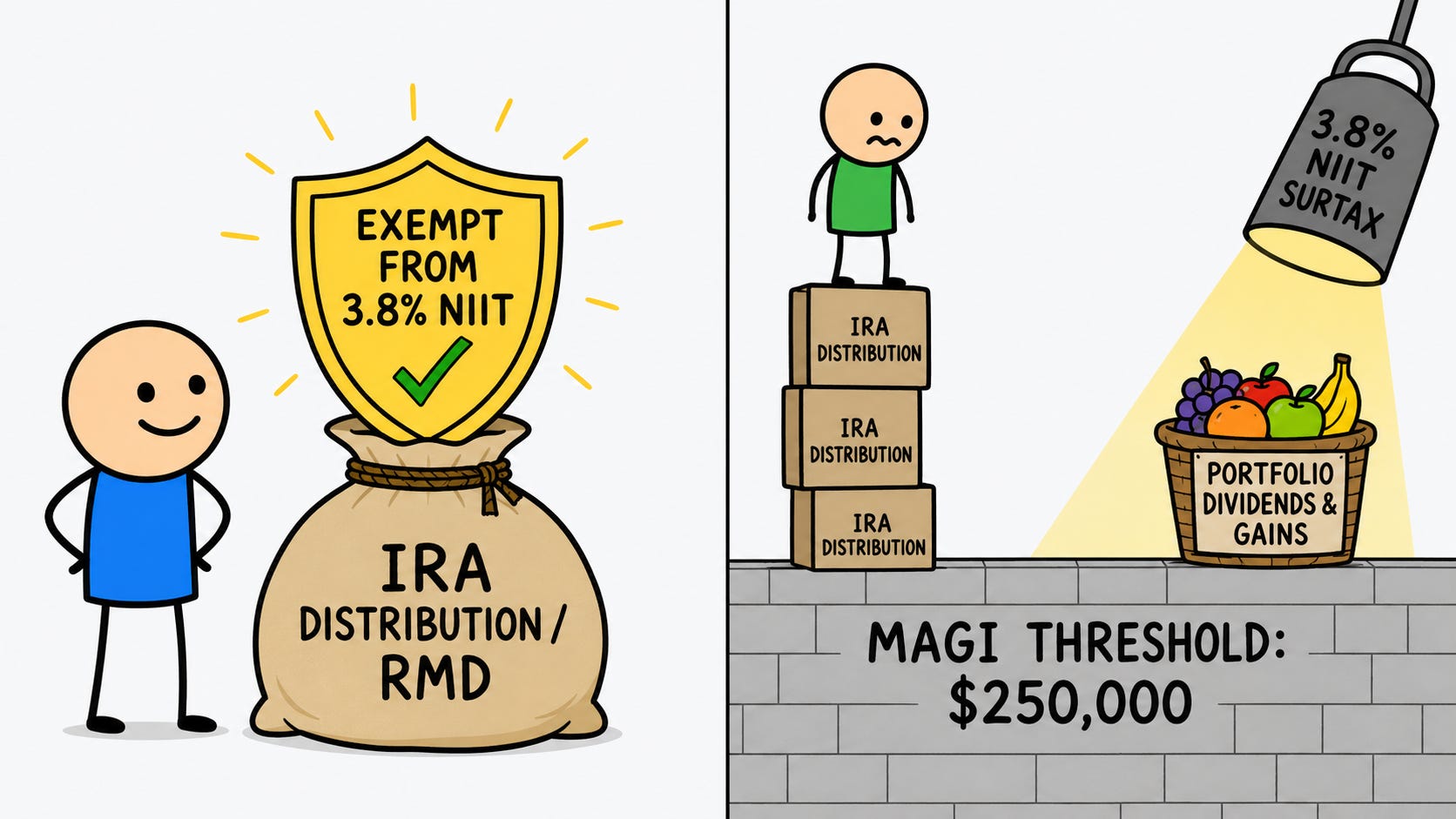
There is a 3.8 percent tax that many retirees have heard of vaguely and understood incorrectly. It is called the Net Investment Income Tax, and its name creates the confusion, because it sounds like it might apply to the money coming out of a retirement account, which is where a lot of a retiree’s income actually comes from. It does not apply to that money directly. But it interacts with retirement distributions in a way that surprises people, because a withdrawal that is itself exempt from this tax can still cause the tax to land on other income. Understanding both sides of that, what the tax does not touch and how it reaches other money anyway, is what keeps a retiree from being blindsided by a bill they did not see coming.
The tax applies to net investment income, which is a specific category. It generally includes interest, dividends, capital gains, non-qualified annuity income, rents, royalties, and income from passive business activities, reduced by certain expenses connected with producing that income. That is why the tax reaches net investment income rather than every gross dollar received, and why exceptions can apply to income earned through an active trade or business. The rate is a flat 3.8 percent, and it does not vary with a person’s tax bracket. It sits on top of whatever ordinary income tax or capital gains tax already applies to that income.
Here is the first thing that matters for retirees, and it corrects the most common misunderstanding. Taxable distributions from traditional IRAs and qualified retirement plans, including required minimum distributions, 401(k) withdrawals, qualified pension payments, and Roth conversions, are not net investment income. None of them is directly subject to the 3.8 percent tax, no matter how large. Non-qualified annuities and other nonqualified arrangements can be treated differently and may be included. Social Security benefits are also outside net investment income, and qualified Roth IRA distributions are excluded entirely. So a retiree living primarily on retirement account withdrawals and Social Security is not paying this tax on that income, which is the reassuring half of the picture.
The second thing is where the interaction appears, and it is the half people miss. The tax is calculated on the lesser of two numbers, a person’s net investment income, or the amount by which their modified adjusted gross income exceeds a threshold. The threshold is where retirement distributions re-enter the story. Even though a retirement distribution is not net investment income, its taxable portion still enters adjusted gross income and therefore raises the modified adjusted gross income used for this calculation. And because the tax reaches investment income once modified adjusted gross income crosses the threshold, a large taxable retirement distribution can lift a person over that line and expose their other investment income to the 3.8 percent tax.
The distribution itself is still not taxed by the NIIT. What happens is that its taxable portion raises the income measure that decides whether the tax applies to everything else. A retiree with a portfolio generating dividends and capital gains might sit comfortably below the threshold in an ordinary year and owe no NIIT at all. Then a big required distribution, or a Roth conversion, pushes their modified adjusted gross income above the line, and their dividends and capital gains, which were always there, become subject to the tax they previously escaped. The investment income did not change. The retirement distribution moved the threshold math around it.
Not every dollar leaving a retirement account has this effect, which is worth knowing. Only the taxable portion raises modified adjusted gross income. A qualified charitable distribution excluded from income does not, a qualified Roth distribution does not, and the portion of a traditional IRA withdrawal that represents already-taxed basis does not. A taxable Roth conversion raises it, while those excluded amounts do not. Social Security follows a similar two-step rule of its own. The benefits themselves are not net investment income, but any taxable portion included in adjusted gross income can help push a person over the threshold and expose their investment income the same way a distribution can.
The thresholds themselves behave like a fixed line that more people cross over time. They are set by statute and are not adjusted for inflation. The amount is 200,000 dollars of modified adjusted gross income for a single filer and 250,000 dollars for a married couple filing jointly, with a lower figure for those married filing separately. Because the thresholds are not indexed for inflation, income growth and inflation can gradually pull more taxpayers across them even when their purchasing power has not increased by the same amount. A frozen threshold means a rule that once applied only to high earners gradually reaches into more ordinary retirements.
Consider a married couple, both retired, with a taxable brokerage account that produces a steady stream of dividends and some capital gains each year. In a normal year their total modified adjusted gross income sits below the married filing jointly threshold, so none of their investment income is touched by the NIIT, even though it clearly qualifies as net investment income. The tax simply does not reach them, because their income is under the line.
Now a required minimum distribution year arrives with a large withdrawal, or the couple decides to do a sizable Roth conversion. That taxable distribution or conversion is not itself net investment income, so it is not directly subject to the 3.8 percent tax. But it adds a substantial amount to their modified adjusted gross income, pushing them above the threshold. Suppose the taxable amount carries them 20,000 dollars past the line, and they have 20,000 dollars of net investment income from the brokerage account. The tax now applies to the lesser of those two figures, so a portion of the dividends and capital gains that were untouched last year becomes subject to the 3.8 percent tax this year. The retirement distribution triggered a tax on their portfolio income without being taxed by it directly.
The resolution is understanding the NIIT as a tax on investment income that retirement distributions can switch on for other income, rather than a tax on the distributions themselves. The retirement money is exempt from the tax, but its taxable portion is not exempt from the modified adjusted gross income calculation that determines whether the tax applies to a person’s dividends, interest, capital gains, and rental income. That two-step relationship is the entire mechanism, and it is why a retiree can be caught off guard by a tax that technically does not apply to most of their income.
The variables that decide the outcome are how much net investment income a person actually has, how large the taxable portion of their retirement distributions and conversions is in a given year, and where the resulting modified adjusted gross income lands against the fixed threshold. A retiree with little investment income has little for the tax to reach regardless of their distributions. A retiree with a substantial taxable portfolio alongside their retirement accounts is the one who feels this interaction most, because their distributions can repeatedly push their investment income into range. Seeing the two pieces together, the exempt distribution and the investment income it can expose, is what turns this from a surprise at tax time into something a person can anticipate as they plan the timing and size of their withdrawals.
I write one of these every day, one retirement rule, explained in plain language and verified against the source. The daily email is free: subscribe here.
Full archive, worksheets, and search live at RetirementNewsRundown.com.
Disclaimer
This article is for educational and informational purposes only. It is not tax, legal, or financial advice and does not create an advisor–client relationship. Always consult appropriate professionals regarding your specific situation.