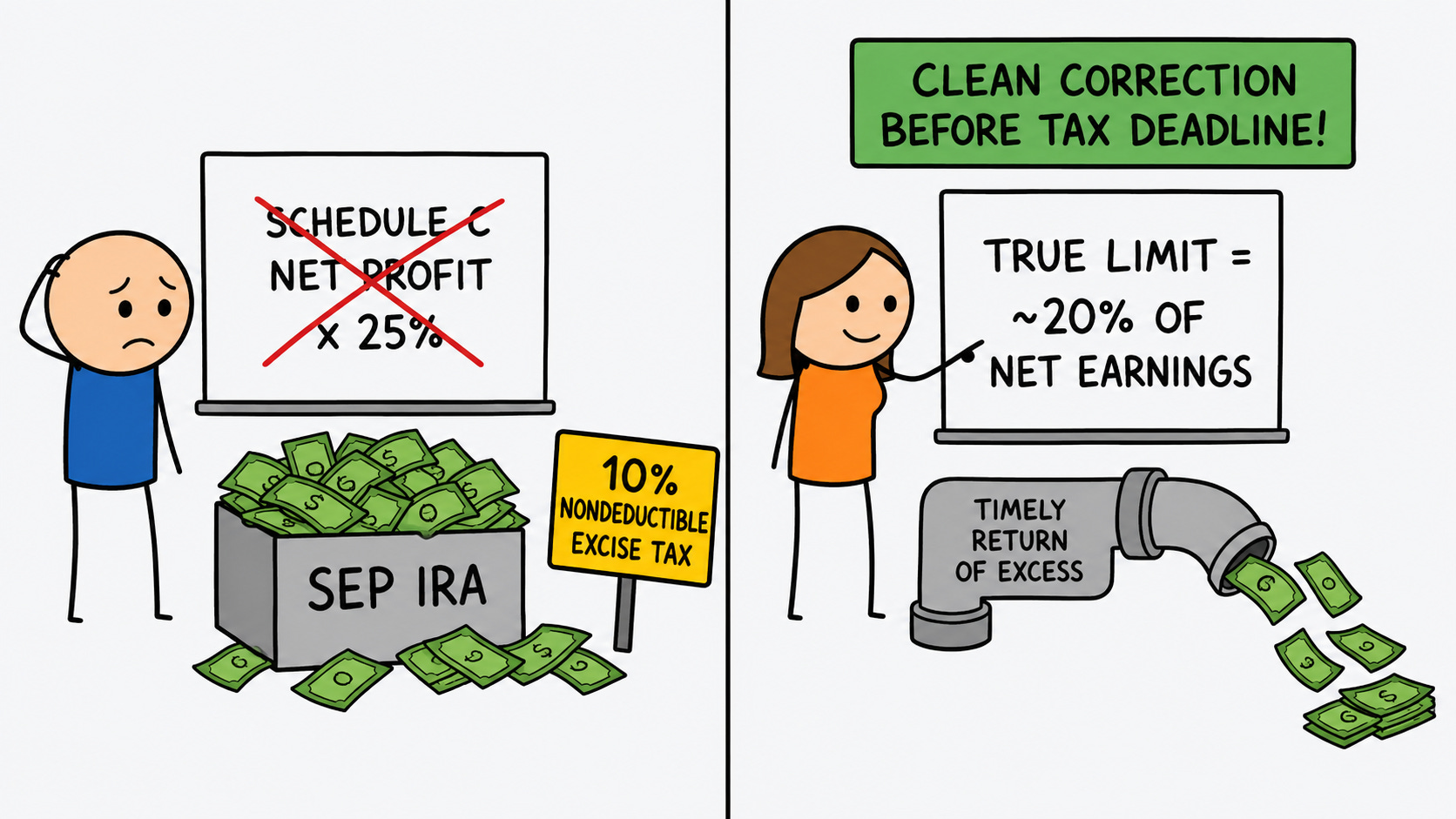
A self-employed person who funds a SEP IRA and later realizes they put in too much has a fixable problem, but the fix depends on understanding why the excess happened and which set of rules applies. SEP contributions follow rules that differ from ordinary IRA contributions, because a SEP contribution is an employer contribution even when a person is their own employer. That single fact changes both how the limit is calculated and how an overage gets corrected. Understanding the specific miscalculation that causes most self-employed SEP excesses, and the distinct routes available to unwind one, is what turns a penalty-generating mistake into a clean correction.
The most common cause of a self-employed SEP excess is a calculation error that almost invites itself. The headline SEP limit is twenty five percent of compensation, up to an annual dollar cap. For an employee, that is straightforward, twenty five percent of their wages. For a self-employed person, compensation is not net profit. It is net earnings from self-employment, which accounts for the deductible part of the self-employment tax and for the SEP contribution itself. Because the contribution reduces the compensation base used to calculate the contribution, the math is circular, and a twenty five percent SEP plan rate becomes a twenty percent reduced rate for a self-employed owner.
That twenty percent is where the precision matters. It is applied to adjusted net earnings from self-employment, not simply to the Schedule C net profit sitting at the bottom of the page. The deductible portion of self-employment tax enters the calculation, and the annual SEP dollar limit still applies as a ceiling on top of all of it. This is where people overshoot. A sole proprietor sees twenty five percent, multiplies their Schedule C net profit by twenty five percent, and contributes that. But applying a flat quarter to raw net profit produces a contribution meaningfully larger than the rule allows, because the rule applies the reduced rate to the adjusted net earnings figure, not to raw profit. The difference is an excess contribution, created without doing anything that felt wrong.
Before getting to corrections, it helps to separate two tax consequences that can overlap, because IRS guidance treats them as different things. A SEP contribution above the legal contribution limit can be included in the participant’s income and treated as a contribution by that participant to the SEP IRA, which brings the individual IRA excess-contribution rules into play. Separately, an employer contribution that exceeds the deductible amount can become a nondeductible employer contribution subject to the employer-side excise rules. A self-employed owner can end up dealing with both the SEP plan rules and the IRA excess-contribution rules from the same funding mistake, but they are not the same rule, and keeping them distinct is what makes the correction make sense.
Those two tracks carry two different excise taxes, and it is worth stating the conditions rather than implying both always apply. Nondeductible employer contributions may trigger a ten percent employer-side excise tax, reported on Form 5330. Separately, an excess amount treated as a participant contribution and left in the SEP IRA beyond the applicable correction deadline can trigger the six percent IRA excess-contribution tax, the same six percent that applies to any uncorrected IRA excess. The same mistake can create consequences on both sides, but the taxes do not automatically apply in every case, and a prompt, correct correction can avoid them.
The correction method matters, and this is where SEP excesses differ from ordinary IRA excesses. For the IRA-level side, removing the excess and the earnings attributable to it by the individual’s tax return deadline, including extensions, can avoid the six percent IRA excise tax, with the reporting following the ordinary IRA excess-contribution rules. But an excess employer contribution can also represent a SEP plan failure, and the IRS SEP correction guidance handles that differently. Under that method, the excess, adjusted for earnings, is distributed from the SEP IRA and returned to the employer, and that correction has its own tax reporting, where the returned amount can be reported with a zero taxable amount rather than as ordinary taxable income. Because the same dollars can implicate both the employer-plan rules and the participant’s IRA rules, the custodian needs to be told specifically that this is a SEP excess correction, rather than simply processing it as an ordinary IRA withdrawal, since the two are reported differently. The earnings that come out are handled according to whichever correction procedure applies, which is why the type of correction has to be identified up front. Calculating those attributable earnings correctly is its own precise task with a specific formula, worth handling carefully because the figure has to be right for the correction to be clean.
There is a carryforward rule, but it applies to the employer deduction and should not be confused with correcting an amount that actually exceeded the legal SEP contribution limit. A nondeductible SEP contribution can potentially be carried forward and deducted in a later year, subject to that later year’s deduction limit, and the ten percent excise tax can continue to matter while nondeductible amounts remain. But if the contribution exceeded the legal participant limit, simply calling it part of next year’s SEP contribution does not by itself correct the SEP plan failure. That kind of excess has its own correction rules, and treating it as a future contribution does not make the failure disappear.
A contribution above the legal SEP limit creates an operational plan failure, which brings the IRS retirement-plan correction framework into the picture. The IRS SEP correction guidance generally describes removing the excess, adjusted for earnings, and returning it to the employer, and depending on the facts an IRS correction program may also be relevant. This is not solely a remedy for very old mistakes. It is the plan-level side of correcting a contribution that should not have been allocated to the SEP IRA in the first place, and it applies whether the excess is caught quickly or discovered years later. Catching it early does not change the type of mistake, but it makes the correction considerably simpler than letting it age across multiple years, when the excise taxes can compound and the correction becomes more involved.
The reason the self-employed calculation deserves this much attention is that the error is silent at the moment it happens. The custodian accepts the contribution without checking whether it exceeds the person’s limit, because the custodian does not know the person’s net earnings from self-employment. That figure depends on business tax information and the special self-employed computation, which the IRA custodian does not have. The overage only surfaces later, when the contribution is measured against the correctly calculated limit at tax time. This is why running the actual limit calculation before funding, rather than after, prevents the problem in the first place.
Picture a sole proprietor with a solid year of net profit who wants to maximize their SEP contribution. They see the twenty five percent figure, apply it to their Schedule C net profit, and contribute that amount. Months later, preparing their return, they or their preparer run the actual self-employed SEP computation, which applies the reduced rate to adjusted net earnings from self-employment rather than raw net profit. The correctly calculated limit comes out noticeably lower than what they contributed. The gap is an excess contribution, created entirely by applying twenty five percent to the wrong base.
Because they caught the error promptly, they contact the SEP custodian and identify it specifically as an excess employer contribution, not an ordinary IRA withdrawal. The amount that exceeded the legal limit, adjusted for earnings, is then handled under the applicable SEP correction procedure, with the reporting that procedure calls for. They deduct only the properly calculated SEP contribution on their return and handle any required employer or participant reporting associated with the excess. Had they missed the deadline and left the excess sitting in the account across years, they would have faced accumulating excise-tax exposure and a more involved correction. Catching the error early did not change what type of mistake occurred, but it made the correction considerably easier than discovering it years later.
The resolution is recognizing that most self-employed SEP excesses come from one specific miscalculation, applying twenty five percent to net profit instead of the reduced rate to adjusted net earnings, and that correcting one requires identifying which rules the excess actually implicates. A SEP contribution is an employer contribution, so an excess can draw the ten percent nondeductible-contribution excise tax on the employer side, while an excess treated as a participant contribution and left in the IRA can draw the six percent excise tax each year, which is why identifying the excess correctly and acting before the deadline both matter.
The variables that determine the correction are how the excess arose, whether it merely exceeded the employer’s deductible amount or actually exceeded the legal SEP contribution limit, whether it is caught before the participant’s tax return deadline, and which plan-level correction procedure applies. A deduction carryforward may help with a nondeductible employer contribution, but it does not automatically cure an amount that exceeded the legal SEP limit. A person who finds the error before their deadline and corrects it under the right procedure can usually resolve it cleanly. The most reliable protection is calculating the true self-employed limit before funding the account, which is exactly the kind of calculation a dedicated tool can handle so the flat-percentage mistake never happens in the first place.
I write one of these every day, one retirement rule, explained in plain language and verified against the source. The daily email is free: subscribe here.
Full archive, worksheets, and search live at RetirementNewsRundown.com.
Disclaimer
This article is for educational and informational purposes only. It is not tax, legal, or financial advice and does not create an advisor–client relationship. Always consult appropriate professionals regarding your specific situation.