Putting too much into an IRA is one of the easiest retirement mistakes to make and one of the most fixable, as long as it is caught in time. An excess contribution does not just sit there harmlessly. It carries a penalty that repeats every year the excess stays in the account, which means a small mistake left alone becomes a recurring cost. The good news is that there are several ways to correct it, and which one fits depends almost entirely on why the excess happened and how quickly it is caught. Understanding the correction options, and the deadline that separates the clean fixes from the messy ones, is what keeps an overcontribution from turning into an ongoing tax.
First, what creates an excess. The most common causes are making regular traditional and Roth IRA contributions that together exceed the annual limit for that person, contributing directly to a Roth IRA when income reduces or eliminates Roth eligibility, and contributing more than the available taxable compensation supports. Married couples filing jointly have an important exception to that last point, because one spouse can use the couple’s combined taxable compensation under the spousal IRA rules even if that spouse personally earned little or nothing. The Roth income case is especially common, because a person can contribute early in the year expecting to stay eligible, then earn more than anticipated and find their Roth eligibility reduced or gone. Marriage can do the same thing, when two incomes combine on a joint return and push a Roth contribution over the joint limit that was fine on separate incomes. Whatever the cause, the tax code treats the resulting excess the same way.
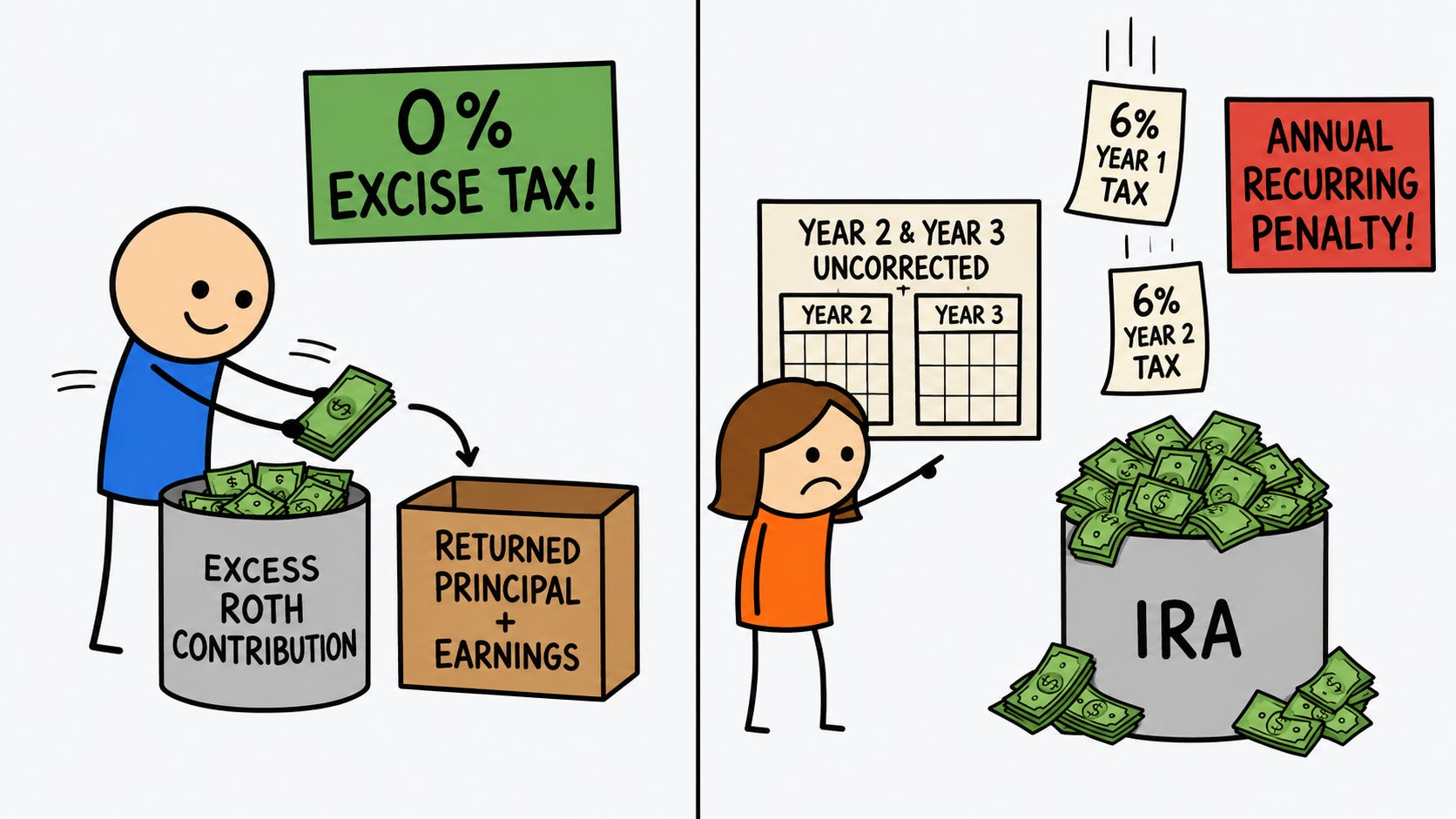
The penalty is generally six percent of the excess for each year it remains unresolved, capped by the year-end value of the applicable IRA type. Traditional IRA and Roth IRA excesses are calculated separately, in separate sections of the reporting form. The critical feature is that it repeats. An excess left uncorrected is not a one-time six percent, it is six percent this year, six percent next year, and so on until the excess is removed or otherwise resolved. This is why the timing of the correction matters so much, because the difference between catching it early and letting it sit is the difference between paying nothing and paying the penalty year after year.
The cleanest correction, available before the deadline, is to withdraw the excess plus its earnings. A person removes the excess contribution along with the net income attributable to it, the earnings that the excess generated while in the account, by the tax filing deadline including extensions. Done this way, the six percent excise tax is avoided entirely, because the contribution is treated as though it was never made. The excess contribution itself generally is not taxed on the way out, because for a Roth or a nondeductible contribution it was already after-tax money, and even for an otherwise-deductible contribution this correction simply removes it before it was deducted. The earnings that come out with it are taxable, and they are taxable in the year the contribution was made, not the year of withdrawal. Calculating those earnings correctly is a specific task with its own formula, worth handling carefully.
A meaningful recent change improves this correction. In the past, if the person was under 59.5, the earnings withdrawn in a corrective distribution were hit with the ten percent early withdrawal penalty on top of ordinary income tax. Under a change made by SECURE 2.0, for these timely corrective distributions that ten percent additional tax no longer applies to the earnings portion. The earnings are still taxable as ordinary income, but the additional ten percent penalty for being under 59.5 is gone for this specific correction. A lot of older guidance still states that the ten percent applies, so this is a point where current rules differ from what many sources say.
A second correction, particularly useful when the problem is the Roth income limit, is recharacterization. A regular Roth IRA contribution can be transferred, along with its attributable earnings or losses, to a traditional IRA and treated as though it had been contributed there from the beginning. Unlike a Roth IRA, a traditional IRA has no upper income limit for making a contribution, although income can affect whether the contribution is deductible. This has to be done by the tax filing deadline including extensions. Recharacterization works only if the contribution would otherwise be allowable as a traditional IRA contribution. It does not cure a contribution that exceeded the overall regular IRA limit or was unsupported by sufficient compensation, because moving that kind of excess from Roth to traditional just relocates it. For someone whose income put them over the Roth limit, though, recharacterizing to a traditional IRA is frequently the natural fix, and it can also set up a later conversion back to Roth through the backdoor approach, subject to the pro-rata rule that governs those conversions.
A third correction is to absorb a prior-year excess using unused contribution room in a later year. If the person’s allowable contribution for that later year exceeds what they actually contribute, some or all of the old excess can be treated as using that unused room. This works when the excess is modest and the person expects to have room in a following year. The catch is that this does not avoid the six percent excise tax for the years before the excess is absorbed. The six percent applies for any earlier year in which the excess remained unresolved at year-end, but once the excess is fully absorbed, it stops generating future excess-contribution tax. For a small excess, some people accept the modest penalty rather than go through the withdrawal process, but it is a real cost, not a free option.
The fourth situation is correcting after the timely-correction window has closed, and here the rules become more account-specific, which is why a single blanket approach does not work. Once the deadline including extensions is gone, the person no longer gets the clean treatment where the original contribution and its earnings are simply treated as though the contribution never happened. A prior Roth IRA excess can generally be reduced through later Roth distributions or unused contribution room in a future year. Traditional IRA excesses have their own after-deadline withdrawal rules, including conditions that turn on whether the contribution was deducted and why it was excessive, and unwinding a deducted contribution can require an amended return. The six percent tax already owed for prior years does not disappear simply because the excess is corrected later, but resolving the excess stops it from continuing into future years. Because these after-deadline paths differ by account type and by the reason for the excess, this is the point where the details of a person’s specific situation matter most.
One under-known rule provides extra breathing room. If a person timely filed the original return without correcting the contribution, the rules generally allow the corrective withdrawal or recharacterization to be completed within six months after the original return due date, excluding extensions. That relief is not simply an extra six months to ignore the return. The taxpayer generally must file an amended return reflecting the correction and identify it as filed under the applicable automatic-extension rule. A person who filed on time and only later realized they had an excess may still be within this window, which many people do not know exists.
Picture someone who contributes the full amount to their Roth IRA early in the year, then has a strong income year and finds, at tax time, that their income landed above the Roth limit. The entire contribution is now an excess. Because they catch it before their filing deadline, they have the clean options. They could withdraw the contribution plus its earnings, paying tax only on the earnings, with no ten percent penalty even though they are under 59.5. Or, since the problem is their income and a traditional IRA has no income ceiling for contributing, they could recharacterize the Roth contribution as a traditional one, moving it and its earnings over and treating it as a traditional contribution from the start. Either fix avoids the six percent excise tax entirely, and the recharacterization keeps the money in a retirement account rather than pulling it out.
Now picture the same person not noticing until two years later. The clean timely-correction window is gone, and six percent excise tax may already be owed for each year the excess remained unresolved. The remaining correction depends on whether the excess is in a Roth or traditional IRA and on the reason it was excessive. They may be able to use a later distribution or future contribution room to eliminate the carried excess, but correcting it now does not erase the valid excise tax from the earlier years. The same mistake cost nothing in the first version and two years of penalties in the second, purely because of when it was caught.
The resolution is matching the correction to the cause and the timing. Before the tax filing deadline including extensions, an excess can be fixed cleanly, either by withdrawing it with its earnings, which avoids the six percent excise tax, or by recharacterizing a Roth contribution to a traditional IRA, which is especially suited to a Roth contribution made over the income limit. After the deadline, the options narrow and turn on the account type and the reason for the excess, and the six percent applies for the years the excess remained unresolved.
The variables that determine the fix are why the excess happened, whether the person is caught before or after the deadline, whether recharacterizing to a traditional IRA actually solves the underlying problem or merely moves the excess, and whether there is future contribution room to absorb it. The single most important factor is timing, because the before-deadline corrections avoid the penalty entirely while the after-deadline ones do not, and the automatic six-month window with its amended-return requirement gives more room than many people realize. Catching an excess early turns it into a routine administrative fix. Letting it sit turns it into a recurring six percent charge, which is exactly the outcome the correction options exist to prevent.
I write one of these every day, one retirement rule, explained in plain language and verified against the source. The daily email is free: subscribe here.
Full archive, worksheets, and search live at RetirementNewsRundown.com.
Disclaimer
This article is for educational and informational purposes only. It is not tax, legal, or financial advice and does not create an advisor–client relationship. Always consult appropriate professionals regarding your specific situation.