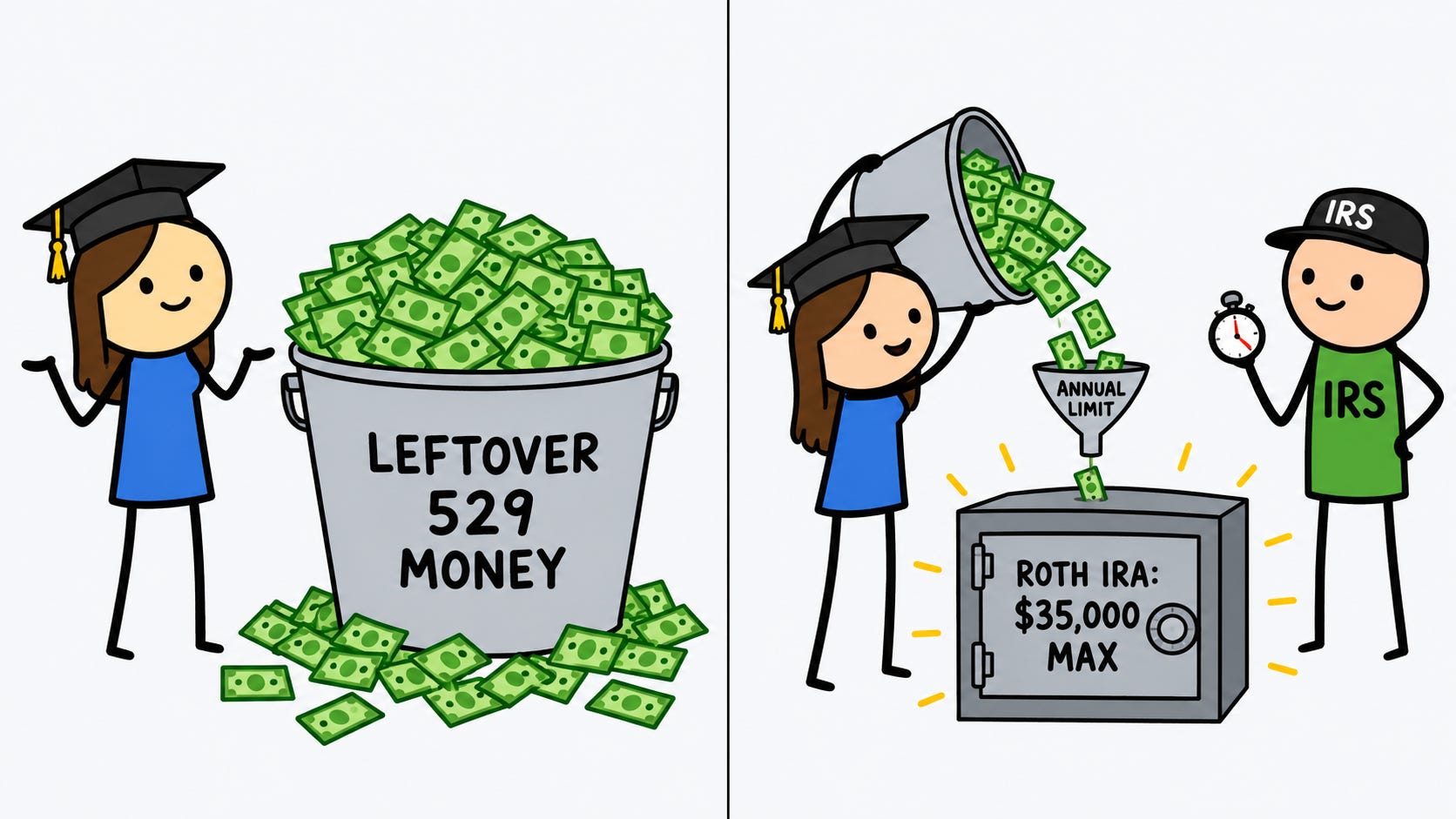
A 529 plan is built around one exit. Money comes out tax free when it pays for qualified education, and everything else gets taxed on the earnings, usually with an extra 10% on top. That design works until the student finishes school with money still in the account, gets a scholarship, or skips college entirely, and the family realizes the leftover balance has nowhere obvious to go.
A newer rule gives some of that money a second exit: a rollover into the beneficiary’s Roth IRA. The headlines made it sound like any leftover 529 balance can slide into a Roth. The actual rule moves a limited amount, at a limited pace, from accounts that meet a set of age requirements.
The rollover has to go into a Roth IRA for the 529’s beneficiary, the student, and nobody else. It has to move as a direct trustee-to-trustee transfer from the 529 plan to the Roth IRA custodian. A check paid to the family and redeposited does not qualify.
The 529 account has to have been maintained for that beneficiary for at least 15 years by the date of the distribution. An account opened when a child was born clears that bar by the child’s 15th birthday. An account opened at 10 does not clear it until 25.
Recent money is excluded. The rollover cannot exceed the contributions made more than five years before the distribution, plus the earnings on those contributions. A deposit a grandparent made three years ago, and whatever it has earned, has to wait.
Then come the limits. Each year’s rollover counts against the beneficiary’s regular Roth IRA contribution limit for that year, reduced by anything else contributed to their IRAs that year. Because the limit runs through the ordinary contribution rules, the beneficiary generally needs taxable compensation at least equal to the amount rolled over. The income limits that phase out direct Roth contributions do not shrink this rollover. And over the beneficiary’s lifetime, total 529-to-Roth rollovers cannot exceed $35,000, a fixed figure in the law that does not adjust for inflation.
What happens if the rules are missed? A distribution that fails the requirements does not get rollover treatment. It becomes an ordinary nonqualified 529 distribution, so the earnings portion is taxable and generally faces the additional 10% tax. If money that failed the test landed in the Roth anyway, it counts as a regular Roth contribution, and anything over the beneficiary’s contribution room for the year is an excess contribution with the usual 6% tax for each year it remains. Withdrawing the excess and its earnings by the due date of the beneficiary’s return, including extensions, avoids that tax.
Timing works like a regular Roth contribution. A rollover counts toward the limit for the year it is made, and one made between January 1 and the April tax-filing deadline can be designated for the prior year, the same way a regular contribution can.
So the clocks run separately. The 15-year account age and the five-year contribution lookback are both measured on the date of the distribution. The annual limit resets each calendar year, with the April filing deadline as the last day to apply a rollover to the prior year. The $35,000 lifetime cap never resets. Fixing an excess contribution runs on the beneficiary’s tax-return due date, including extensions.
Emma’s parents opened a 529 for her the year she was born and contributed regularly until she turned 16. Her grandmother added $3,000 two years before Emma graduated. Emma finishes school at 22 with a partial scholarship and $24,000 left in the account. She takes a job with wages well above the annual Roth contribution limit.
The account is 22 years old, so the 15-year test is met. The grandmother’s $3,000 and its earnings fall inside the five-year lookback, so that portion has to stay put for now. The rest is eligible.
Using a $7,500 annual limit for illustration, Emma can move $7,500 in her first year working, as long as she makes no other IRA contributions that year. If she also puts $2,000 of her own money into her Roth that year, the 529 rollover is capped at $5,500. Moving all $24,000 takes at least four years at that pace, and the grandmother’s money becomes eligible once five years have passed since it went in.
Suppose her parents get impatient and request a $10,000 rollover in a single year. Only $7,500 fits. The extra $2,500 misses the rollover treatment. It is a nonqualified 529 distribution on the way out, which makes the earnings in it taxable with the additional 10% generally applied, and an excess contribution once it lands in her Roth. Pulling the excess and its earnings out of the Roth by her return’s due date, including extensions, stops the 6% tax from applying.
Had the account been opened when Emma was 12 instead, none of this could start until she turned 27.
The 529-to-Roth rollover is a useful release valve, sized for leftover money. It moves a capped amount, one year’s contribution limit at a time, into an account the student owns.
What matters is the age of the account, how recent the last contributions were, and how much room the beneficiary has in their own Roth limit each year. For how a rollover like this sits next to the beneficiary’s regular contributions, and why choosing Roth over traditional money matters early in a career, our Roth vs. Traditional calculator lays out the comparison.
I write one of these every day, one retirement rule, explained in plain language and verified against the source. The daily email is free: subscribe here.
Full archive, worksheets, and search live at RetirementNewsRundown.com.
Disclaimer
This article is for educational and informational purposes only. It is not tax, legal, or financial advice and does not create an advisor-client relationship. Always consult appropriate professionals regarding your specific situation.