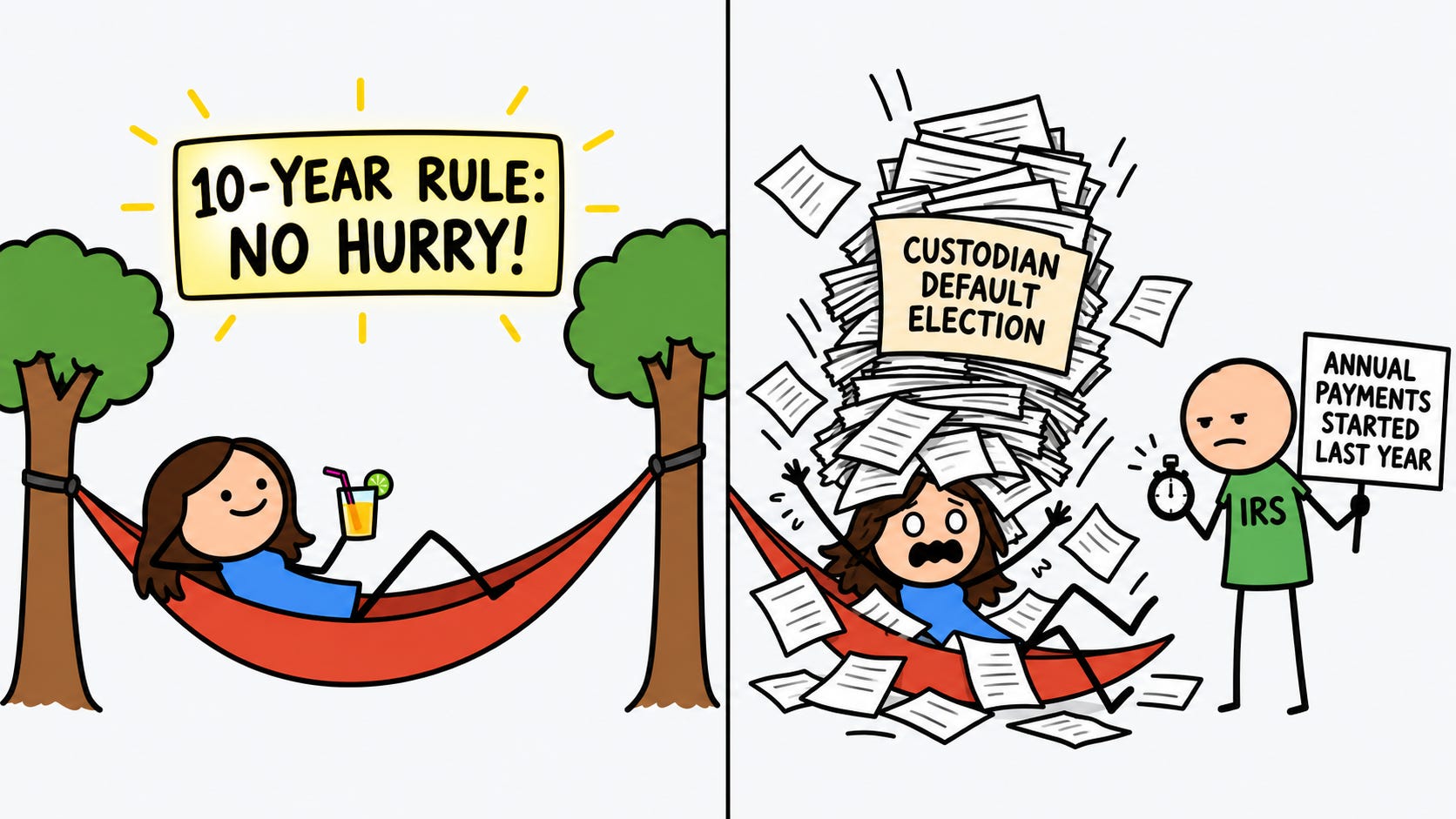
Most people who inherit an IRA have heard of the 10-year rule: empty the account by the end of the tenth year after the owner’s death. For beneficiaries who inherit from someone who died before their required beginning date, that usually means nothing has to come out until year ten. So when a sister inherits her brother’s IRA, she files the paperwork, retitles the account, and plans to deal with it later.
For a particular group of beneficiaries, though, the 10-year rule is an option, and the IRA itself may have already picked the other one. Those beneficiaries can owe a withdrawal every December starting the year after the death, and the custodian’s paperwork is where that choice was made.
The group is called eligible designated beneficiaries. It includes the owner’s surviving spouse, the owner’s minor child, a disabled individual, a chronically ill individual, and any individual who is not more than 10 years younger than the owner. A sibling close in age often qualifies, and so does a partner or friend of similar age. These rules cover IRAs inherited from owners who died after the original SECURE Act took effect. Accounts inherited before then follow the older stretch rules.
When the owner died before the required beginning date, an eligible designated beneficiary has two ways to take the money out. One is the 10-year rule, which requires no distribution in any year before the tenth and the whole balance gone by December 31 of the year containing the tenth anniversary of the death. The other is life expectancy payments, which stretch the account over the beneficiary’s own lifetime with a required distribution every year.
Here is the part that catches people. According to the IRS, the terms of most IRAs require eligible designated beneficiaries to take life expectancy payments unless they elect the 10-year rule. Doing nothing usually means choosing life expectancy payments. The deadline to elect the 10-year rule is generally December 31 of the year the first life expectancy distribution would be due, which is the year after the death.
Life expectancy payments start the year after the owner’s death. For a beneficiary other than a surviving spouse, the first one is the prior December 31 balance divided by the beneficiary’s life expectancy from the Single Life Expectancy Table, based on their age that year. Each later year, that factor drops by one. Each payment is due by December 31.
What happens if a payment is missed? The shortfall faces the 25% excise tax for missed required distributions, reduced to 10% if it is corrected within the correction window, which generally ends with the second year after the year it was missed unless the IRS mails a deficiency notice or assesses the tax first. A waiver for reasonable error can also be requested on Form 5329.
The regulations add a special penalty waiver for this mistake, separate from the ordinary election deadline. If an eligible designated beneficiary of an owner who died before the required beginning date never affirmatively chose life expectancy payments, misses required distributions, and later elects the 10-year rule by the end of the ninth calendar year after the year of death, the excise tax on those missed payments is waived automatically unless the IRS determines otherwise. The beneficiary also has to be able to make the switch under the IRA’s own terms and procedures. The entire balance then has to be distributed by the end of year ten.
The 10-year rule has its own penalty. Whatever remains in the account after December 31 of the tenth year is subject to the same excise tax, applied to everything left in it.
So the clocks run like this. Life expectancy payments are calendar-year deadlines, every December 31 starting the year after the death. The election to use the 10-year rule generally has to happen by the end of that first year, with the automatic waiver available for a switch through the end of the ninth year after the death where the IRA allows it. The correction window for a missed payment runs separately, through the end of the second year after the miss. Surviving spouses have additional options of their own and a different set of tables.
Frank dies in March at 64, before his required beginning date. His traditional IRA goes to his sister Joan, who is 60, four years younger, which makes her an eligible designated beneficiary. Frank never made nondeductible contributions, so every dollar is pretax. Joan retitles it as an inherited IRA and assumes she has ten years.
The IRA’s terms default eligible designated beneficiaries to life expectancy payments, and Joan never elects otherwise. On December 31 of the year Frank died, the account holds $262,000. Joan turns 61 the next year, and the Single Life Expectancy Table factor for 61 is 26.2. Her first required distribution is $10,000, due December 31 of the year after Frank’s death. The following year, her factor drops to 25.2.
In the first version, the custodian’s year-end notice flags the RMD in November, and she takes $10,000 in December. It is taxable income for that year, and she continues annual payments from there.
In the second version, Joan takes nothing that year or the next. In the third year after Frank’s death, her tax preparer spots it. Her IRA allows a switch, and she elects the 10-year rule. Because she never chose life expectancy payments and made the switch well before the end of the ninth year, the excise tax on the two missed payments is waived. She now has until December 31 of the year containing the tenth anniversary of Frank’s death to empty the account, with nothing required before then.
In the third version, Joan wants the lifetime stretch and keeps life expectancy payments. She takes both missed distributions in the third year. The 25% tax on the first $10,000 shortfall would be $2,500, which drops to $1,000 at the 10% rate because she corrects it within its correction window and reports it on Form 5329. The second missed year is figured separately from that year’s own required distribution, based on the prior December 31 balance and the 25.2 factor, and follows the same penalty rules. She can also attach a statement to Form 5329 explaining the reasonable error and asking for a full waiver.
For eligible designated beneficiaries, the difference between the two payout methods is real, and the default is set by paperwork most people never read. The good news is that the system has a generous way back for anyone who landed on annual payments by accident.
What matters is knowing whether you are an eligible designated beneficiary, which method the IRA has you on, and whether the owner died before the required beginning date. Our Inherited IRA Calculator is built to map out a beneficiary’s schedule for the years after the death, which is the quickest way to see what the account expects each December.
I write one of these every day, one retirement rule, explained in plain language and verified against the source. The daily email is free: subscribe here.
Full archive, worksheets, and search live at RetirementNewsRundown.com.
Disclaimer
This article is for educational and informational purposes only. It is not tax, legal, or financial advice and does not create an advisor-client relationship. Always consult appropriate professionals regarding your specific situation.