Retirement and Medicare run on separate calendars. Someone who leaves a job at 60 or 62 loses the employer health plan on a date the employer sets, and Medicare eligibility generally starts at 65 regardless of when the paychecks stopped. The years in between have to be covered somehow, and the two usual answers, COBRA and a Marketplace plan, price that coverage in very different ways.
COBRA charges based on what the plan costs. A Marketplace plan with a premium tax credit charges based on income. For early retirees who are also drawing down IRAs or doing Roth conversions, that second pricing method means the tax return and the health insurance bill are now the same conversation.
COBRA lets someone who loses employer coverage after leaving a job keep the same group plan, generally for up to 18 months. The catch is the price. The employer usually stops contributing, and the plan can charge up to 102% of the full premium. The election window runs 60 days from the later of losing coverage or receiving the election notice, and coverage elected in time reaches back to the day the employer coverage ended. The first premium is due within 45 days of electing.
Losing employer coverage also opens a special enrollment period for the Marketplace, with 60 days to pick a plan outside the annual open enrollment period. Marketplace open enrollment runs each fall starting November 1, and it allows a switch from COBRA to a Marketplace plan regardless of how much COBRA time is left. When COBRA runs out, that also opens a special enrollment period.
The premium tax credit is what makes a Marketplace plan affordable or expensive. It is available to people with household income between 100% and 400% of the federal poverty line for their family size, with the credit shrinking as income rises. Above 400%, under the permanent rules, there is no credit at all. Congress temporarily removed that ceiling for several years, and that expansion has since expired, so the cliff is back unless Congress acts again.
Someone offered COBRA or retiree coverage by a former employer can decline it, even if it is affordable, and still claim the credit for a Marketplace plan. Enrolling in that coverage ends eligibility for the credit for those months.
Household income for the credit is modified adjusted gross income. That means adjusted gross income plus nontaxable Social Security benefits, tax-exempt interest and excluded foreign income. Pretax IRA and 401(k) withdrawals count. Roth conversions count in full, in the year they are done. Qualified Roth IRA distributions and withdrawals of money from a taxable account, apart from any gains, generally do not.
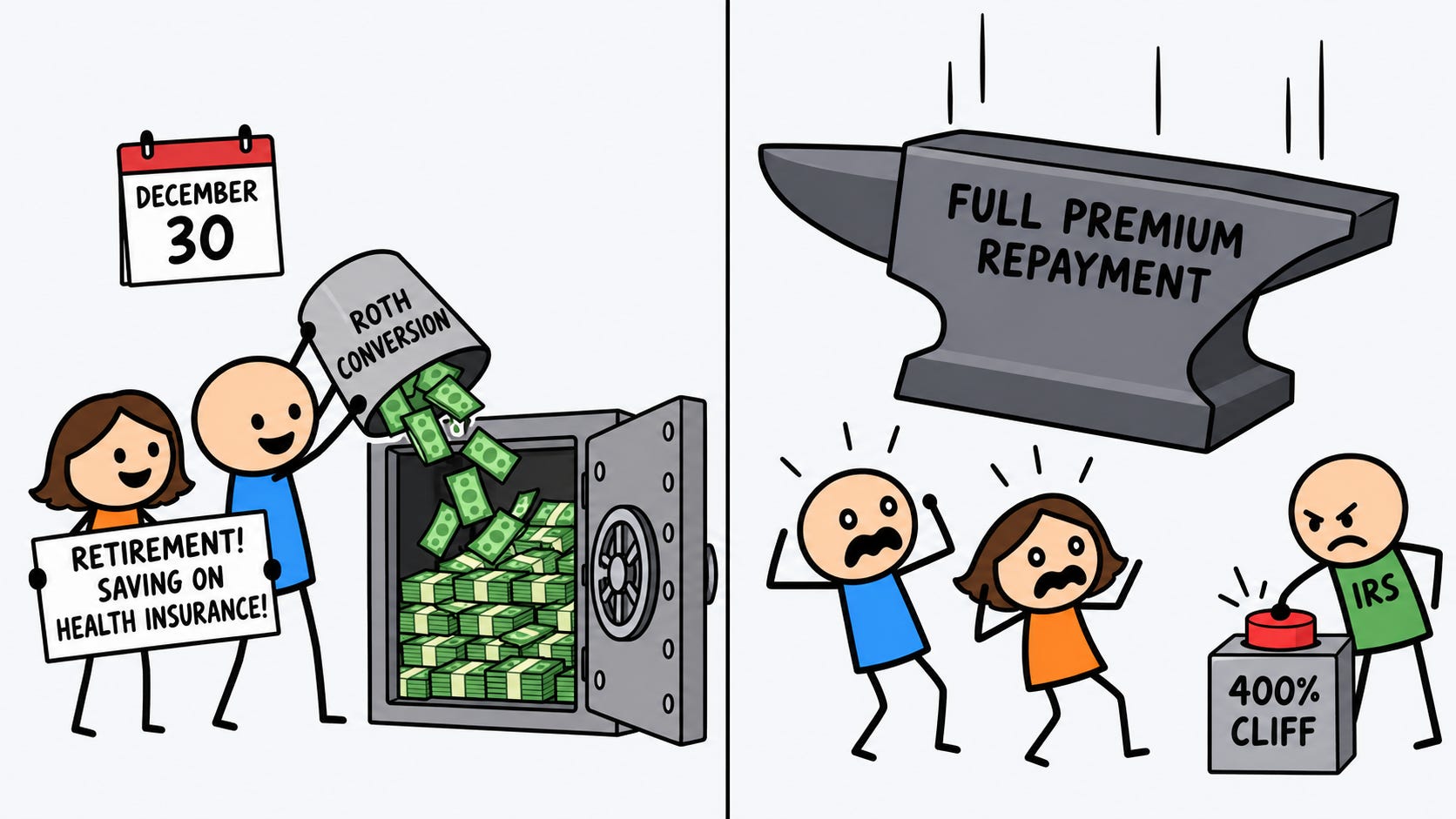
The timing is where it gets expensive. The credit is usually paid in advance, monthly, straight to the insurer, based on an income estimate given at enrollment. The real number gets settled on the tax return through Form 8962. If actual income comes in lower, the difference comes back as a larger credit. If it comes in higher, the excess advance payments get repaid. Under current law there is no cap on that repayment, so someone whose income lands above 400% repays every dollar of advance credit received that year. A Roth conversion done on December 30 counts for that whole calendar year, and a conversion cannot be undone.
So the deadlines sort into three groups. COBRA gives 60 days from the later of losing coverage or receiving the election notice, then 45 days after electing to make the first payment. The Marketplace special enrollment period generally runs 60 days from losing coverage, and open enrollment comes once a year. The credit itself runs on the calendar year and gets reconciled at tax filing, with income changes reported to the Marketplace during the year to adjust advance payments before then.
Tom and Karen are 61 and 60, married, and retire together at the end of June. Their employer plan ends June 30. Their COBRA notice arrives July 10, and they have until early September to elect it.
They look at COBRA and the Marketplace side by side. Their income for the year, two half-year salaries plus some interest, sits well above 400% of the poverty line, so this year a Marketplace plan would come with no credit. They elect COBRA in August, pay the first premium within 45 days, and the coverage reaches back to July 1.
In November, open enrollment lets them plan for next year, their first full year with no wages. They expect to live on savings in a taxable brokerage account plus $35,000 of pretax IRA withdrawals, which puts their projected household income below 400% of the poverty line. They enroll in a Marketplace plan starting January 1, drop COBRA at the end of December, and receive an advance credit of $1,100 a month based on that estimate.
In the same year, they also convert $60,000 from a traditional IRA to a Roth IRA in December, with no nondeductible contributions in the account, so all of it is taxable. That pushes their household income over 400%. When they file, Form 8962 shows they qualified for no credit at all, and they repay the full $13,200 of advance payments, on top of the income tax on the conversion. Advance payments only adjust going forward once an income change is reported, so a late-year jump in income gets settled almost entirely at tax time.
Had they done the conversion in the year they retired, when they were on COBRA and their income was already past 400%, it would have changed nothing about their health insurance cost.
The coverage gap before 65 is solvable, and for many early retirees with controllable income, a Marketplace plan with a credit costs far less than COBRA. The credit ties the premium to income, so every pretax withdrawal and conversion during those years moves the bill.
What matters is knowing which year each dollar of income lands in and where that year sits relative to the 400% line. Our RMD & Roth Conversion Planner maps conversion income year by year, which is the starting point for seeing which pre-Medicare years have room and which ones are already close to the edge.
I write one of these every day, one retirement rule, explained in plain language and verified against the source. The daily email is free: subscribe here.
Full archive, worksheets, and search live at RetirementNewsRundown.com.
Disclaimer
This article is for educational and informational purposes only. It is not tax, legal, or financial advice and does not create an advisor-client relationship. Always consult appropriate professionals regarding your specific situation.