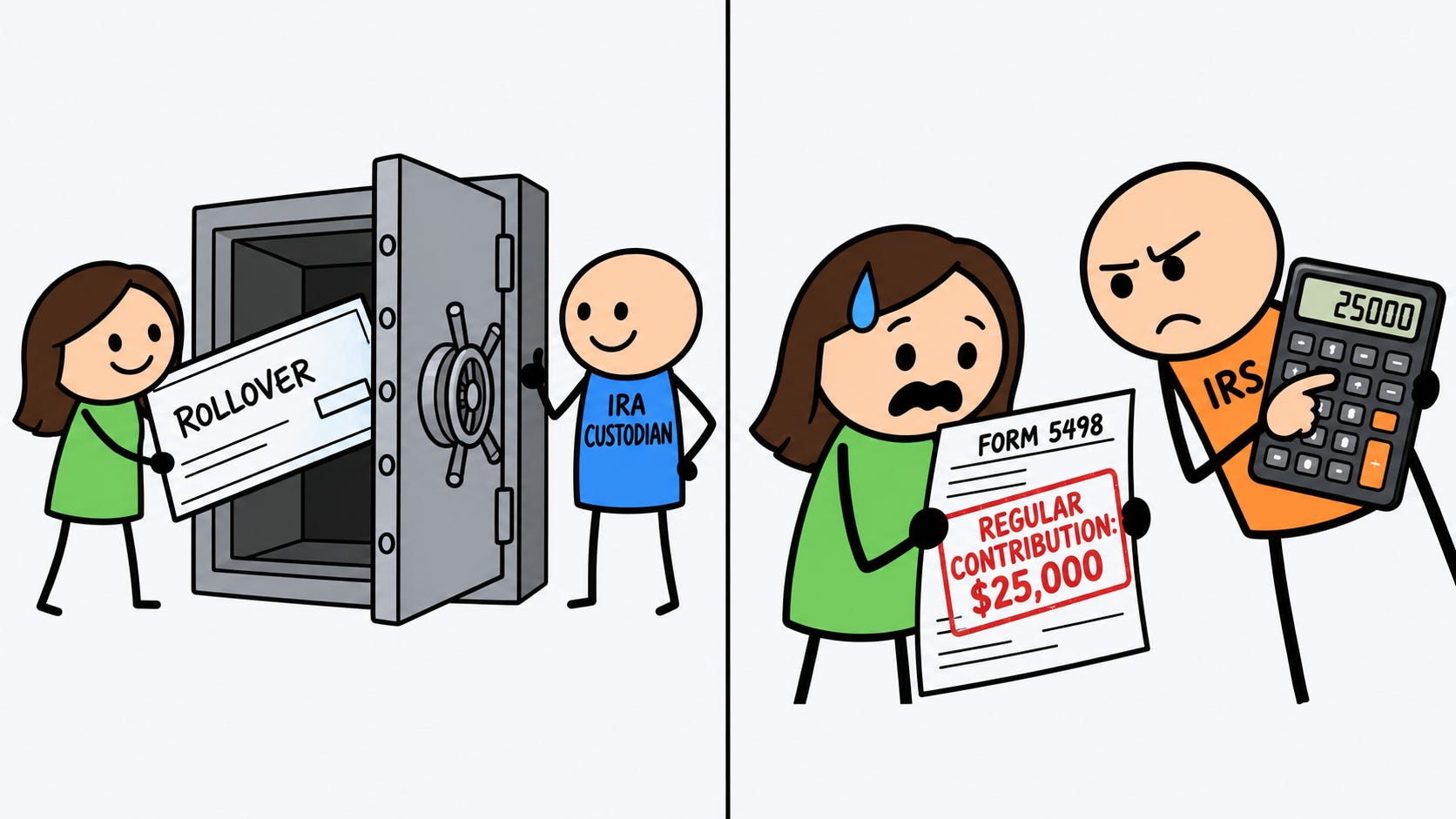
Every IRA deposit gets a label when it arrives. Somebody at the receiving custodian decides whether the money is a regular contribution for this year, a contribution for last year, or a rollover. That label flows into the custodian’s records and, months later, onto Form 5498, the form the custodian sends to the IRS showing what went into the account.
Most of the time the label is right. When a rollover check gets keyed as a regular contribution, the account owner usually finds out in late spring, when a Form 5498 shows a contribution several times the annual limit and the obvious question is whether they now owe a penalty on money they only moved.
Form 5498 reports regular traditional IRA contributions in Box 1 and rollover contributions, including direct rollovers, in Box 2. The form is an information return. The custodian files it with the IRS by May 31 of the year after the deposit and sends the owner the contribution information by the same date, so it usually arrives after the return is filed. It reports the transaction. The tax rules decide what the transaction actually was.
Whether a deposit is a rollover depends on the rollover rules. For an indirect rollover, the money has to go in within 60 days of the distribution, and IRA-to-IRA rollovers are limited to one per person in any one-year period. A deposit that meets those rules is a rollover, and a deposit that fails them is a regular contribution, no matter which box the custodian used.
That splits the problem in two.
If the rollover was valid and only the coding is wrong, the fix is administrative. The owner asks the receiving custodian to recode the deposit in its records as a rollover, usually with paperwork showing where the money came from and when it was distributed. The custodian then issues a corrected Form 5498 moving the amount from Box 1 to Box 2. The IRS instructions tell custodians that discover an error on a filed Form 5498 to correct it as soon as possible. One wrinkle: a late rollover accepted under a self-certification is reported in a separate box for late rollovers, so a late rollover missing from Box 2 is not automatically a coding error. On the tax return, a rollover from one traditional IRA to another is reported on the IRA distribution lines with the full distribution, zero as the taxable amount when all of it was rolled over, and the rollover box checked. That reporting follows the facts, so a correct return can be filed before the corrected Form 5498 ever shows up.
If the coding fix comes later, the main cost is a mismatch. The IRS compares what custodians report against what taxpayers file, and a Box 1 amount far above the annual limit next to an IRA distribution can generate a letter. A corrected Form 5498, the distribution statement and the deposit records are what answer it.
If the rollover itself failed, the coding is accurate and the deposit really is a regular contribution. The IRS instructions make the point from the other direction: a deposit reported as a rollover that turns out to be ineligible has to be moved to Box 1 on a corrected form, even when the amount exceeds the regular contribution limit. Whatever exceeds the owner’s contribution room for the year, which depends on taxable compensation and the annual limit, is an excess contribution. The original distribution is taxable to the extent it would have been, with the 10% additional tax on the taxable portion for someone under 59.5 without an exception. Withdrawing the excess and its earnings by the due date of the return, including extensions, avoids the 6% tax. Someone who filed on time without removing it may still use a special six-month period after the normal filing deadline. After the applicable correction window, the 6% applies each year the excess remains at year-end, capped at 6% of the total IRA value, until it is withdrawn or absorbed by unused contribution room in a later year.
There is one more variation, and it involves employer retirement plans. If a rollover creates an IRA excess because the plan gave the owner incorrect information it was required to provide about the amount eligible for rollover, a special correction rule applies. The excess caused by that bad information can be withdrawn without including it in income, and the return for the year of the excess has to be amended to correct the rollover reporting. This is a separate rule from a custodian labeling a valid IRA rollover incorrectly.
So the clocks run separately. The 60-day window and the one-year limit decide whether the rollover was valid. The tax-return due date, with extensions, and the six-month window after a timely filed return govern an excess contribution fix. A pure coding error has no IRS deadline of its own, only the practical one of getting it corrected before a notice arrives.
Maria is 58 and works full time, with enough wages to cover a full IRA contribution. Her traditional IRA holds only pretax money, with no nondeductible contributions, so every dollar in it is taxable. She is moving it to a new custodian, and the old custodian sends her a $25,000 check payable to her on April 2. She deposits it at the new custodian on April 20, well inside 60 days. It is her only IRA-to-IRA rollover in the past year.
The new custodian keys the deposit as a regular contribution for the current year. Maria files her return the following February. She reports the $25,000 distribution from her Form 1099-R, enters zero as taxable, checks the rollover box, and makes no other IRA contribution. In May, her Form 5498 shows $25,000 in Box 1.
The rollover was valid, so nothing about her taxes changes. She calls the new custodian, sends the distribution statement and her deposit receipt, and the custodian recodes the deposit and issues a corrected Form 5498 with $25,000 in Box 2. If an IRS letter arrives before the correction, the same documents answer it.
In the other version, Maria had already rolled over a different IRA distribution in January. The April rollover falls within one year of that one, so it fails. The $25,000 is taxable on her return, plus the 10% additional tax of $2,500 because she is under 59.5. The part of the deposit within her annual limit counts as her regular contribution for the year, and everything above it is an excess. If she removes the excess and its earnings by her extended due date, or within the six-month window after a timely filed return, the 6% tax never applies. Otherwise the 6% tax applies for each year an uncorrected excess remains, until it is removed or absorbed by available contribution room in a later year.
A rollover coded as a contribution looks alarming on paper and is usually the easier of the two problems. When the rollover met the rules, the label is a clerical error with a clerical fix.
What matters is which version you are in: a valid rollover with the wrong label, or a rollover that failed and left a real excess behind. When it is the second, our Excess Contribution Correction Tool walks through removing the excess and the deadline that decides whether the 6% tax applies.
I write one of these every day, one retirement rule, explained in plain language and verified against the source. The daily email is free: subscribe here.
Full archive, worksheets, and search live at RetirementNewsRundown.com.
Disclaimer
This article is for educational and informational purposes only. It is not tax, legal, or financial advice and does not create an advisor-client relationship. Always consult appropriate professionals regarding your specific situation.