When an IRA owner dies in the middle of the year, the account usually freezes in everyone’s mind. The family is dealing with a funeral, an executor, a pile of mail, and the custodian’s request for a death certificate. The IRA feels like something to sort out later, once the estate settles down and the beneficiaries figure out what they inherited.
The required minimum distribution system keeps running through all of it. If the owner was already taking required distributions and had not finished that year’s amount, the rest still has to come out by December 31, and the job of taking it passes to the beneficiaries.
Whether there is a year-of-death RMD at all depends on one date: the owner’s required beginning date. For a traditional IRA, that is April 1 of the year after the year the owner reaches RMD age.
If the owner died before the required beginning date, there is no RMD for the year of death. That holds even for an owner who had already reached RMD age, say someone who turned 73 last year and died in February, before that first April 1 arrived. The beneficiaries’ own rules take over from there.
If the owner died on or after the required beginning date, the year-of-death RMD is calculated as if the owner had lived the entire year. The math is the owner’s usual math: the account balance on December 31 of the prior year, divided by the factor from the Uniform Lifetime Table for the age the owner would have reached that year. If the sole beneficiary is a spouse more than 10 years younger, the joint life table is used instead. Anything the owner already withdrew earlier that year counts toward the amount. Whatever remains is the beneficiaries’ responsibility to take.
The deadline is December 31 of the year of death. The money comes out of the inherited account and is taxed to whoever receives it, as part of that beneficiary’s income for the year it is distributed. A surviving spouse who wants to roll the IRA into their own account can still do that, with one exception: required distributions can never be rolled over, so the year-of-death amount has to come out first.
The beneficiaries’ own distribution rules are a separate schedule that begins after the year of death. Whether yearly withdrawals are required depends on when the owner died and which beneficiary rule applies. Some beneficiaries take yearly distributions starting the year after the death, and some only have to empty the account by the end of the tenth year. Surviving spouses have their own set of options.
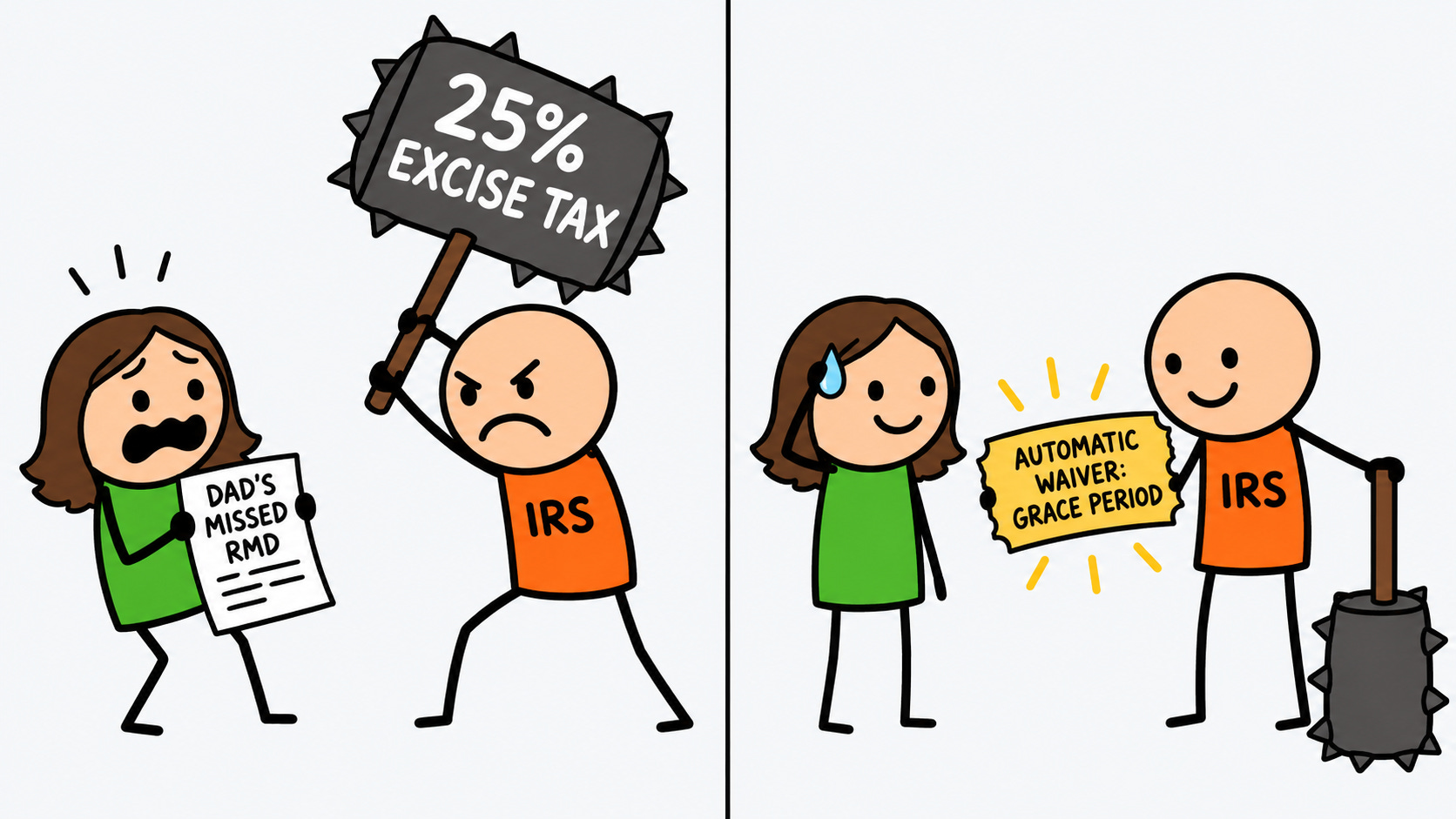
What happens if the year-of-death amount comes out later? The penalty for a missed RMD is a 25% excise tax on the shortfall, reduced to 10% if it is corrected within a correction window that generally runs through the end of the second year after the year it was missed, unless the IRS mails a deficiency notice or assesses the tax before then. For this specific situation, though, the regulations provide something better. The excise tax is waived automatically if the beneficiary takes the missed year-of-death distribution by their tax filing deadline, including extensions, for the year of death, or by the end of the following calendar year if that is later. For most individual beneficiaries, the later date is December 31 of the year after the death.
So there are three clocks. The calendar-year deadline for taking the distribution is December 31 of the year of death. The automatic waiver for a late distribution runs to the later of the beneficiary’s extended filing deadline for that year or the end of the next calendar year. After that, the ordinary correction window governs whether the tax is 25% or 10%, and a waiver request for reasonable error remains available on Form 5329.
Walter was 80 when he died on June 10. He had been taking RMDs from his traditional IRA for years, so he was well past his required beginning date. He never made nondeductible contributions, so every dollar in the account was pretax. The IRA held $404,000 on December 31 of the prior year, and the Uniform Lifetime Table factor for age 80 is 20.2, which made his RMD for the year $20,000.
He had taken $5,000 in February. That $5,000 is income on his final return. The remaining $15,000 still had to come out by December 31, and his daughter Ellen, the sole beneficiary, was responsible for it.
In the first version, Ellen’s custodian flags the shortfall when she opens the inherited IRA in September, and she withdraws $15,000 in November. It is taxable income on Ellen’s return for that year, and that is the end of it. Because Walter died after his required beginning date, her own yearly distributions from the inherited IRA start the next year.
In the second version, nobody mentions it. Ellen opens the inherited IRA in October, assumes she has nothing to do until next year, and learns about the shortfall the following March while talking to her tax preparer. She withdraws the $15,000 that March. That falls well inside the automatic waiver deadline, which for her runs to December 31 of the year after Walter’s death, so no excise tax applies. The $15,000 is income on her return for the year she actually took it.
In the third version, Ellen misses even that, and takes the $15,000 in the spring of the second year after Walter’s death. The automatic waiver has expired. The 25% excise tax would be $3,750 on the shortfall, which drops to $1,500 at the 10% rate because she corrected it within the correction window and reports the tax on Form 5329. She can also attach a statement to Form 5329 explaining the circumstances and asking the IRS to waive the tax because the shortfall came from reasonable error and is being fixed.
Had Walter died in February of the year after he turned 73, before his first April 1, Ellen would have had no year-of-death RMD to take at all.
The year-of-death RMD is one of the few retirement rules built with grieving families in mind. The calculation is the same one the owner was already doing, and the automatic waiver gives beneficiaries more than a year past the deadline to catch a missed amount without owing anything. Most families who miss it in the chaos of the first months still land comfortably inside that window.
What matters is knowing whether the owner had reached the required beginning date and how much of that year’s amount was already withdrawn. The owner’s figure for the year comes from the same formula our free RMD calculator runs on a prior year-end balance and an age, and the beneficiary’s own schedule for the years that follow is what the Inherited IRA Calculator is built to map out.
I write one of these every day, one retirement rule, explained in plain language and verified against the source. The daily email is free: subscribe here.
Full archive, worksheets, and search live at RetirementNewsRundown.com.
Disclaimer
This article is for educational and informational purposes only. It is not tax, legal, or financial advice and does not create an advisor-client relationship. Always consult appropriate professionals regarding your specific situation.