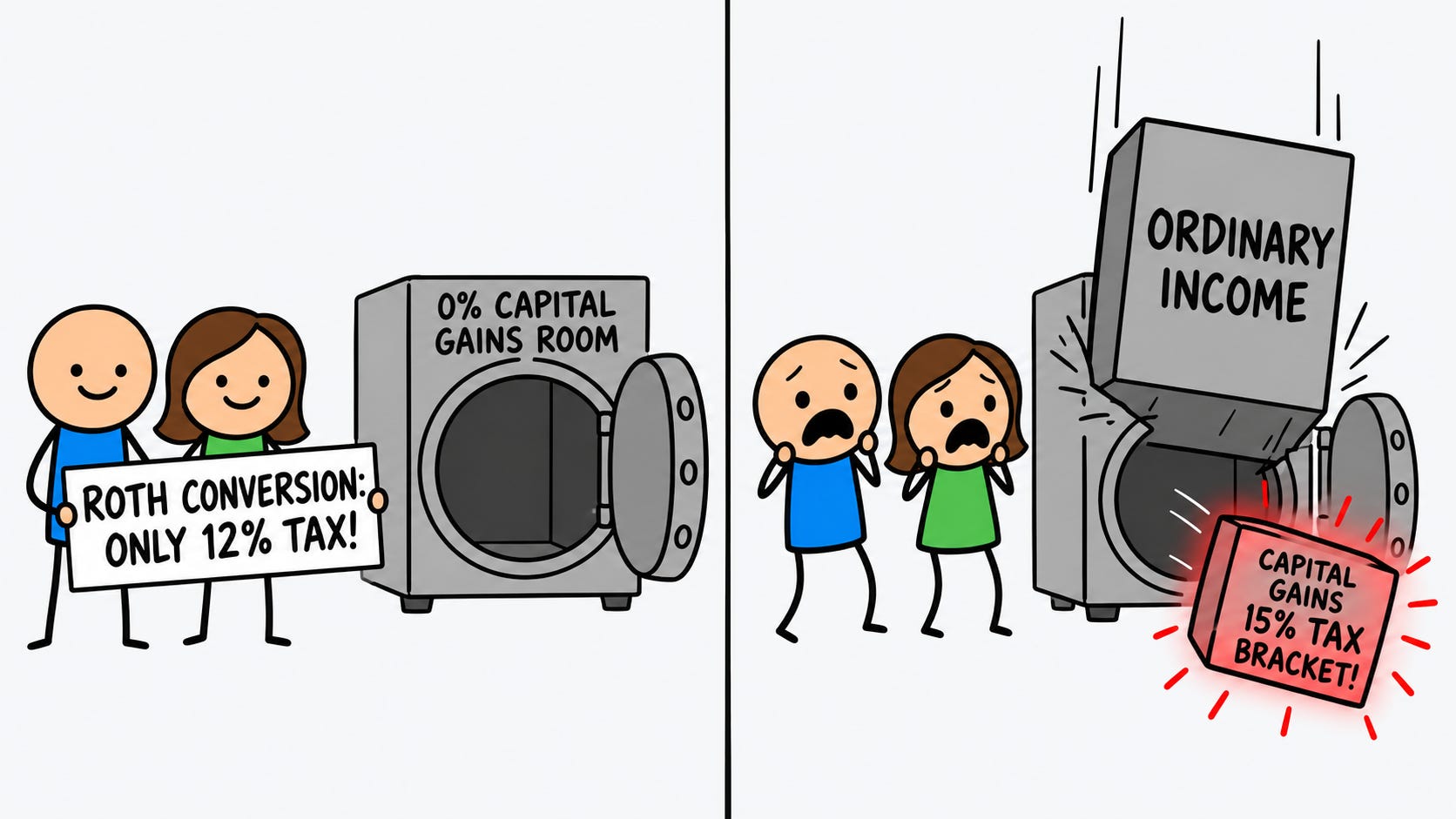
The low-bracket Roth conversion is one of the most repeated moves in early retirement planning. Income drops after the paychecks stop, the tax bracket drops with it, and the idea is to convert just enough traditional IRA money to “fill up” the 12% bracket before required distributions and Social Security push income back up later. Plenty of people run the numbers on a bracket chart, convert exactly to the top of 12%, and expect a tax bill of 12% of the conversion.
For people who also have long-term capital gains or qualified dividends, the bill can come in noticeably higher, with nothing on the return looking wrong. The conversion stays in the 12% bracket the whole time. What it takes is the seat the capital gains were sitting in.
Long-term capital gains and qualified dividends get their own rate schedule: 0%, 15% or 20%, depending on taxable income. The 0% rate applies to gains that fall below a taxable income ceiling set for each filing status and adjusted for inflation each year. Above that ceiling, gains are taxed at 15%, and at much higher incomes, 20%.
The key is the order in which income gets counted. The IRS worksheet that figures the tax starts with ordinary income, wages, pensions, IRA withdrawals and Roth conversions among them, and lets it fill the 0% band first. Gains and qualified dividends stack on top of the ordinary income. Whatever room is left below the ceiling after ordinary income is counted is the room the gains get at 0%.
So every dollar of conversion income has two effects when gains are present and the 0% band is not already full. It is taxed at the ordinary rate, 12% for someone in that bracket. And it can push one dollar of gains from the 0% rate up to 15%. Together, that dollar of conversion costs 12 cents plus 15 cents, or 27 cents, until the gains have all been pushed above the ceiling. After that point, the conversion goes back to costing its plain bracket rate.
Short-term gains are a different animal. They are taxed as ordinary income, so they sit alongside the conversion in the ordinary pile and get no 0% treatment to lose.
The timing rules decide which year the collision happens in. A Roth conversion counts as income in the calendar year it is done, and the window for a given year closes December 31. A gain counts in the year the asset is sold. A conversion cannot be undone by recharacterizing it, so once it is done, the year’s math is set. Moving either the conversion or the sale into a different calendar year changes which year’s ceiling each one meets.
Ray and Linda are 62, married filing jointly, and retired. Neither has claimed Social Security yet. Their traditional IRAs hold only pretax money, with no nondeductible contributions, so every dollar they convert is taxable.
After the standard deduction, their ordinary taxable income from a small pension and interest, with no qualified dividends, sits $30,000 below the 0% capital gains ceiling for joint filers. They also sell a fund in their taxable brokerage account in November and realize $30,000 of long-term gains. With no conversion, all $30,000 of gains fits in the remaining room and is taxed at 0%.
In December they convert $30,000 from a traditional IRA to a Roth IRA, which keeps them inside the 12% bracket. The conversion itself costs 12%, or $3,600. It also fills the $30,000 of room the gains had been using, so all $30,000 of gains now sits above the ceiling and is taxed at 15%, another $4,500. The conversion added $8,100 to their federal tax bill, 27% of the amount converted, while their bracket never moved.
Had they converted $10,000 instead, the conversion would have cost $1,200 and pushed $10,000 of gains into 15%, adding $1,500, for $2,700 total. That is still 27%, because every converted dollar in this range displaces a gain dollar. Had they sold the fund in January of the following year instead, with no other gains in the conversion year, the December conversion would have met an empty capital gains column and cost its plain 12%.
If either of them had already claimed Social Security, the conversion could also have made more of their benefits taxable, an effect covered in its own article, and the true marginal cost would climb further.
The bracket chart leaves out part of the cost when gains or qualified dividends share the return, and that part is easy to measure once the stacking order is clear. The 27% figure applies only while there are gains left to push out of the 0% band. Past that point, the conversion costs its ordinary rate again, and people with no long-term gains or qualified dividends never see the effect at all.
What matters is looking at the whole return, gains included, before the December 31 conversion deadline. Our RMD & Roth Conversion Planner models how a conversion moves taxable income across brackets, which is the starting point for seeing where gains and conversions overlap.
I write one of these every day, one retirement rule, explained in plain language and verified against the source. The daily email is free: subscribe here.
Full archive, worksheets, and search live at RetirementNewsRundown.com.
Disclaimer
This article is for educational and informational purposes only. It is not tax, legal, or financial advice and does not create an advisor-client relationship. Always consult appropriate professionals regarding your specific situation.