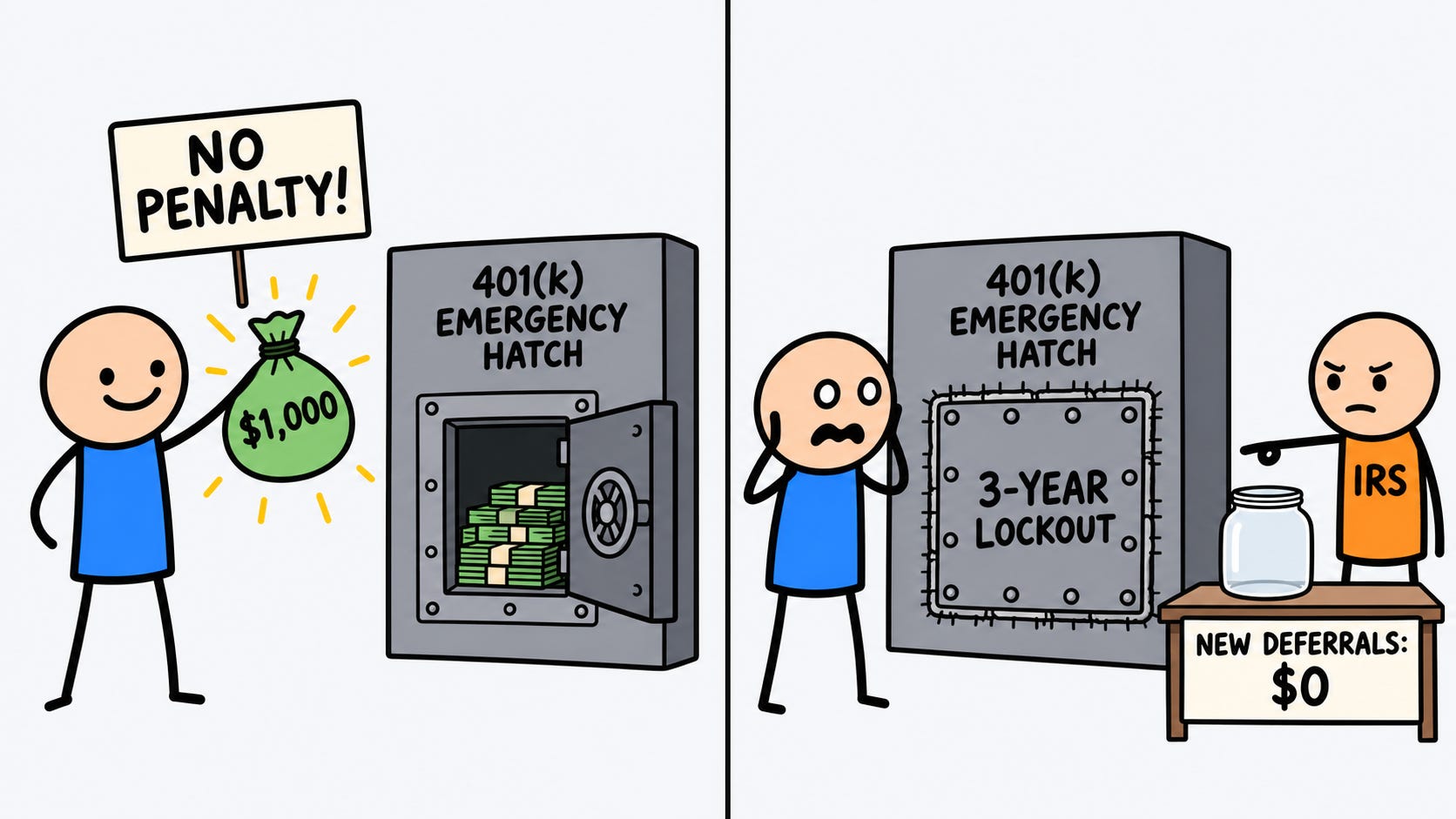
Retirement plans now come with a small emergency hatch. Someone under 59.5 can pull up to $1,000 out of a 401(k) or IRA for an emergency expense and skip the 10% additional tax, with no hardship paperwork and no proof beyond a written statement that the need is real. Plan sponsors announce it, the news covers it, and it sounds like a free $1,000 a year.
The rule attaches a three-year memory to each of those withdrawals, and the second emergency, the one that seems to show up about a year after the first, is where people find out what the memory does.
The distribution has to be for unforeseeable or immediate financial needs relating to necessary personal or family emergency expenses. The IRS guidance gives examples: medical care, a casualty loss, imminent foreclosure or eviction from a primary residence, funeral costs, auto repairs, and other necessary emergency expenses. Whether a given expense qualifies depends on the facts.
The plan administrator can rely on the person’s written certification that they qualify. No receipts have to go to the plan.
The amount is capped at the lesser of $1,000 or the vested balance above $1,000. Someone with a vested balance of $1,500 can take only $500 as an emergency distribution. Only one emergency distribution counts per calendar year.
It is still income. The exception removes only the 10% additional tax, so the taxable portion is taxed like any other retirement withdrawal.
Plans do not have to offer it. When a 401(k) plan does offer it, the IRS guidance treats the emergency distribution as meeting the plan’s withdrawal restrictions, so it is available even to someone still on the job. When a plan does not offer it, a person who takes some other distribution the plan already allows can still treat it as an emergency distribution on their tax return by claiming the exception on Form 5329, if it meets the requirements. IRAs can be the source too.
Now the memory. After taking an emergency distribution from a plan or IRA, a person cannot treat another distribution from that same plan or IRA as an emergency distribution for the three calendar years immediately following, and the one-per-year limit already covers the rest of the current year. There are two ways to reopen the door early. One is repaying the earlier distribution in full to that plan or IRA. The other is making new elective deferrals or employee contributions to the same plan after the withdrawal, or contributions to the IRA it came from, that at least equal whatever was not repaid. Either route can reopen eligibility under that plan or IRA starting in a later calendar year.
Repayment has its own clock. Any part of an emergency distribution can be repaid within three years, starting the day after it was received, to a plan or IRA that accepts rollovers and in which the person is a beneficiary. A repayment in a later year means amending the return for the year of the withdrawal to take the income back off.
So the clocks run like this. The one-per-year limit runs on the calendar year. The lockout runs on calendar years too, covering the three that immediately follow, and it applies account by account. The repayment window runs three years from the day after the distribution, on its own dates. The tax year of the distribution is where the income lands, and where any later repayment gets corrected.
Marcus is 41, and his 401(k) holds only pretax deferrals, no Roth or after-tax money, so every dollar he takes out is taxable. His plan offers emergency distributions. In April his car’s transmission fails, and he takes $1,000 with a signed certification. The $1,000 is income on that year’s return, and there is no 10% additional tax.
He does not repay it. He does keep deferring from every paycheck, and by June his new deferrals since the April withdrawal pass $1,000. That covers the unrepaid amount. He still cannot take a second emergency distribution that year, because only one counts per calendar year, but starting January 1 of the next year the door is open again.
His sister Dana takes $1,000 from her IRA in March for an emergency dental bill. She makes no IRA contributions afterward and does not repay it. She cannot treat another distribution from that IRA as an emergency distribution for the rest of that year or the following three calendar years. If a second emergency hits the next year and she takes money out of that IRA anyway, that withdrawal faces the regular 10% additional tax on its taxable portion unless some other exception applies.
Dana has a way back. If she repays the full $1,000 to that IRA within three years of the day after her March withdrawal, or contributes at least $1,000 to that IRA after it, an emergency distribution from it becomes available again once that happens, in any calendar year after the one with her March withdrawal. A repayment in a later year would also let her amend the original year’s return to take that $1,000 back out of income.
The emergency distribution is a modest tool with modest stakes. The cap is small, the paperwork is a signature, and a second withdrawal that does not qualify for the exception generally faces the ordinary early-distribution tax rules, the same ones that would have applied without the exception. In a workplace plan, whether that second withdrawal can happen at all depends on the plan’s other distribution options.
What matters is the order of events. Someone who keeps contributing to the same plan or IRA after the first withdrawal tends to reopen the door without thinking about it. Someone who stops contributing to that account has three calendar years of lockout there unless they repay in full. For how emergency withdrawals fit alongside hardship distributions, loans and the rest of a workplace plan’s withdrawal options, our 401(k) guide lays out the full picture.
I write one of these every day, one retirement rule, explained in plain language and verified against the source. The daily email is free: subscribe here.
Full archive, worksheets, and search live at RetirementNewsRundown.com.
Disclaimer
This article is for educational and informational purposes only. It is not tax, legal, or financial advice and does not create an advisor-client relationship. Always consult appropriate professionals regarding your specific situation.