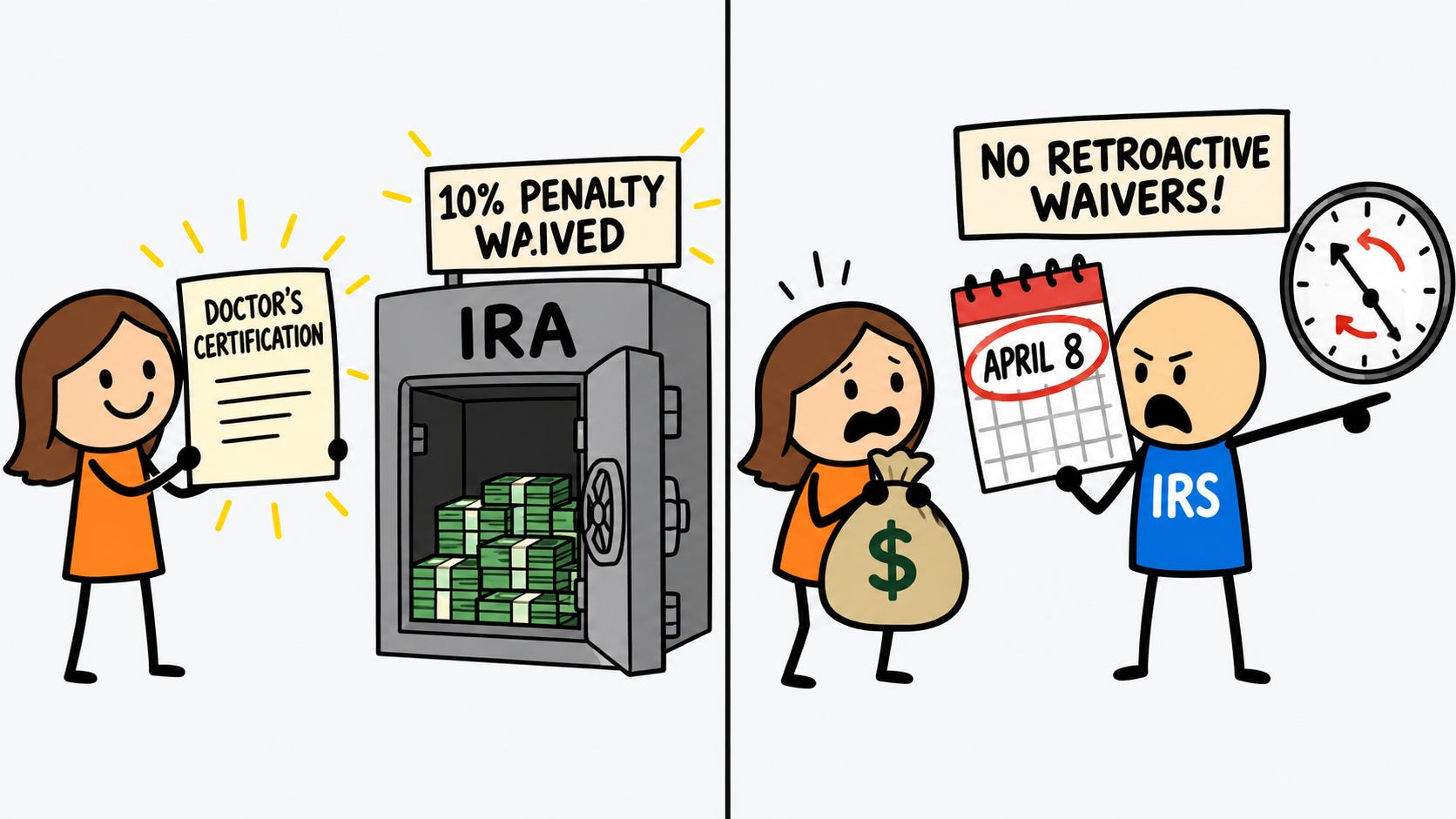
When someone receives a terminal diagnosis, retirement accounts tend to move fast. Bills arrive, plans change, and the money that was supposed to wait decades suddenly needs to be available now. Most people in that position, and the family helping them, have heard there is an exception to the 10% early withdrawal tax for terminal illness, and they assume the diagnosis itself is the ticket.
The exception is real, and it is generous. It also runs on paperwork in a specific order. The date that matters is the day a doctor signs a particular kind of statement, and a withdrawal made a week before that date can miss the exception entirely.
The exception removes the 10% additional tax on early distributions for someone who is terminally ill. For this purpose, terminally ill means a physician has certified that the person has an illness or physical condition that can reasonably be expected to result in death within 84 months, seven years, of the date of the certification. The window is far wider than most people expect, and it covers many diagnoses that nobody would describe as imminent.
The withdrawal is still income. The exception only removes the extra 10%, and the taxable portion of the distribution is taxed like any other retirement withdrawal.
The certification has to come first. A distribution qualifies only if it is made on or after the date the physician certifies the terminal illness. A certification signed after the money comes out does not reach back to cover it, and the IRS says so in as many words.
The certification also has content requirements. It has to state that the illness or condition can reasonably be expected to result in death in 84 months or less from the certification date. It has to include a narrative description of the evidence supporting that statement, the physician’s name and contact information, the date the physician examined the person or reviewed the evidence, the date the certification was signed, and the physician’s signature with an attestation that the physician wrote the narrative based on that examination or review. A physician here means a doctor of medicine or osteopathy legally authorized to practice. A physician cannot certify their own terminal illness.
The underlying medical records do not have to go to the plan or IRA custodian, but they and a copy of the certification belong in the person’s tax records in case the IRS asks.
There is no dollar cap. The exception works for IRAs, 401(k)s, 403(b)s and other qualified plans. Governmental 457(b) plans are outside it.
Workplace plans add a wrinkle. The exception only removes a tax. Getting money out of a 401(k) or 403(b) still runs on the plan’s own withdrawal rules. Someone still working for the employer needs to qualify for an in-service distribution the plan already allows, such as a hardship distribution. Plans may choose to offer terminal illness distributions directly, but they are not required to. When a plan does not, the person can take an otherwise permissible distribution and claim the exception on Form 5329 with their tax return, keeping the certification on file. IRAs have no such restriction, since IRA money can generally be withdrawn at any time.
The money can also go back. A terminal illness distribution can be repaid within three years, beginning the day after it was received, to an IRA or another eligible plan that accepts rollovers. A repayment in a later year means amending the return for the year of the withdrawal.
So the dates sort out like this. The certification date controls everything, and any distribution has to come on or after it. The tax year of the distribution determines where the income and the Form 5329 claim land. The three-year repayment window starts the day after each distribution. None of these involve the calendar-year deadlines that govern so much of retirement planning.
Helen is 58 and still working. Her traditional IRA holds only pretax money from an old 401(k) rollover, with no nondeductible contributions, so every dollar is taxable.
Her doctor signs a certification on April 8 that meets all the content requirements, stating her condition can reasonably be expected to result in death within 84 months. On April 20 she withdraws $30,000 from the IRA. The $30,000 is income for the year, and because the distribution came after the certification, there is no 10% additional tax. When she files, she claims the exception on Form 5329 and keeps the certification with her tax records.
In the other version, Helen withdraws the $30,000 on March 15, while the paperwork is still being arranged, and the certification is signed on April 8. The March withdrawal came before the certification date, so it does not qualify. Unless another exception applies, she owes the 10% additional tax, $3,000, on top of the income tax. Any later withdrawal, made on or after April 8, would qualify.
Her 401(k) at her current employer works differently. The plan does not offer terminal illness distributions, and she is still employed, so she can reach that money only through an in-service option the plan allows, such as a hardship distribution. If she qualifies for one and takes it on or after April 8, she can claim the terminal illness exception on Form 5329 for it.
The exception is broader than most people realize. Seven years is a long window, there is no cap on the amount, and the money can even be put back within three years if circumstances change. For a family dealing with a diagnosis, the 10% tax is usually avoidable.
What matters is the order of operations: the physician’s certification, with all its required pieces, has to exist before the money comes out. If any of it is repaid later, the reporting runs through an amended return, and when an IRA holds basis from nondeductible contributions, through Form 8606, which our Form 8606 guide walks through.
I write one of these every day, one retirement rule, explained in plain language and verified against the source. The daily email is free: subscribe here.
Full archive, worksheets, and search live at RetirementNewsRundown.com.
Disclaimer
This article is for educational and informational purposes only. It is not tax, legal, or financial advice and does not create an advisor-client relationship. Always consult appropriate professionals regarding your specific situation.