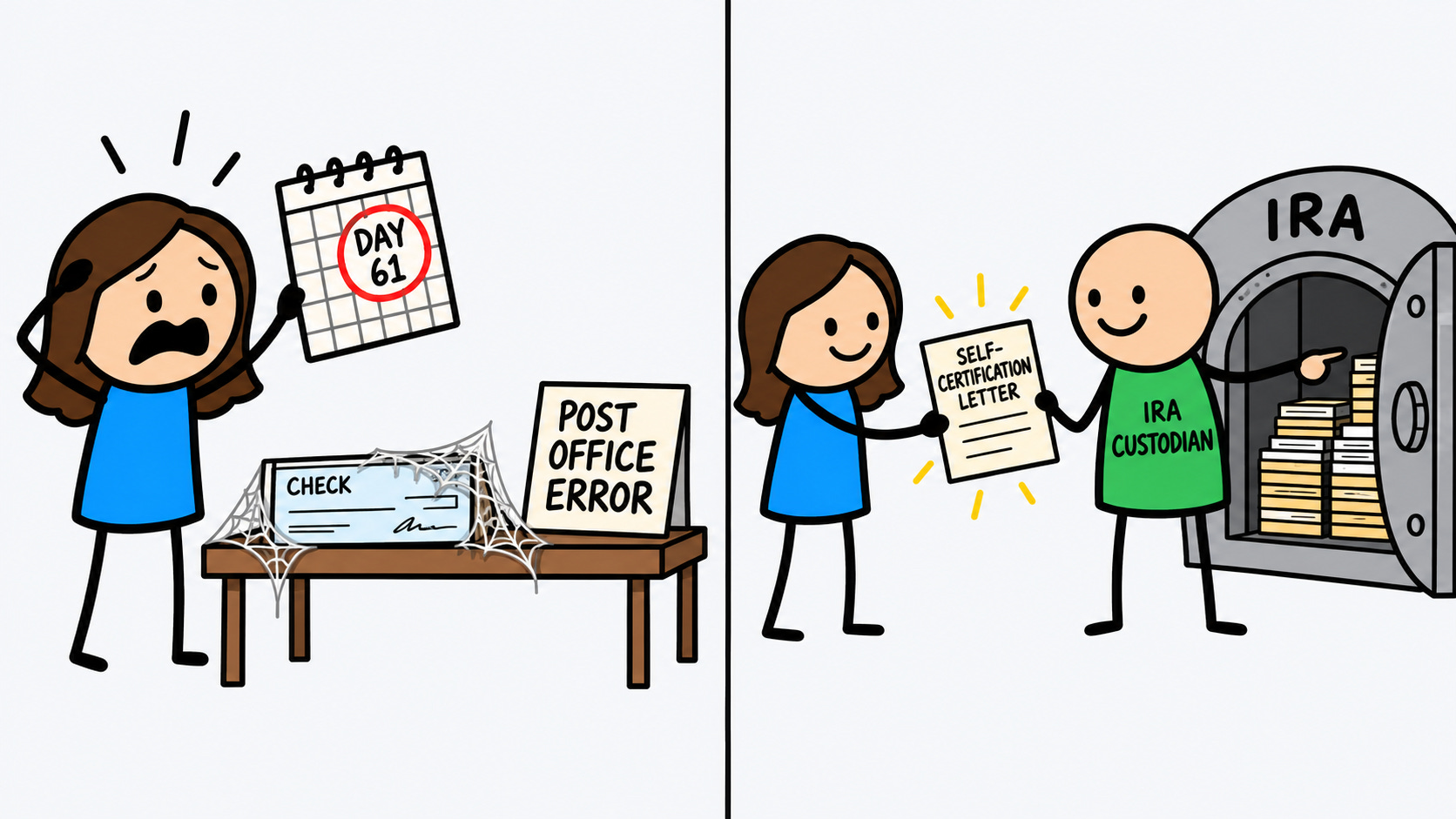
Self-Certifying a Missed 60-Day Rollover
The 60-day rollover window has a reputation as one of the most unforgiving clocks in the tax code. Day 61 arrives, the check is still sitting in a kitchen drawer, and the conventional wisdom says the distribution is now taxable income and nothing can be done about it.
The IRS built a back door for exactly this situation, and most people never hear about it. It takes one letter, no IRS fee, and no permission from anyone at the IRS in advance. It also comes with conditions, and the letter is a promise the taxpayer makes, which the IRS can check later.
The rule underneath it all is simple. A rollover has to land in the receiving IRA or plan by the 60th day after the distribution is received. Money that misses the window is a taxable distribution for the year it came out, even when the 60th day falls in the next year, and the 10% additional tax applies to the taxable portion for someone under 59.5 without an exception. If a failed rollover was deposited into an IRA, that deposit is instead subject to the ordinary IRA contribution rules and may become an excess contribution.
Pub 590-A lists three ways around the 60-day deadline.
The first is automatic. It applies when a financial institution received the money within the 60 days, the taxpayer followed all of its procedures for depositing it, the deposit failed only because of the institution’s error, the money lands within one year from the start of the 60-day period, and it would have been a valid rollover had the institution done its job.
The second is self-certification. The taxpayer writes a letter to the receiving IRA trustee or plan administrator stating that the deadline was missed for one or more reasons on the IRS’s approved list. The IRS publishes a model letter, and a substantially similar letter works too. The trustee can rely on it to accept the deposit as a rollover. There is no IRS fee, and the IRS does not have to approve anything first.
The approved reasons are specific. They include an error by the financial institution, a distribution check that was misplaced and never cashed, money deposited into an account the taxpayer mistakenly thought was an eligible retirement plan, severe damage to the taxpayer’s principal residence, a death in the family, serious illness of the taxpayer or a family member, incarceration, restrictions imposed by a foreign country, a postal error, an IRS levy whose proceeds were returned, a delay by the paying institution in providing information the receiving plan or IRA needed, and a distribution made to a state unclaimed property fund.
Two more conditions apply. The IRS cannot have already denied a waiver request for that same rollover. And the deposit has to be made as soon as practicable after the reason stops getting in the way, a requirement the IRS treats as met if the money goes in within 30 days of that point.
The third route is a private letter ruling, where the IRS itself grants the waiver after weighing the facts, including whether the money was used and how much time has passed. It comes with a hefty user fee that the IRS sets each year.
Self-certification has limits worth knowing. It is not an IRS waiver. If the return is later examined and the IRS decides the conditions were not met, the rollover can be undone after the fact, with tax, the 10% additional tax where it applies, and possible penalties. The receiving trustee is also expected to report that the deposit came in after the 60-day deadline, so the late timing shows up on paper. A trustee with actual knowledge that contradicts the letter cannot rely on it. And the IRS can waive only the 60-day requirement. Every other rollover rule still applies, including the one-rollover-per-year limit, which no waiver can fix.
So the clocks line up this way. The 60-day window runs from the day the distribution is received. Once a self-certification reason is in play, the 30-day safe harbor runs from the day that reason stops preventing the deposit. The automatic waiver for institution errors stretches to one year from the start of the 60-day period. The tax year of the distribution governs where the income lands if any of this fails.
Grace is 63, retired with no taxable compensation, and moving her traditional IRA to a new custodian. She has never made nondeductible contributions, so every dollar is pretax. She takes a $40,000 check payable to herself on March 3, which gives her until May 2 to complete the rollover.
On March 20 her mother dies, and Grace spends the next two months in another state handling the funeral and the estate. She returns home on May 20, eighteen days after her 60-day window closed, when the family circumstances that had kept her from completing the rollover are finally resolved enough for her to handle her own financial affairs again.
On June 10, three weeks after the reason stopped preventing her, she deposits the $40,000 into the new IRA along with a self-certification letter based on the model, citing the death in the family. The new custodian accepts it as a rollover and flags it as a late rollover in its reporting. Grace keeps a copy of the letter in her tax files. Unless an examination concludes she did not qualify, the $40,000 is a rollover, and none of it is income.
Had Grace waited until September to deposit the money, she would have been well outside the 30-day safe harbor, and her letter would rest on an argument that the delay was still as soon as practicable. Had the IRS rejected the rollover on audit, the $40,000 would be taxable for the year of the March distribution. Being over 59.5, she would owe no 10% additional tax, but the deposit would become a regular contribution, and with no taxable compensation, all of it would be an excess contribution subject to the excess rules.
Day 61 is less final than its reputation. For the situations people actually run into, a lost check, a bank error, a death or a hospital stay, the self-certification letter can let a late rollover be accepted and reported as valid without asking the IRS for advance approval.
What matters is having a real reason from the approved list and moving quickly once that reason passes. If an examination later rejects the self-certification, a deposit into an IRA falls under the ordinary contribution rules and can become an excess contribution, and our Excess Contribution Correction Tool walks through what that means and the deadlines for removing it.
I write one of these every day, one retirement rule, explained in plain language and verified against the source. The daily email is free: subscribe here.
Full archive, worksheets, and search live at RetirementNewsRundown.com.
Disclaimer
This article is for educational and informational purposes only. It is not tax, legal, or financial advice and does not create an advisor-client relationship. Always consult appropriate professionals regarding your specific situation.