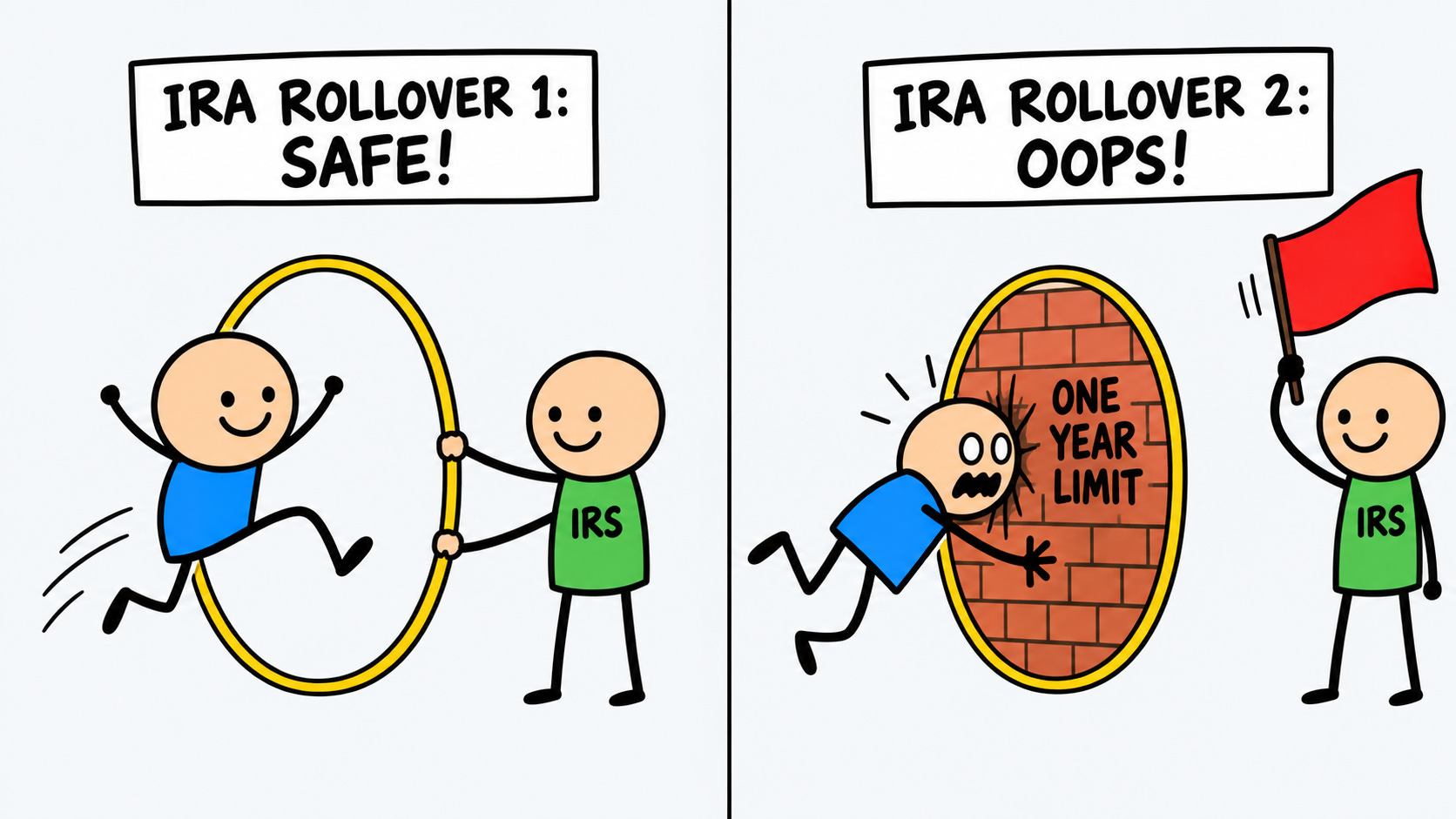
Most people who have heard of the one-rollover-per-year rule picture it as a limit per account. One rollover out of this IRA, one out of that IRA, and a fresh allowance every January. Some picture it as a limit on moving money between custodians at all, which makes them nervous about every account transfer they ever request.
The actual rule is narrower than the second picture and stricter than the first, and it is one of the few rollover rules the IRS has no power to forgive.
The rule covers one specific move: taking a distribution from an IRA, having the money paid to you, and putting it back into the same IRA or another IRA within 60 days. That is an IRA-to-IRA rollover, and a person can make only one of them in any one-year period.
The one-year period starts on the date the IRA distribution is received and runs a full year from there. The redeposit date and the calendar year play no part in it, so a December rollover stays on the books well into the following year.
The limit is per person. All of a person’s IRAs are lumped together for this purpose, traditional, Roth, SEP and SIMPLE alike, and treated as if they were one IRA. Someone with five IRAs still gets one IRA-to-IRA rollover per year across all five. Pub 590-A’s own example puts it plainly: after a rollover from one IRA into another, no other IRA distribution inside that one-year period can be rolled over, including one from a third IRA that was never involved.
Plenty of money movement falls outside the rule entirely.
A trustee-to-trustee transfer is not a rollover, so it is not limited. That includes the case where the old custodian cuts a check payable to the new custodian and hands it to the account owner to deliver. The payee on the check is what matters. A check payable to the new institution for the benefit of the owner is a transfer. A check payable to the owner personally is a distribution, and putting it back is a rollover.
A conversion from a traditional IRA to a Roth IRA is technically a rollover, but the one-year limit does not apply to it. Rollovers from employer plans into IRAs are outside it too, and someone can roll over more than one distribution from the same employer plan in a year. A recharacterization does not count as a rollover for this purpose. For a Roth IRA, rollovers coming in from retirement plans other than Roth IRAs are disregarded.
There is also a narrow exception for an IRA distribution made by the FDIC as receiver of a failed bank, when neither the bank nor the depositor started the distribution and no other institution took over the IRAs.
The penalty for a second IRA-to-IRA rollover inside the year is that it simply fails as a rollover. The distribution is taxable to the extent it would have been taxable anyway, and the 10% additional tax applies to that taxable portion if the person is under 59.5 without an exception. The money that went back in is treated as an ordinary IRA contribution. Whatever exceeds the person’s contribution room for the year, which depends on taxable compensation and the annual limit, becomes an excess contribution, drawing a 6% tax for each year it remains at year-end, capped at 6% of the person’s total IRA value.
The usual relief valve is missing here. The IRS can waive the 60-day deadline in hardship cases, and taxpayers can self-certify for some late rollovers, but the IRS states outright that it cannot waive the one-rollover-per-year rule. What remains is the excess contribution fix: withdrawing the excess and its earnings by the due date of the return, including extensions, avoids the 6% tax. Someone who filed that return on time without removing it may still have a special six-month period after the normal filing deadline to make the correction and amend the return. After the applicable correction window closes, the 6% can apply year after year until the excess comes out or later contribution room absorbs it.
So the clocks separate cleanly. The one-year period runs from the date the earlier distribution was received. The 60-day window governs each individual rollover. The tax-return deadline generally governs the excess contribution fix, with the special six-month period available after a return filed on time. The calendar year controls nothing except which year’s return reports what.
Carol is 66, retired, and has two traditional IRAs, neither holding any nondeductible contributions, so every dollar in them is pretax. She has no taxable compensation, so she has no room for a regular IRA contribution.
On February 10 she takes $20,000 out of IRA-1 to cover a short-term need and puts it back into IRA-1 on March 25. That is a valid rollover, completed inside 60 days.
In October she decides to move IRA-2 to a different custodian. She asks for a check payable to herself, receives $30,000 on October 6, and deposits it into a new IRA at the new custodian on October 20.
The October rollover falls within one year of the February 10 distribution, so it fails. The $30,000 is fully taxable on her return. Because she is over 59.5, there is no 10% additional tax. The October deposit is a $30,000 excess contribution. If she withdraws it with its earnings by her return’s due date, including extensions, she avoids the 6% tax. If she filed on time without removing it, she may still have the special six-month correction period. If the excess remains after the applicable window and her IRAs hold at least that much at year-end, the tax is $1,800 for the year, repeating while the excess remains.
Had Carol asked for a trustee-to-trustee transfer, or a check made payable to the new custodian for her benefit, the move would have been a transfer and none of this would have happened. Had she waited, her next IRA-to-IRA rollover would have been available a year after February 10, with January 1 bringing no reset.
The rule sounds more threatening than it is. Most account moves are trustee-to-trustee transfers, and those never touch the limit. Employer plan rollovers and conversions are outside it too. The rule only bites when an IRA owner takes the money personally, twice, inside a year.
What matters is how the money moves and who the check is payable to. When the second rollover has already happened and the deposit is sitting in the new IRA, our Excess Contribution Correction Tool walks through removing the excess and the deadline that decides whether the 6% tax applies.
I write one of these every day, one retirement rule, explained in plain language and verified against the source. The daily email is free: subscribe here.
Full archive, worksheets, and search live at RetirementNewsRundown.com.
Disclaimer
This article is for educational and informational purposes only. It is not tax, legal, or financial advice and does not create an advisor-client relationship. Always consult appropriate professionals regarding your specific situation.