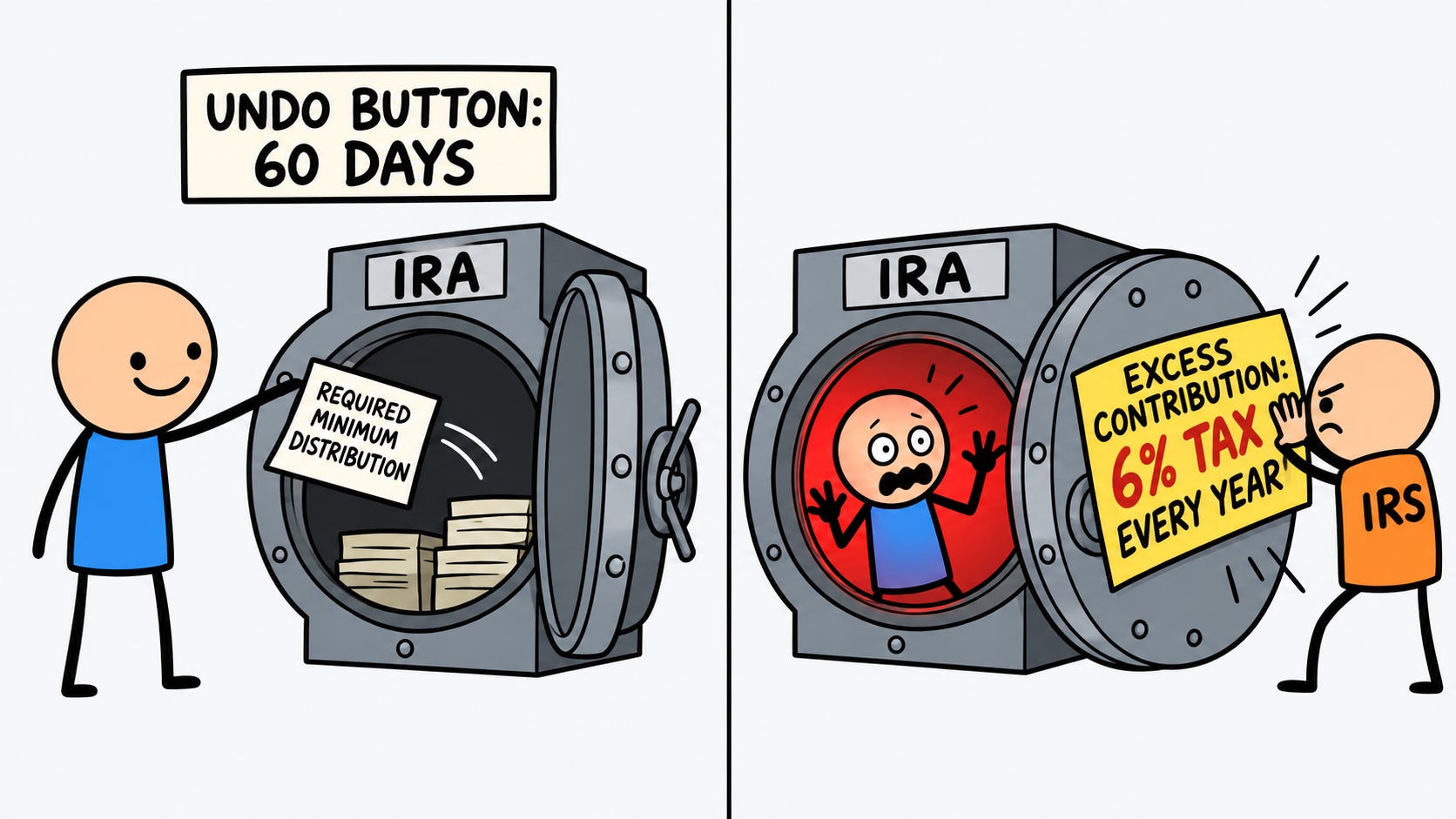
Rollovers have a reputation as the universal undo button of retirement money. Take it out, put it back within 60 days, and the tax system acts as if nothing happened. Custodians accept rollover deposits every day without asking many questions, which only strengthens the impression that any money leaving a retirement account can find its way back in.
The tax rules carve out a list of distributions that are never eligible for rollover treatment, no matter how fast the check gets redeposited. A deposit of one of them looks like a rollover on the statement and gets treated by the tax code as something else entirely.
From an employer plan such as a 401(k), 403(b) or governmental 457(b), most distributions can be rolled over. The exceptions are specific. A required minimum distribution cannot be rolled over. Neither can a hardship distribution. A payment that is part of a series of substantially equal periodic payments, made at least once a year over a lifetime, a joint life expectancy, or a period of ten years or more, is excluded too. So are corrective distributions of excess contributions or excess deferrals and their earnings, a plan loan that is treated as a distribution because it broke the loan rules, dividends on employer securities, and the cost of life insurance coverage. A life insurance contract itself cannot go from a qualified plan into an IRA either.
The loan item has a twist worth separating out. A loan that defaults and becomes a deemed distribution cannot be rolled over. A plan loan offset, where the account balance is reduced to repay the loan, can be. A qualified plan loan offset, which happens when a loan in good standing is offset because the plan terminates or the employee leaves the job, gets until the tax return due date, including extensions, to be rolled over. Other offsets get the usual 60 days.
IRAs have their own list. Amounts that must be distributed as a required minimum distribution for the year are not eligible for rollover. An inherited IRA from anyone other than a spouse cannot take a rollover in or out at all. Money can only move between inherited IRAs by trustee-to-trustee transfer, set up in the deceased owner’s name for the beneficiary. A Roth IRA can roll only into another Roth IRA, never into a traditional IRA or an employer plan. A SIMPLE IRA generally can roll only into another SIMPLE IRA during the first two years of participation, with a special exception when an employer ends a SIMPLE and replaces it with a qualifying plan. And the one-rollover-per-year limit means a second IRA-to-IRA rollover inside the same 12-month stretch does not qualify, a rule with enough quirks to deserve its own article.
Even an eligible rollover has limits on what goes back in. Property distributed from an IRA generally has to be rolled over as that same property. Property distributed from an employer plan can be sold and the proceeds rolled over, but the recipient cannot keep the property and substitute other cash for it. When money moves from a traditional IRA into an employer plan, only the part that would otherwise be taxable can go, so basis from nondeductible contributions stays behind in the IRA world.
The consequence of redepositing an ineligible amount is the part that bites. The original distribution is taxed as if it had never been rolled over: income on the taxable portion, and the 10% additional tax on that portion if the person is under 59.5 and has no exception. The money that went back into the IRA is treated as an ordinary IRA contribution, and whatever exceeds the person’s available contribution room, which depends on taxable compensation and the annual limit, becomes an excess contribution. An excess draws a 6% tax for each year it remains in the IRA at year-end, capped at 6% of the combined value of the person’s IRAs.
There is a correction window. Withdrawing the excess along with any earnings on it by the due date of that year’s tax return, including extensions, avoids the 6% tax. The withdrawn excess itself is not income again, though the earnings are. Miss that date, and the 6% tax can apply for that year and later years while an excess remains. A later withdrawal ends it, and unused contribution room in a later year can absorb some or all of it. The tax-filing deadline governs the fix, the 60-day window is irrelevant, and the calendar year matters only for where each year’s 6% lands.
Hank is 75 and takes his required minimum distribution of $18,000 from his traditional IRA in March. He has never made nondeductible contributions, so the whole amount is taxable, and he has no taxable compensation, so he has no room for a regular IRA contribution that year. By September he decides he did not need the money after all and deposits the $18,000 back into the IRA, assuming the deposit counts as a rollover.
A required minimum distribution is never eligible, so the deposit fails as a rollover no matter its timing. The $18,000 stays fully taxable on his return for the year, and the September deposit is an $18,000 excess contribution.
If Hank or his tax preparer spots it while preparing his return, he can withdraw the $18,000 plus whatever it earned before the return’s due date, including extensions. He avoids the 6% tax, the earnings are taxable, and the RMD stays satisfied because it was taken in March.
If nobody notices, the $18,000 sits in the IRA as an excess. His IRA holds far more than that at year-end, so the 6% tax for that year is $1,080, and it can repeat in later years for as long as the excess remains. As long as Hank has no taxable compensation, he has no contribution room to absorb it, so in practice it stays until he takes it out.
His neighbor Rosa inherited an IRA from her brother. She asks for a check to move it to a different custodian, planning to redeposit it into a new inherited IRA. Because she is not a surviving spouse, the redeposit is not allowed. The check is a distribution from the inherited IRA, taxable to the extent it represents pretax money, and the only way she could have moved the account was a direct trustee-to-trustee transfer.
An ineligible deposit is usually fixable. The excess contribution can be pulled back out, and if that happens by the return’s due date, the 6% tax never applies. What cannot be reversed is the tax on the original distribution, because that distribution was never rollover-eligible in the first place.
The question worth asking before any money leaves an account is whether that kind of distribution is eligible at all. When the answer comes too late and the deposit has already landed, our Excess Contribution Correction Tool walks through removing the excess and the deadline that decides whether the 6% tax applies.
I write one of these every day, one retirement rule, explained in plain language and verified against the source. The daily email is free: subscribe here.
Full archive, worksheets, and search live at RetirementNewsRundown.com.
Disclaimer
This article is for educational and informational purposes only. It is not tax, legal, or financial advice and does not create an advisor-client relationship. Always consult appropriate professionals regarding your specific situation.