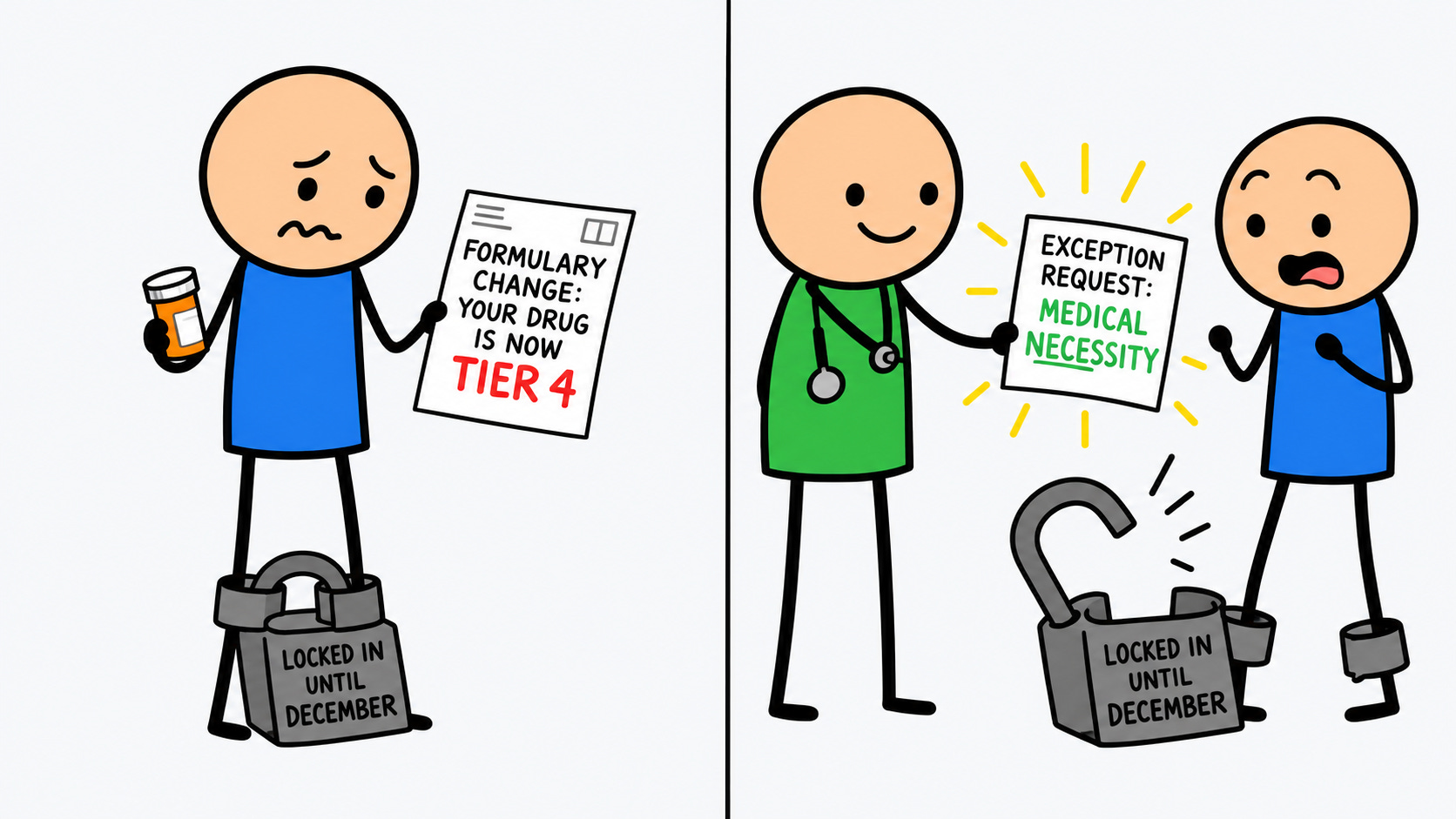
A Medicare drug plan arrives with a list of covered drugs, called a formulary, and most people treat it like a contract signed in January. The plan picked it, the member picked the plan, and the list is supposed to hold until the next Open Enrollment rolls around. That belief survives right up until a letter shows up in June saying a prescription is moving.
Medicare lets drug plans change their formularies during the year. The member, meanwhile, is generally locked into the plan until the next enrollment window. That combination produces the most annoying letter in Medicare, and it helps to know what the letter can and cannot do before it arrives.
Medicare’s own handbook says plans can change their formularies at any time, following guidelines Medicare sets. Drug therapies change, new drugs come out, and new medical information turns up. What the handbook summary leaves out is that the rules treat changes very differently depending on what they do to someone already taking the drug.
The changes that hurt are called negative formulary changes: removing a drug, moving it to a higher cost-sharing tier, or adding or tightening prior authorization, step therapy or quantity limits. Medicare’s rules sort those into categories. Maintenance changes, a defined list that includes changing a drug within 90 days of adding a corresponding drug such as a generic, can take effect during the year after CMS review. Certain qualifying swaps of a brand for a newly available generic can happen faster under their own rules. Everything else is a non-maintenance change, and for those, members already taking the drug are exempt for the rest of the plan year. The new terms reach them in January, if at all.
When a mid-year negative change does apply to someone already taking the drug, the plan generally has to give written notice at least 30 days before it takes effect, or, when the member asks for a refill, provide an approved month’s supply under the old terms along with notice of the change. That letter is the trigger for everything that follows, so it pays to read it the week it arrives.
Cost can move without the drug ever leaving the list. A member’s coinsurance can rise when the manufacturer raises its price. A copay or coinsurance can also go up when the plan starts offering a generic version of a brand-name drug, or a biosimilar version of a biological product, and the member keeps taking the original. The drug is still covered. It just costs more to stay loyal to the brand.
Plans also attach rules to particular drugs. Prior authorization means the prescriber has to get the plan’s approval first. Quantity limits cap how much can be filled at once. Step therapy means trying one or more lower-cost drugs before the plan covers the one prescribed.
The tool for pushing back is the exception. A member or the prescriber can ask the plan to cover a drug that is off its list, to waive a coverage rule like prior authorization, or to charge less for a higher-tier drug when the preferred drugs for the same condition would not work as well or would cause adverse effects. The prescriber has to supply a statement explaining the medical reason. A request can be standard or expedited, and it is expedited when waiting could put the member’s life or health at risk. The plan’s answer is a formal decision called a coverage determination, and a denial can be appealed.
What the member usually cannot do mid-year is leave. Outside the enrollment windows, people generally stay in their drug plan for the full year, so a formulary change usually means keeping the plan until the next window. The next routine chance to change plans is Open Enrollment, October 15 through December 7, with the new plan starting January 1. People in a Medicare Advantage plan also have a January to March window to make one change, and people with Medicaid or Extra Help may be able to change drug coverage once a month.
New members get one extra cushion. During the first 90 days of coverage under a new plan, the plan generally must provide a temporary transition supply, at least an approved month’s worth, of an eligible drug the member was already taking if it is off the new formulary or subject to restrictions like prior authorization or step therapy. That cushion belongs to new coverage, so for a mid-year change in an established plan, the exemption, the notice and the exception process are the tools to know.
So the calendar sorts out like this. Formulary changes can arrive any month. The exception request can go in whenever the letter arrives, and the faster version exists for urgent cases. Switching plans runs on the enrollment calendar, with Open Enrollment changes taking effect January 1. None of this is a tax deadline, and none of it has a correction window.
George takes a brand-name cholesterol drug through his stand-alone Medicare drug plan. In June, the plan adds a generic version and sends him a letter: if he stays on the brand, his copay goes up. Because the change rides on a newly added generic, it falls in the category Medicare lets a plan apply to current users mid-year, so the rest-of-year exemption does not shield him.
George has two paths that do not involve changing plans. His doctor can switch him to the generic, which avoids the higher brand copay. Or, if the doctor believes the preferred alternatives would not work as well for him or would cause adverse effects, George can request a tiering exception, with the doctor’s statement explaining why. George’s doctor submits it on June 20. If the plan approves it, George pays the lower cost-sharing level the exception allows under that plan. Medicare’s rules let a plan refuse to give a brand-name drug the cost sharing of a tier reserved only for generics, so an approval may still leave the brand costing more than the generic. If the plan denies the exception, George can appeal, and he still has the generic as an option.
What George cannot do in June is move to a plan with a friendlier list. He keeps his plan through December. In early November, during Open Enrollment, he compares plans using his actual prescriptions and joins one where his drug sits on a lower tier. The new plan starts January 1.
Had the letter arrived in late October instead, the timing would have worked in his favor: the change and the enrollment window would have overlapped, and a switch by December 7 would have taken effect January 1.
Mid-year changes are built into the program from the start, and so are the protections around them: the rest-of-year exemption for many changes, the notice, and the exception. A letter about a drug starts a process, and the member and prescriber have real moves inside it.
What matters is reading the letter when it arrives and knowing which tool fits. The exception handles the drug, and Open Enrollment handles the plan. For anyone weighing how drug coverage fits with the rest of their Medicare, including a supplemental policy, our Medigap guide covers how a separate drug plan sits next to Medigap and Original Medicare.
I write one of these every day, one retirement rule, explained in plain language and verified against the source. The daily email is free: subscribe here.
Full archive, worksheets, and search live at RetirementNewsRundown.com.
Disclaimer
This article is for educational and informational purposes only. It is not tax, legal, or financial advice and does not create an advisor-client relationship. Always consult appropriate professionals regarding your specific situation.