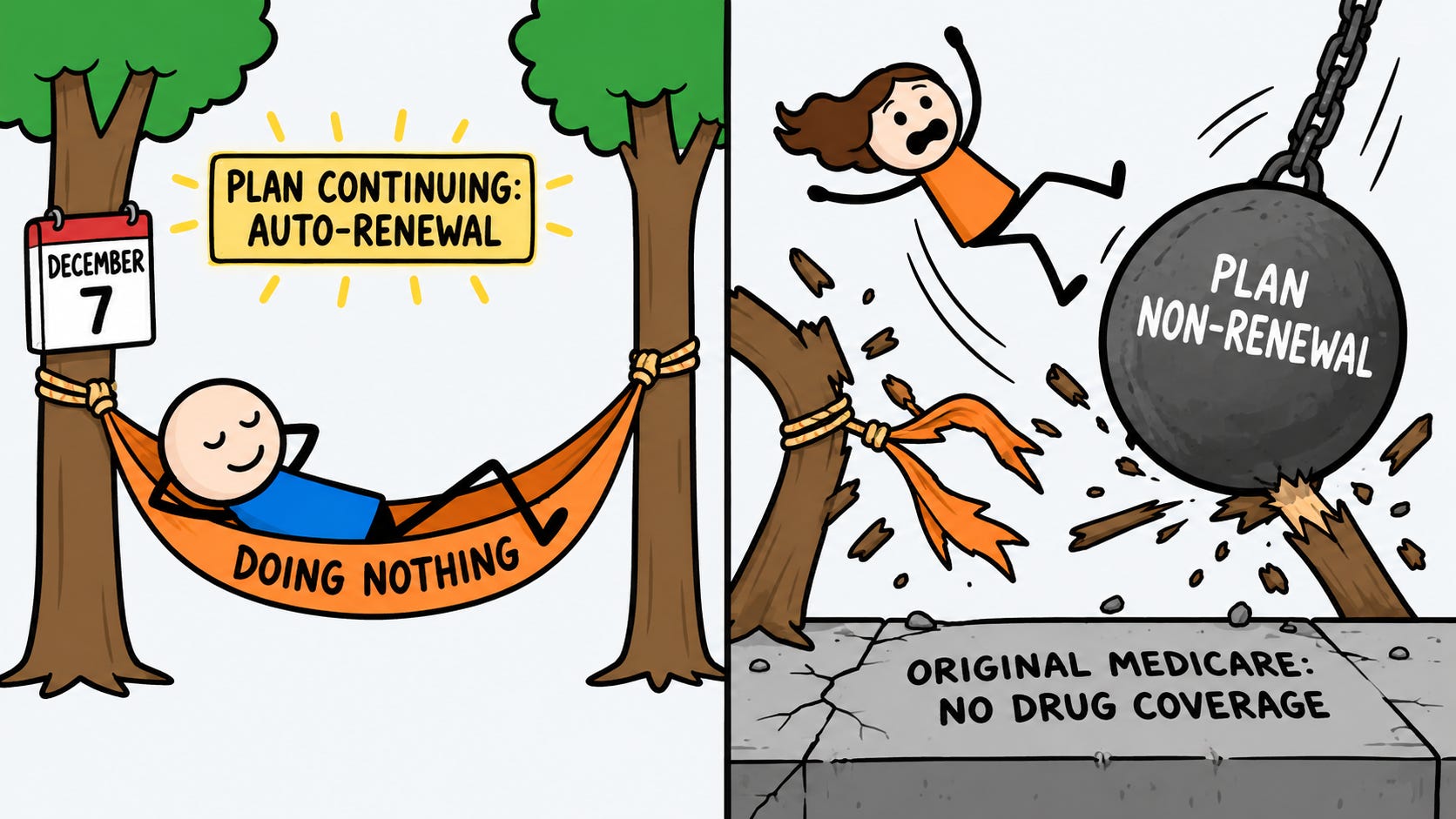
Medicare Open Enrollment runs from October 15 through December 7, and it comes with a built-in default for anyone who would rather spend those weeks raking leaves. Most people take the default. They skip the brochures, ignore the comparison tool, and let December 7 go by without a phone call to anyone.
For most of them, that works out fine, which is exactly why the default deserves a closer look. Doing nothing has two very different outcomes depending on one fact most people never check: whether their plan is coming back next year.
When a plan continues into the new year, doing nothing renews it. The member stays enrolled, nothing needs to be signed, and on January 1 the plan runs under whatever new premium, cost sharing, drug list and network it announced in its Annual Notice of Change. The renewal is automatic. The terms are new. Someone using Medicare’s prescription payment plan, the option that spreads drug costs across the year, also stays in it automatically by staying in the same drug plan.
The same default applies to people who have no plan at all. Someone in Original Medicare without a separate drug plan who does nothing in this window simply stays in Original Medicare without one. Open Enrollment never adds coverage on its own.
The second outcome is the one that surprises people. Medicare Advantage plans and drug plans can decide to stop participating in Medicare for the coming year. When that happens, coverage under the plan ends after December 31, and the plan sends a letter explaining the member’s options. Doing nothing does not renew a plan that no longer exists.
The member of a departing plan has several routes. They can choose another plan during Open Enrollment, with coverage starting January 1. Federal rules also give members of a nonrenewing plan a special enrollment period from December 8 through the last day of February to choose replacement Medicare Advantage or drug coverage, as applicable, so their options run past December 7. A request made in December takes effect January 1, one made in January takes effect February 1, and one made in February takes effect March 1. Depending on their situation and their state, they may also have rights to buy certain Medigap policies for a limited time after the plan coverage ends.
Without any action, Part A and Part B keep running, because Medicare itself provides those. A Medicare Advantage member whose plan leaves lands in Original Medicare on January 1, with no drug coverage and no supplemental policy unless they arranged one. A member of a departing drug plan keeps Original Medicare and loses the drug coverage. A stretch without drug coverage can carry its own long-term cost under the late enrollment rules, which are their own subject.
So the deadlines sort into a short list. Open Enrollment closes December 7, and changes made by then take effect January 1. A departing plan’s coverage ends December 31. The nonrenewal special enrollment period runs from December 8 through the last day of February. People already in a Medicare Advantage plan on January 1 also have the January to March window to make one change. None of these are tax deadlines, and none of them are correction windows in the IRS sense. They are enrollment periods, and missing one usually means waiting for the next opening.
Earl and Marion live on the same street and both have Medicare Advantage plans with drug coverage. Both let Open Enrollment pass without doing anything.
Earl’s plan is continuing. On January 1 he is still enrolled, his premium is a little higher, and his copays are whatever the plan’s Annual Notice of Change said they would be. He never signed anything, and nothing lapsed.
Marion’s plan is leaving Medicare. Her letter arrived in October, and it went into the same pile as the brochures. On January 1 her plan coverage ends. She still has Part A and Part B, so she is in Original Medicare, but she has no drug coverage and no Medigap policy. Her first January prescription costs the full price at the counter, and her first doctor visit runs on Original Medicare’s cost sharing.
Because her plan left Medicare, her options run past December 7. Marion still has the nonrenewal special enrollment period, which runs through the last day of February. She joins a new Medicare Advantage plan with drug coverage on January 20. Because the plan gets her request in January, the new coverage starts February 1, leaving her January on Original Medicare alone.
Had Marion opened the letter in October, she could have joined a new plan by December 7 and started January 1 with no gap at all. Had she waited past the last day of February, the special enrollment period would have expired, and her next routine chance to join a plan would be the following Open Enrollment.
For someone whose plan is continuing, doing nothing is an ordinary choice with one catch: next year’s terms arrive along with it. The plan keeps running, and the member keeps the coverage.
What actually matters is the one letter that says the plan is leaving. That letter changes the default from renewal to Original Medicare on January 1, and it starts its own set of clocks. When a plan departure is in the picture, the Medigap rights that can come with it are laid out in our Medigap guide, alongside how a supplemental policy fits next to Original Medicare and a drug plan.
I write one of these every day, one retirement rule, explained in plain language and verified against the source. The daily email is free: subscribe here.
Full archive, worksheets, and search live at RetirementNewsRundown.com.
Disclaimer
This article is for educational and informational purposes only. It is not tax, legal, or financial advice and does not create an advisor-client relationship. Always consult appropriate professionals regarding your specific situation.