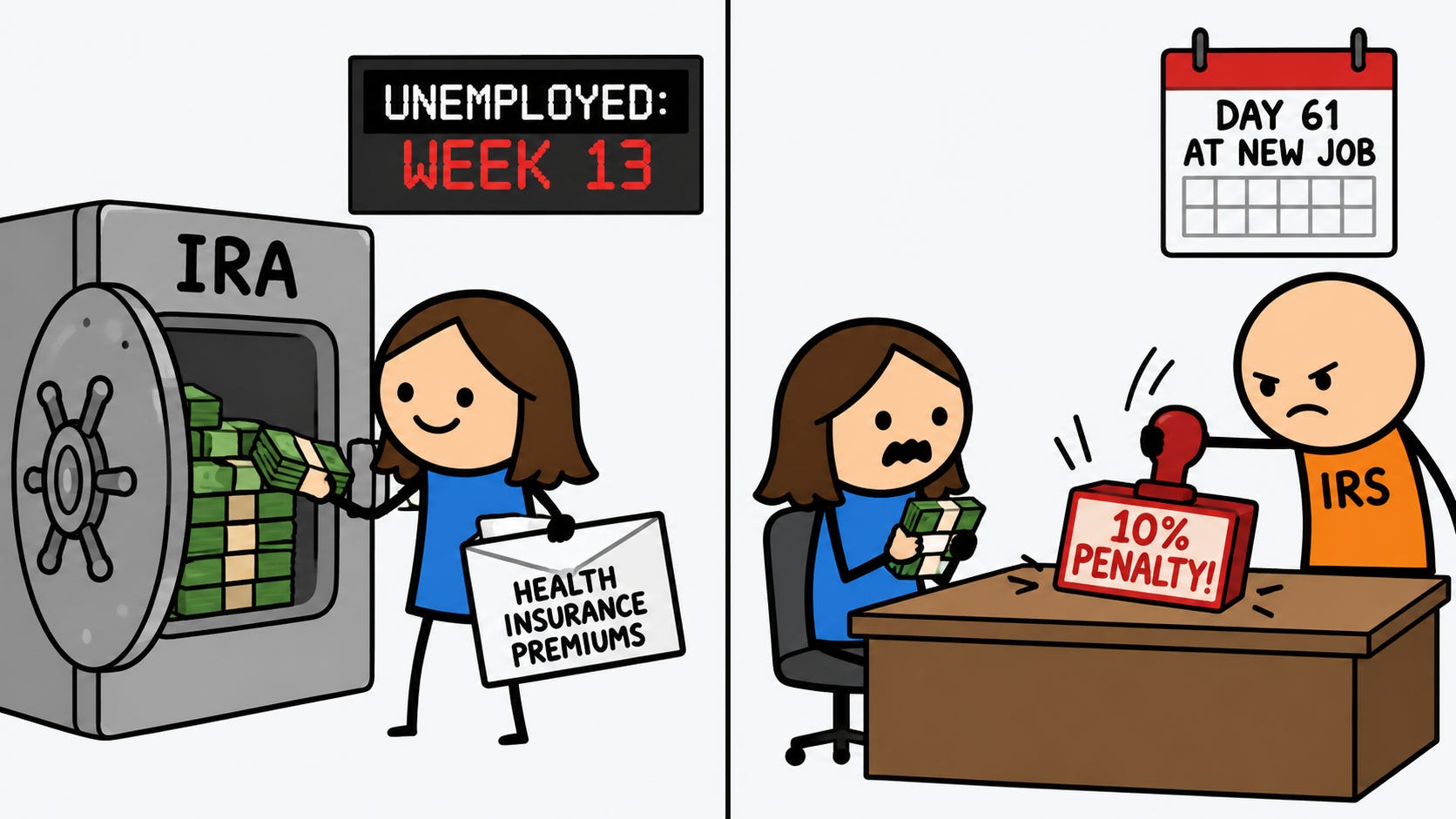
The job ends on a Friday. The coverage ends with it, or in a few weeks, and the replacement costs more than anything you have ever paid for insurance. Meanwhile the largest pile of money you own is sitting in an IRA you cannot touch before 59.5 without the 10% additional tax on top of the ordinary income tax.
There is an exception written for exactly this situation, and almost nobody uses it, partly because it sits in a long list of others and partly because of what happens on the custodian’s end. Call and ask for the money and you will get it. The form that arrives in January will still code it as an early distribution with no known exception, and that coding holds whether or not anyone there knows you lost a job or bought insurance. The exception exists only if you claim it yourself on your return, and the form that triggers the penalty is the same form where you knock it back out.
The exception covers distributions up to the amount you paid during the year for medical insurance for yourself, your spouse, and your dependents. That is the ceiling, it moves with the premiums you actually paid, and it resets every January. The premiums and the distribution have to land in the same year to match. Pay $9,000 in premiums across a year and up to $9,000 of IRA distributions taken that same year escape the 10%. Pull $14,000 against that $9,000 and the extra $5,000 has no cover.
Four conditions have to hold, all of them. You lost your job. You received unemployment compensation under a federal or state law for 12 consecutive weeks because you lost that job. You take the distributions during the year you received that unemployment compensation or during the following year. And you take them no later than 60 days after you have been reemployed.
Each one of those fails in its own way. The 12 consecutive weeks is a gate, so eleven weeks opens nothing, and neither do scattered weeks adding to twelve. The year window shuts at the end of the year after the unemployment year, so premiums you are still paying two years later have nothing left to draw against.
The fourth condition is the one that catches people, because it has nothing to do with insurance or unemployment and everything to do with good news. Sixty days after you start working again, the door closes. It closes whether or not you are still inside the year window. It closes whether or not you are still paying the premium, which many people are, because new coverage often starts the first of the following month or later and the old premium keeps coming due in the meantime. Someone who takes the distribution during that gap is covered. Someone who gets busy with the new job and handles it in the spring pays the 10%.
What the exception does is narrow. It waives the 10%, and the 10% only ever applied to the part of the distribution that counts as income in the first place. The taxable portion of a traditional IRA distribution still goes into income for the year, and it still lands in adjusted gross income, where it can reach the cost of marketplace coverage, the taxable share of any Social Security in the household, and anything else keyed to income. Pulling $9,000 to cover premiums during a year with little other income is usually a mild tax event. Pulling it in a year with severance in it can be a different story.
This one belongs to IRAs, and the entry on the penalty form says so in its own name: IRA distributions made to certain unemployed individuals for health insurance premiums. The same layoff and the same premiums draw the 10% if the money comes out of a 401(k) or another workplace plan instead. On a Roth IRA the exception appears in the list that applies to distributions which are not qualified, against the taxable part.
The ordinary route through all of this runs on having received unemployment compensation for those 12 consecutive weeks. There is also a separate provision for self-employed people who would have qualified for unemployment compensation except for being self-employed. It carries its own requirements, so someone self-employed should assume nothing either way.
Teresa is 54 and gets laid off on March 6. Her state unemployment starts paying on March 22 and runs weekly into August, well past twelve straight weeks. Her continuation coverage runs $1,180 a month, and she pays it from April through October, which comes to $8,260.
In late October she takes $8,260 from her traditional IRA. Every condition holds. She lost the job, the benefits ran twelve consecutive weeks and then some, the distribution falls in the same year as the unemployment compensation, and she has not been reemployed. The 10% does not apply to any of it. The $8,260 still goes on her return as income, which in a year with three months of wages and some unemployment is a modest bill.
Then the good news. She starts a new job on November 17. The new employer’s coverage begins January 1, so she keeps paying $1,180 for November and December, another $2,360 out of pocket.
Her 60-day window ran to January 16, and that is where two separate limits cross. Taking the $2,360 from the IRA by December 31 would have been clean, because the premiums and the distribution would have fallen in the same year. Once January arrived the ceiling reset. Her new coverage starts January 1 and the employer carries it, so there are no qualifying premiums in the new year for a new-year distribution to match, and the November and December premiums belong to a year that has closed. She takes the $2,360 in late February. The 10% applies to all of it, $236. The 60-day clock was still running for the first half of January, which turned out to be the wrong clock to be watching.
This exception is worth knowing because it covers an expense people are already paying out of accounts they are already raiding. The money usually comes out of the IRA anyway, during the worst possible year to be paying a penalty on it. The difference between paying the 10% and not paying it is whether anyone told you the four conditions while the window was open.
Three things are worth writing down somewhere. The 12 consecutive weeks has to actually happen, so it is worth knowing whether your benefits ran that long before planning around any of this. The 60 days runs from reemployment, which means the clock starts on the best day of the whole stretch, when nobody is thinking about tax forms. And the premium ceiling resets with the calendar, so December 31 can end the match even while the 60-day clock is still running. If you are paying premiums into the gap before new coverage starts, that gap is when to move the money.
Because the custodian codes the distribution as an early one regardless, the exception stands or falls on what you file. The guide to Form 5329 walks through how an exception gets claimed against the 10% and what has to be attached. The broader picture of taking money out of a traditional IRA before and after 59.5 sits in the traditional IRA guide.
I write one of these every day, one retirement rule, explained in plain language and verified against the source. The daily email is free: subscribe here.
Full archive, worksheets, and search live at RetirementNewsRundown.com.
Disclaimer
This article is for educational and informational purposes only. It is not tax, legal, or financial advice and does not create an advisor-client relationship. Always consult appropriate professionals regarding your specific situation.