Every other way out of the 10% early distribution tax asks what happened to you. A disability, medical bills past a threshold, a first house, unemployment and the insurance premiums that came with it. You qualify because of a circumstance, you document the circumstance, and the exception attaches to that one distribution.
One path works on completely different terms. It asks nothing about your life. It asks you to commit to a schedule and keep it, and in exchange it lets you draw from an IRA at any age without the 10%. Your custodian will set it up in an afternoon and start sending the money. Nothing in that setup tells you how long you just agreed to keep going, and that gap is where the damage happens.
The arrangement is a series of substantially equal payments, calculated over your life expectancy or over the joint life expectancies of you and your beneficiary. The IRS publishes three accepted ways to compute the annual amount: a required minimum distribution method, a fixed amortization method, and a fixed annuitization method. The last two are involved enough that the publication itself suggests getting professional help with them.
The first one carries a naming problem worth flagging. Used for this purpose, the required minimum distribution method produces the exact amount you have to take each year, with no room above it. The word minimum is doing something different here than it does everywhere else in retirement rules, and treating it as a floor is one way people break a series without realizing they have.
Now the part that costs money. The series has to continue until whichever of two dates falls later: the fifth anniversary of your first distribution, or the day you reach 59.5. Start a series at 48 and 59.5 is the finish line, since it sits well past the fifth anniversary. Start one at 57 and the fifth anniversary governs instead, which puts the finish line two and a half years beyond 59.5. People who start in their late fifties are the ones who get hurt, because 59.5 arrives, feels like the end of something, and leaves years still on the clock.
Change the annual amount before that finish line and a recapture tax arrives. It is assessed in the year you made the change, and it is the 10% that would have applied to the taxable part of the earlier distributions had the exception never covered them, plus interest for the years it went unpaid. What gets recaptured is the whole run of earlier payments, which is the detail that turns a small cash need into a four-figure bill.
It does have a ceiling. The recapture does not touch amounts distributed after you reached 59.5. So someone who breaks a series at 61 pays on the payments taken before 59.5 and keeps the rest clean. Death and disability end a series without any recapture at all.
Two things that look like breaking the series are specifically not treated as modifications. Running the account completely out of assets is one, which is a real relief valve for a small account that simply ran dry on schedule. The other is a single switch to the required minimum distribution method from either of the other two, available at any time, and permanent once you make it. That switch exists for the person whose fixed amortization payment has outgrown the account, which is a different problem from needing extra money once. It lowers the scheduled amount. It does not license taking more than the schedule calls for.
What breaks a series is changing the money, in either direction. Taking extra does it. So does adding to the account or rolling other money into it. Certain transfers between employer plans are carved out when specific conditions are met, which is one of several places where this exception behaves differently inside a workplace plan than it does in an IRA. The reporting lands on the penalty form, on its own line, with an explanation attached.
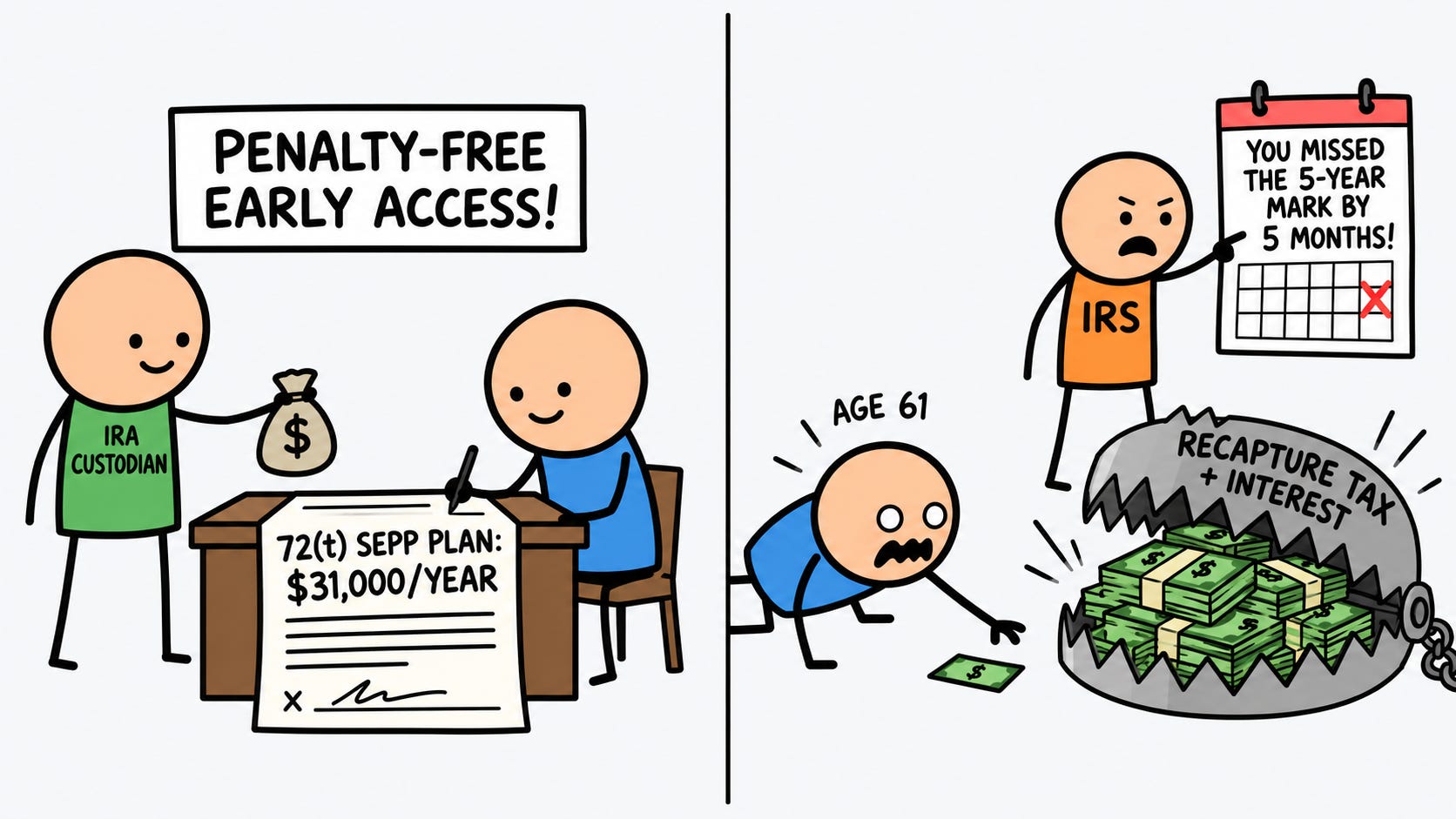
Paul turns 57 in November and retires earlier than he planned. He sets up a series from a traditional IRA holding nothing but pretax money, using the fixed amortization method, and the first payment lands on March 14 the following spring. The arithmetic gives him $31,000 a year.
He takes that March 14 payment at 57, again at 58, and again at 59. In May of that third year he turns 59.5, and the calendar in his head says the obligation is done. He keeps taking the payments because he needs them, collecting the fourth at 60 and the fifth at 61.
That October the roof fails. He calls the custodian and takes $20,000 beyond the scheduled amount.
The real finish line was the following March 14, the fifth anniversary of the first payment. He missed it by about five months. The recapture is assessed for the year he took the extra money, and it reaches the three payments he received before turning 59.5, $93,000 in all. The 10% on that is $9,300, and interest runs on top of it for the years between. The payments he took at 60 and 61 are untouched, because those came after 59.5. He reports the recapture on the penalty form with an explanation attached.
Five months of waiting would have made the recapture zero. The one-time switch would have done nothing for him, because it resizes the scheduled payment and still requires him to take exactly that amount.
The thing to carry out of this is that the finish line is computable on the first day. It is a date, and you can write it down the same afternoon the paperwork gets signed: the fifth anniversary of the first payment, or the day you turn 59.5, whichever falls later. Almost everyone who gets caught here could have told you the rule and still had the wrong date in mind, because the rule has two halves and one of them is the half that actually governs for anyone who starts after about 54.5.
The second thing is that pressure on a series has an approved outlet. A payment that has become unaffordable has the one-time switch available, and an account that genuinely empties out is not a violation. The failures are the ones where somebody needed money, called the custodian, and got it without anyone mentioning the date. Custodians process the request you make. The recapture shows up on your return.
If you are mapping where 59.5 and the other age thresholds actually bite, the rundown of retirement rules by age lays them out in order. The broader mechanics of drawing from a traditional IRA before and after those ages sit in the traditional IRA guide.
I write one of these every day, one retirement rule, explained in plain language and verified against the source. The daily email is free: subscribe here.
Full archive, worksheets, and search live at RetirementNewsRundown.com.
Disclaimer
This article is for educational and informational purposes only. It is not tax, legal, or financial advice and does not create an advisor-client relationship. Always consult appropriate professionals regarding your specific situation.