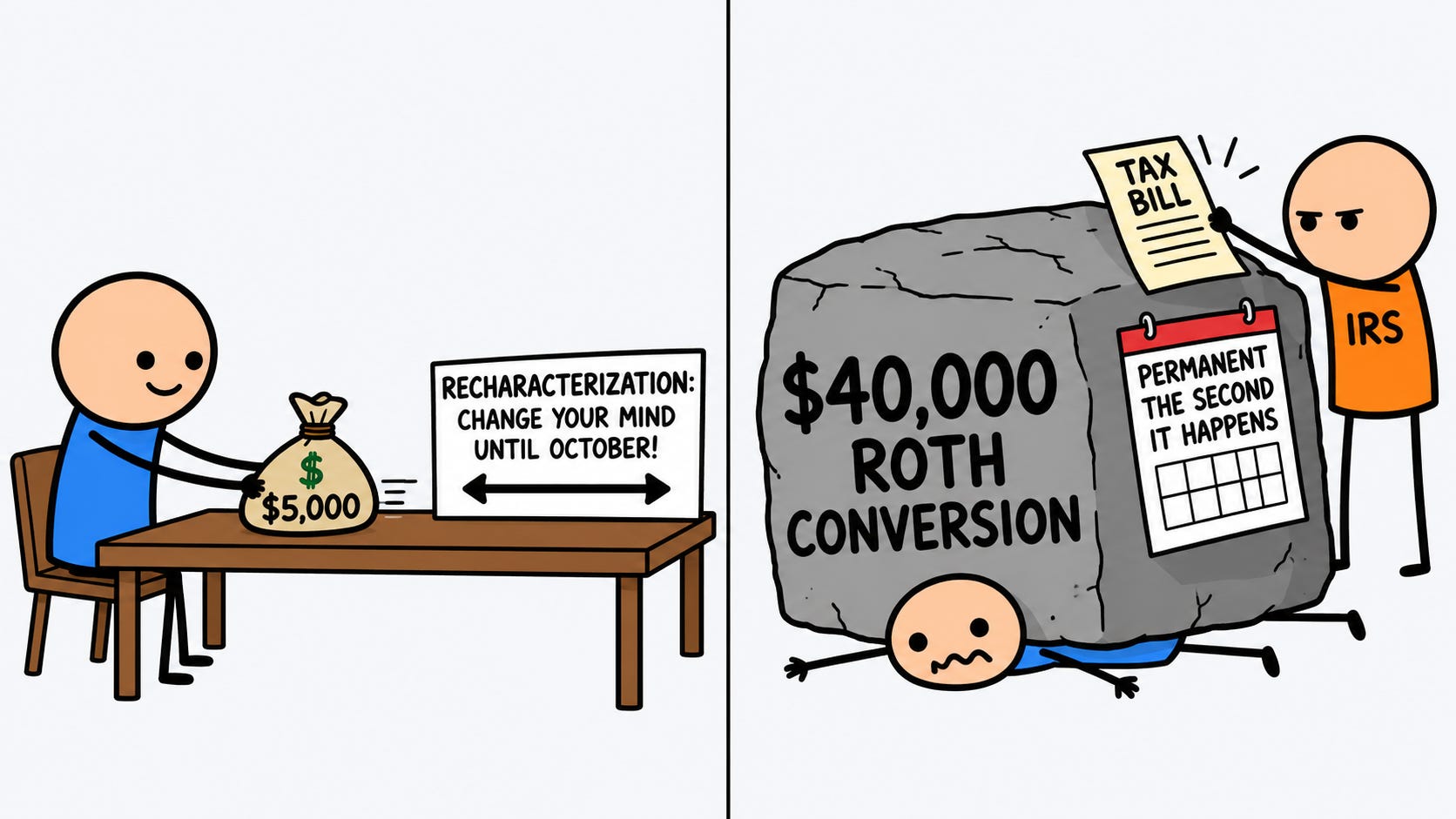
The retirement rules contain exactly one procedure that edits the past. Almost every other fix runs forward: money comes out, something gets paid, a form gets filed, and the record shows what happened followed by what you did about it. A recharacterization works differently. It reaches back to the day you made a contribution and changes which kind of IRA received it, as though you had made the other choice from the start. Your statement shows a transfer between two accounts. The tax record shows a contribution that was always in the second one.
That is a strange amount of power for a retirement account to hand anybody, and people reasonably assume it covers more ground than it does. The assumption that costs real money is that the same eraser reaches a Roth conversion.
A recharacterization applies to a regular contribution, the ordinary annual kind you make to a traditional IRA or a Roth IRA. You tell the custodian to treat it as having gone to the other type instead, and the money moves directly between the two accounts, either between firms or inside the same firm. You cannot take the money out and redeposit it yourself and call it a recharacterization.
What moves is the contribution adjusted for what it earned or lost while it sat there. What counts as the contribution stays the full original amount. Those are two different numbers whenever the market did anything at all, and the gap between them confuses almost everybody. Contribute $5,000, watch it fall to $4,640, recharacterize, and $4,640 lands in the other account while the record shows a $5,000 contribution to it, made on the day you made the original one. Any gain or loss is treated as having happened in the receiving account all along.
The deadline is the due date of the return for the year the contribution was for, including extensions. Same structure as the excess correction window: extend, and you have until the October due date. File on time without extending, and you still get six months past the April deadline, which lands on that same October date, with an amended return carrying the notation the instructions call for. Miss it and there is no late recharacterization at all. What remains at that point is the excess removal path or the 6% annual charge, which is a worse set of choices than the one you had in August.
Direction matters more than people expect. Moving a Roth contribution to a traditional IRA does nothing to make it deductible, because deductibility runs on its own rules about workplace plan coverage and income. Plenty of recharacterized contributions land as nondeductible money, which then has to be tracked as basis for as long as the account exists. Going the other way, traditional to Roth, requires that you were actually eligible to make a Roth contribution for that year, since the contribution is treated as having been Roth from day one and has to satisfy the Roth rules on that day.
Then the part with no window. A conversion cannot be recharacterized. Neither can a rollover from a workplace plan into a Roth IRA. Once either one happens there is no route back out, whatever the market does next. How much of it is taxable still runs on the ordinary conversion rules, so someone whose traditional IRAs hold nothing but pretax money is taxed on the entire amount converted, while basis anywhere in the mix sends the question through the pro rata calculation instead. Either way the conversion itself stands. There is no correction period to miss here, because there is no correction period. A contribution gets until the extended due date. A conversion gets until the moment it settles.
Converting a recharacterized contribution afterward is a separate transaction with its own consequences, including the pro rata calculation if you hold pretax money in any traditional, SEP, or SIMPLE IRA. The recharacterization does not preapprove it or exempt it.
Marcus puts $5,000 into his Roth IRA on February 11. In June he converts $40,000 out of an old traditional IRA, all of it pretax money, into that same Roth.
By the following March, when he sits down with his return, two things have gone wrong. A bonus in the fourth quarter pushed his income above the range where he could contribute to a Roth at all, so the $5,000 was never allowed. And the converted money is now worth about $31,000.
He files an extension in April, which gives him until October for the contribution. On August 6 he tells the custodian to recharacterize. The $5,000 has lost ground along with everything else, so $4,640 moves into a traditional IRA, and the record shows a $5,000 traditional IRA contribution dated February 11. He has a plan at work and his income sits above the deduction range, so it goes in as nondeductible basis he will be tracking for decades. He attaches a statement to the return explaining what moved and when.
The $40,000 does not move. It was a conversion of pretax money, so it is taxable for the year he made it, on the full $40,000, while the account holding it shows $31,000. He will pay tax on roughly $9,000 of value that stopped existing. Had he done the identical thing years ago, before the law changed, he could have unwound the whole conversion and owed nothing on it. That door is closed, and the only thing that would have helped is having known in June.
The two halves of Marcus’s year are worth separating in your head, because they behave nothing alike. The contribution had a long, forgiving window and a procedure built specifically for people whose income surprised them. The conversion had no window at all, and no amount of hindsight reopens it.
So the practical question on a contribution is only whether you are still inside the window, and the answer is more generous than people fear. The October date catches anyone who extended, and it catches anyone who filed on time without extending. The work after that is arithmetic, figuring out what share of the gain or loss follows the contribution into the other account, which is what the recharacterization calculator computes from your actual account values along with the statement language the return wants.
The practical question on a conversion is different, and it gets asked in the wrong season. It belongs in the year you are deciding, while the decision is still open. The longer version of all of this, including how the reporting lands on each side, sits in the guide to IRA recharacterizations.
I write one of these every day, one retirement rule, explained in plain language and verified against the source. The daily email is free: subscribe here.
Full archive, worksheets, and search live at RetirementNewsRundown.com.
Disclaimer
This article is for educational and informational purposes only. It is not tax, legal, or financial advice and does not create an advisor-client relationship. Always consult appropriate professionals regarding your specific situation.