The conversion happens, the tax bill arrives, the converted dollars settle into a Roth IRA, and the early-retiree mind starts doing math. The pre-tax money is now Roth money. The conversion was already taxed. The dollars feel free to move. The temptation to tap them sets in well before age 59.5 because the whole point of converting was to get the money into a more flexible account.
The flexibility is real. The freedom is not. Converted dollars carry their own penalty rules for owners under age 59.5, and the conversion itself does not unlock the money. The conversion only changes the tax bucket. The age and timing rules still apply.
A Roth conversion before age 59.5 has two timing rules layered on top of each other. The conversion itself is fully taxable in the year of conversion, regardless of age. The owner pays ordinary income tax on the converted amount, and that part of the math has nothing to do with age. No 10% early withdrawal tax applies merely because the money was converted, because the transaction moved the dollars into a Roth rather than paid them out for personal use.
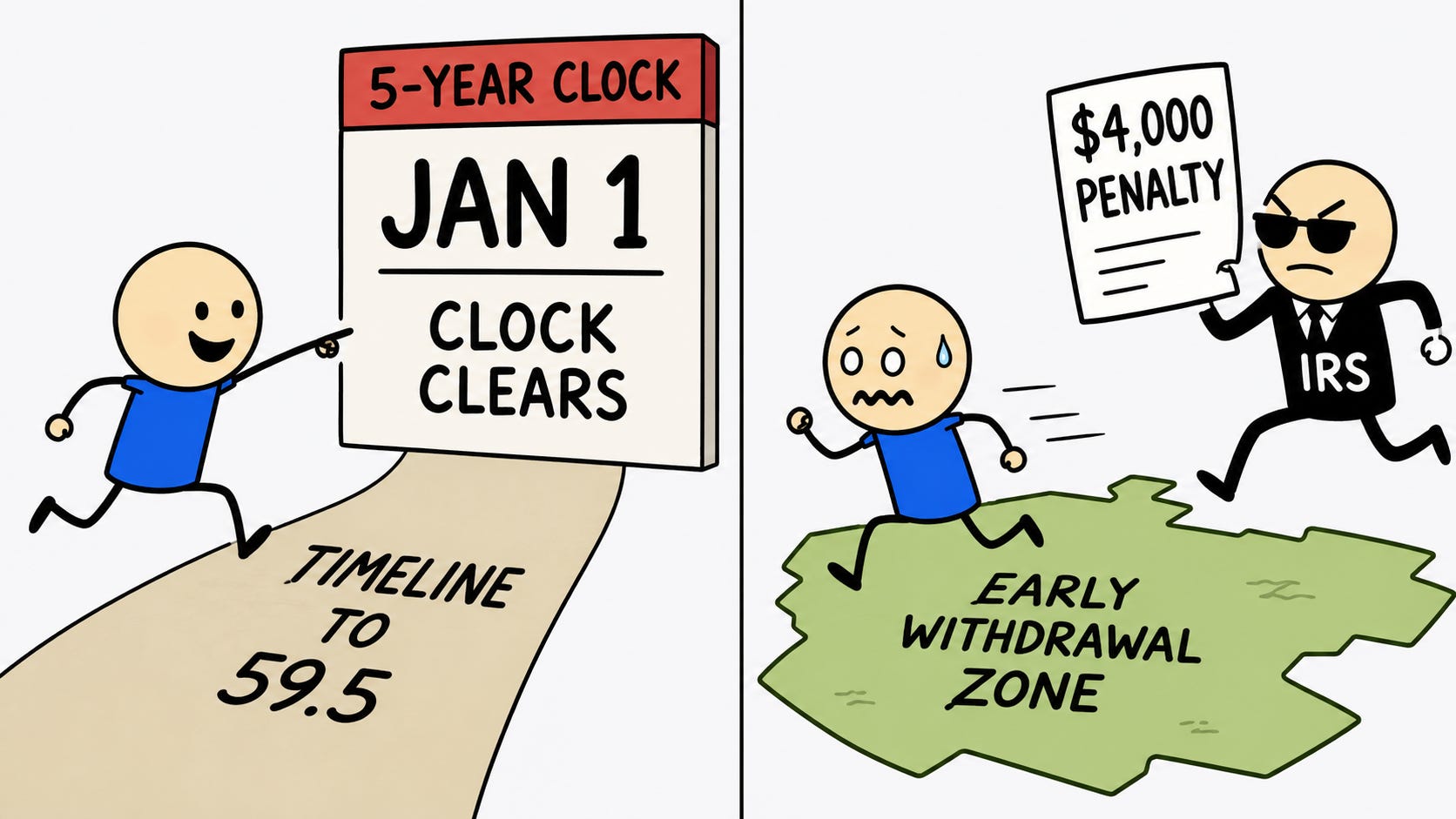
The five-year conversion clock starts on January 1 of the year the conversion is made. Each conversion has its own clock. If the converted dollars are withdrawn before that clock clears and before the owner reaches age 59.5, the 10% early withdrawal tax applies to the taxable portion of the conversion being tapped. The penalty does not apply to the conversion. It applies to the early withdrawal of converted dollars.
The age 59.5 milestone overrides the conversion clock. Once the owner reaches 59.5, the 10% early withdrawal tax generally no longer applies to converted dollars, even if a conversion clock is still running. The clocks still exist on paper, but the age override makes them irrelevant for the early withdrawal penalty in most fact patterns.
The trap for owners under 59.5 is the gap between the conversion and the eventual withdrawal. The conversion looks like it freed up the money because the tax was paid and the dollars are now in a Roth. The withdrawal looks like a tax-free return of already-taxed dollars. Both observations are true on their own. The 10% early withdrawal tax sits in the space between them, attached not to the conversion and not to the principal, but to the early withdrawal of converted dollars by an owner under 59.5 whose five-year clock has not cleared.
Other early-distribution exceptions can still matter. Disability, certain medical expenses, substantially equal periodic payments, and a handful of other situations can lift the 10% early withdrawal tax even when the clock has not cleared. None of those exceptions are created by the conversion itself. The conversion does not unlock the money. The owner’s specific situation does or does not.
What happens if the owner waits until age 59.5 before withdrawing? The 10% early withdrawal tax generally does not apply, regardless of when the conversion was made.
What happens if the owner waits until the five-year clock clears but is still under 59.5? The 10% early withdrawal tax also does not apply, because the clock has cleared for that specific conversion. The age override and the clock-clearing are two separate ways to escape the penalty. Either one alone is enough.
What about the conversion’s tax bill itself? That is owed in the year of conversion, regardless of age and regardless of whether the converted dollars are eventually withdrawn early or not. The tax bill on a conversion is settled in the year of conversion and does not change based on later distribution decisions.
A 48-year-old converts $60,000 from a traditional IRA to a Roth IRA in October. The conversion is fully taxable in that year. The owner pays roughly $13,200 in federal income tax on the converted amount, assuming a 22% marginal rate. No 10% early withdrawal tax applies merely because the conversion happened.
Two years later, at age 50, the owner needs $40,000 for a large personal expense and decides to pull it from the Roth IRA. Assume the withdrawal reaches converted dollars under the Roth IRA ordering rules. The conversion was already taxed, so no income tax applies to the withdrawal. But the five-year conversion clock has not cleared, and the owner is under 59.5. The 10% early withdrawal tax applies to the $40,000, costing the owner $4,000 in additional tax. The total cost of the conversion-plus-early-withdrawal sequence is the original $13,200 in conversion tax plus the $4,000 in early withdrawal tax, against a $40,000 withdrawal that felt tax-free.
If the same owner had waited until age 59.5 to withdraw the $40,000, the 10% early withdrawal tax generally would not have applied. The only cost would have been the original $13,200 paid at the time of conversion.
If the same owner had waited five tax years from the conversion (still under 59.5), the conversion clock would have cleared and the 10% early withdrawal tax would not have applied. The age 59.5 override and the clock-clearing both protect the same dollars, just through different paths.
The early-conversion trap is not that the conversion was a mistake. The conversion did what conversions do, which is move pre-tax dollars into a Roth IRA at the cost of income tax in the year of conversion. The trap is treating the converted dollars as if they are free to move out of the Roth immediately. They are not, until either the clock clears or the owner reaches 59.5.
For owners under 59.5 who do not yet need the converted money, the conversion is a long-term repositioning move. The penalty rules are not a punishment for converting. They are the system’s way of preventing conversions from becoming a workaround for the early withdrawal penalty on traditional IRAs. Without those rules, every pre-59.5 owner could convert in the morning and withdraw in the afternoon, sidestepping the early withdrawal penalty entirely.
The conversion is a fine move if the owner can leave the converted dollars alone until age 59.5 or until the five-year clock clears. The conversion is an expensive move if the owner needs the converted dollars sooner than that. The decision to convert is downstream of the question of when the dollars will actually be needed.
I write one of these every day, one retirement rule, explained in plain language and verified against the source. The daily email is free: subscribe here.
Full archive, worksheets, and search live at RetirementNewsRundown.com.
Disclaimer
This article is for educational and informational purposes only. It is not tax, legal, or financial advice and does not create an advisor–client relationship. Always consult appropriate professionals regarding your specific situation.