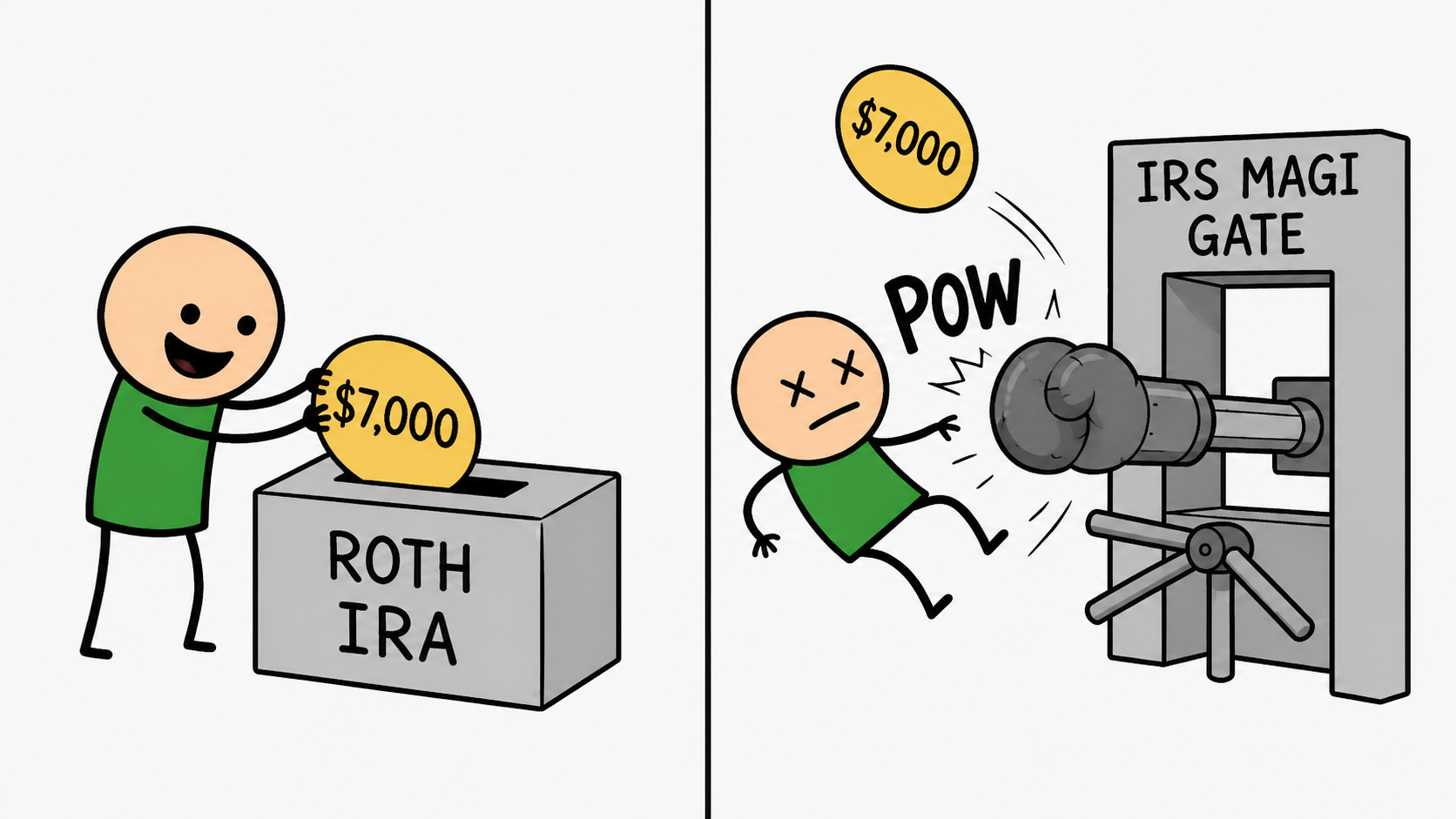
The Roth IRA gets pitched as the simple option. Contribute after-tax dollars, let the money grow, withdraw it tax-free in retirement. Most articles end the explanation right there. The complication shows up at tax time, when a high earner who confidently contributed $7,000 in March learns that the IRS does not actually allow the contribution at that income level.
The Roth IRA has an income gate. The gate is based on Modified Adjusted Gross Income (MAGI), not gross salary, and it operates on a phaseout band rather than a hard cliff. Inside the phaseout band, the maximum allowed contribution shrinks. Above the band, no direct Roth contribution is permitted at all. The contribution itself is legal until it crosses the line, at which point the same dollars that were a normal retirement contribution become an excess contribution that has to be removed or recharacterized.
The Roth IRA contribution limit applies in full to anyone whose MAGI falls below the lower edge of the phaseout band for their tax filing status. Inside the phaseout band, the allowed contribution is reduced proportionally as MAGI climbs. Above the upper edge of the band, no direct Roth contribution is allowed.
MAGI is calculated by starting with Adjusted Gross Income, then adding back specific deductions that the IRS does not let into the Roth calculation. Common or important add-backs can include a traditional IRA deduction taken on the same return, student loan interest deduction, foreign earned income exclusion, foreign housing exclusion or deduction, and several less common items. For most earners, MAGI ends up close to AGI. For some, the add-backs push MAGI noticeably higher than AGI.
The phaseout bands are set per tax filing status. Single filers, head of household filers, married filing jointly filers, and married filing separately filers each have their own band. The bands shift slightly each year for inflation, which is why this article does not name specific dollar thresholds. The structure stays the same. Only the numbers move.
The contribution itself can be made at any time during the tax year and up through the tax filing deadline of the following year (typically April 15) without an extension. A contribution made in January is allowed up to the limit as long as the eventual year-end MAGI lands below the phaseout cap. A contribution made in March of the following year and designated for the prior tax year is treated as a contribution for that prior year, and the MAGI test applies to that prior year’s income.
What happens if the contribution is made and then MAGI ends up higher than expected, pushing the allowed contribution down or to zero? The excess portion of the contribution becomes an excess contribution. The owner has until the tax filing deadline (with extensions) of the following year to remove the excess plus any earnings on it, or to recharacterize the contribution as a traditional IRA contribution. If the excess is not removed or recharacterized in time, a 6% excise tax applies for each year the excess remains in the account.
The MAGI test is run after the year ends, when the full income picture is known. A high earner who contributes in January is not automatically blocked at the time of the contribution. The custodian may accept the contribution before the final MAGI number is known, and the excess issue is discovered later when the return is prepared. The block is retroactive in effect, even though it feels prospective at the time of the deposit.
For earners above the upper edge of the phaseout band, the direct Roth contribution route is closed. The backdoor Roth path remains available, which involves contributing to a traditional IRA (no income limit on the contribution itself) and converting the traditional IRA balance to a Roth IRA in a subsequent step. The backdoor route still has its own traps, especially when the owner has other pre-tax IRA money, because the conversion tax calculation can pull those dollars into the math. The conversion mechanic itself is separate from the contribution limit and is not subject to the MAGI phaseout. That is a separate set of rules covered in adjacent articles in this series.
A married couple files jointly with combined MAGI estimated at the lower end of the phaseout band for their filing status. In February, both spouses contribute the full annual maximum to their respective Roth IRAs. The contributions are made and the money is invested.
By December, one spouse receives a year-end bonus that pushes the couple’s combined MAGI to the upper edge of the phaseout band. When taxes are prepared in March of the following year, the couple discovers that only about half of each spouse’s contribution was allowed under the phaseout calculation. The other half is an excess contribution.
The couple has until the tax filing deadline (or the extended deadline if they file for an extension) to remove the excess from each Roth IRA, along with any attributable earnings on the excess. The excess principal is not taxed again because it was after-tax money. Any earnings returned with it are the taxable piece. No 6% excise tax applies because the correction happens within the window.
If the couple had instead waited until December to make the contribution, after the bonus had already been received and the MAGI picture was clear, they could have calculated the allowed contribution accurately and contributed only the amount the phaseout permitted. The flexibility of waiting until late in the year (or even until April 15 of the following year) prevents the excess-contribution mess entirely.
If the couple had ignored the situation and left the excess in the account, the 6% excise tax would apply for that tax year, and again for every subsequent year until the excess is removed. The 6% tax can repeat every year the excess remains. A small excess left alone for ten years becomes a large excess tax bill.
The Roth contribution phaseout is one of the few retirement rules where waiting until the last minute is actually the safest move. Year-end MAGI is the figure that matters, and that figure is only known after the year ends. Contributing in January is fine if MAGI is reliably below the phaseout band. Contributing in January when MAGI is uncertain or close to the band creates the excess-contribution problem.
For earners who land above the upper edge of the band, the direct Roth contribution route is simply not available. That does not mean Roth IRA dollars are out of reach. The backdoor path exists and is covered in adjacent articles in this series. The MAGI gate is specifically for direct contributions, not for the broader Roth IRA structure.
The phaseout is annual. Every year resets the calculation. A high earner this year can contribute directly next year if income drops below the band. A lower earner this year can lose direct access next year if income rises above the band. The phaseout is a yearly test, not a permanent designation.
I write one of these every day, one retirement rule, explained in plain language and verified against the source. The daily email is free: subscribe here.
Full archive, worksheets, and search live at RetirementNewsRundown.com.
Disclaimer
This article is for educational and informational purposes only. It is not tax, legal, or financial advice and does not create an advisor–client relationship. Always consult appropriate professionals regarding your specific situation.