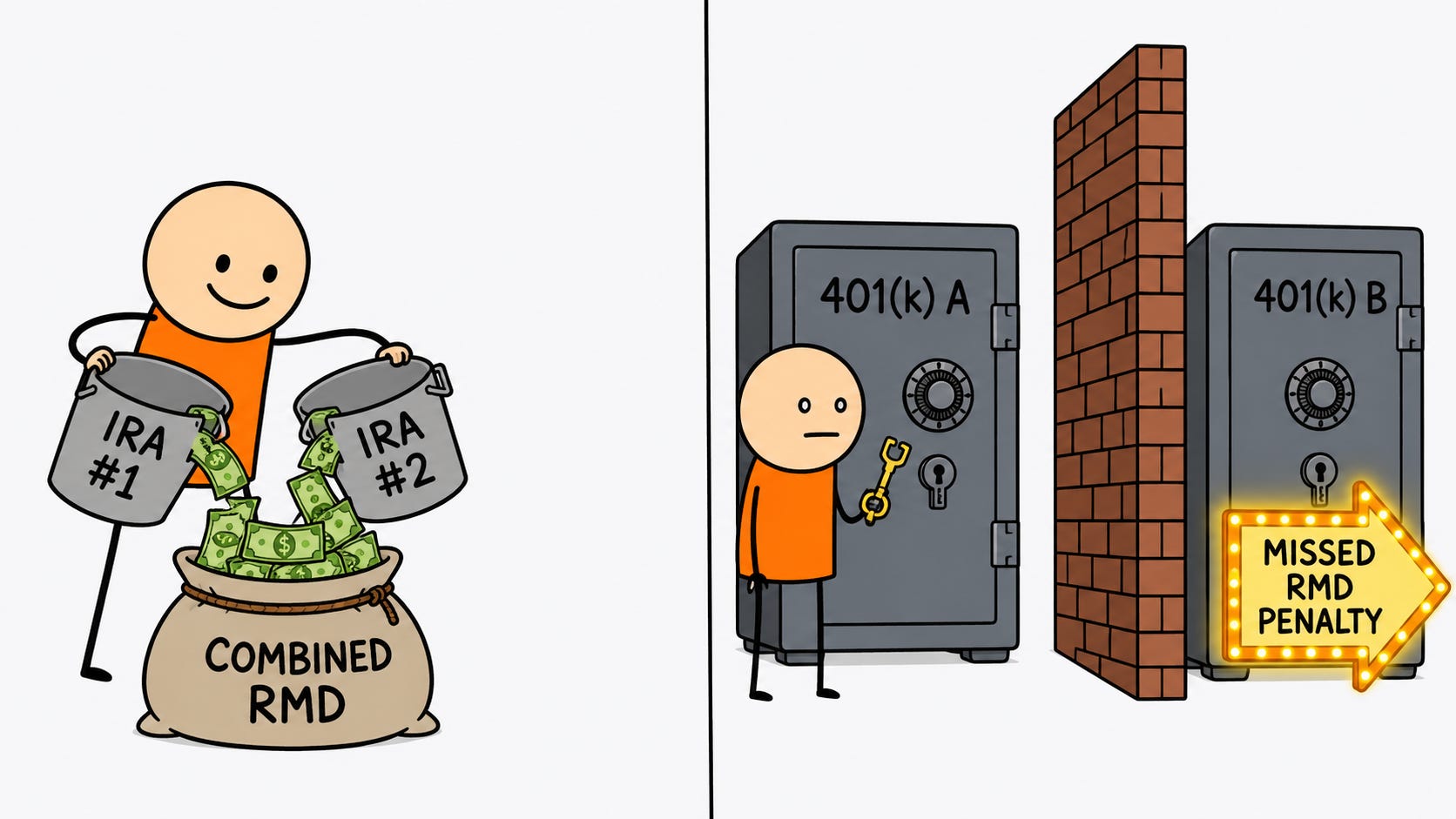
Someone reaches the age when required minimum distributions begin, looks at a pile of retirement accounts, and reasonably assumes the government wants one number pulled from one place. Add up the balances, take the required amount from whichever account is most convenient, done. That assumption works for IRAs. It falls apart the moment an old 401(k) enters the picture, and the person who guesses wrong may find out through a penalty rather than a friendly warning letter.
Required minimum distributions follow a rule that treats IRAs and employer plans as two separate worlds that never touch. On the IRA side, aggregation is allowed. If you own three traditional IRAs, you calculate the required amount for each one, add those amounts together, and then withdraw the total from any single IRA or any combination of them. The IRS only cares that the full total leaves your IRAs by the deadline. SEP IRAs and SIMPLE IRAs join the same pool.
Employer plans do not work this way. Each 401(k) you own stands alone. You calculate the required amount for that specific plan and you withdraw that specific amount from that specific plan. A second 401(k) gets its own separate calculation and its own separate withdrawal. You cannot add two 401(k) figures together and satisfy both from one plan the way you can with IRAs, and you absolutely cannot reach into an IRA to cover a 401(k) requirement or the reverse. The two categories are sealed off from each other. An employer plan distribution has to come out of that employer plan.
There is one exception living inside the employer world, and it belongs to 403(b) plans. If you hold more than one 403(b), those behave like IRAs among themselves. You calculate each one and then take the combined amount from any single 403(b) you choose. This does not extend outward. A 403(b) still cannot mix with an IRA, and it still cannot mix with a 401(k). It only aggregates with other 403(b) accounts.
Picture someone who spent a long career collecting accounts. Two old 401(k) plans left behind at former employers, one holding a required amount of five thousand dollars for the year and the other holding three thousand. Alongside those sit two traditional IRAs with required amounts of four thousand and two thousand.
On the IRA side, this person has flexibility. The four thousand and the two thousand combine into six thousand, and that six thousand can come entirely out of one IRA, leaving the other untouched for the year. Nothing about that draws a penalty.
The 401(k) plans offer no such grace. The five thousand has to leave the first plan and the three thousand has to leave the second plan, each as its own distribution. Pulling the full eight thousand from the first 401(k) does nothing for the second. The second plan still shows a three thousand dollar shortfall at year end, and the IRS reads that shortfall as a missed distribution regardless of how much came out of the first plan.
A missed required distribution carries a penalty on the amount that should have come out and did not. Under current rules that penalty runs at twenty five percent of the shortfall, and it drops to ten percent if the account owner corrects the miss within the two year window the law provides. The correction generally means taking the delayed amount out and filing the form that reports the shortfall. Depending on timing and facts, the account owner may qualify for the reduced ten percent rate or request waiver relief for reasonable error. Most annual required distributions are due by December 31, but the first one has its own special deadline of April 1 of the following year, and delaying that first distribution can force two taxable distributions into the same calendar year.
The cleaner move happens before any of this becomes a problem. Consolidation is the reason the IRA rules feel so much simpler, because a single IRA produces a single calculation and a single withdrawal. An old 401(k) left at a former employer can generally be rolled into an IRA, and once those dollars land in the IRA they follow IRA aggregation rules from that point forward. For a year when a required distribution is already due from the 401(k), that year’s distribution generally has to be taken before any rollover happens. The distinction that trips people up is not a law of nature. It is a consequence of where the money currently sits, and money that sits in scattered employer plans creates scattered obligations that each have to be satisfied on their own terms.
I write one of these every day, one retirement rule, explained in plain language and verified against the source. The daily email is free: subscribe here.
Full archive, worksheets, and search live at RetirementNewsRundown.com.
Disclaimer
This article is for educational and informational purposes only. It is not tax, legal, or financial advice and does not create an advisor–client relationship. Always consult appropriate professionals regarding your specific situation.