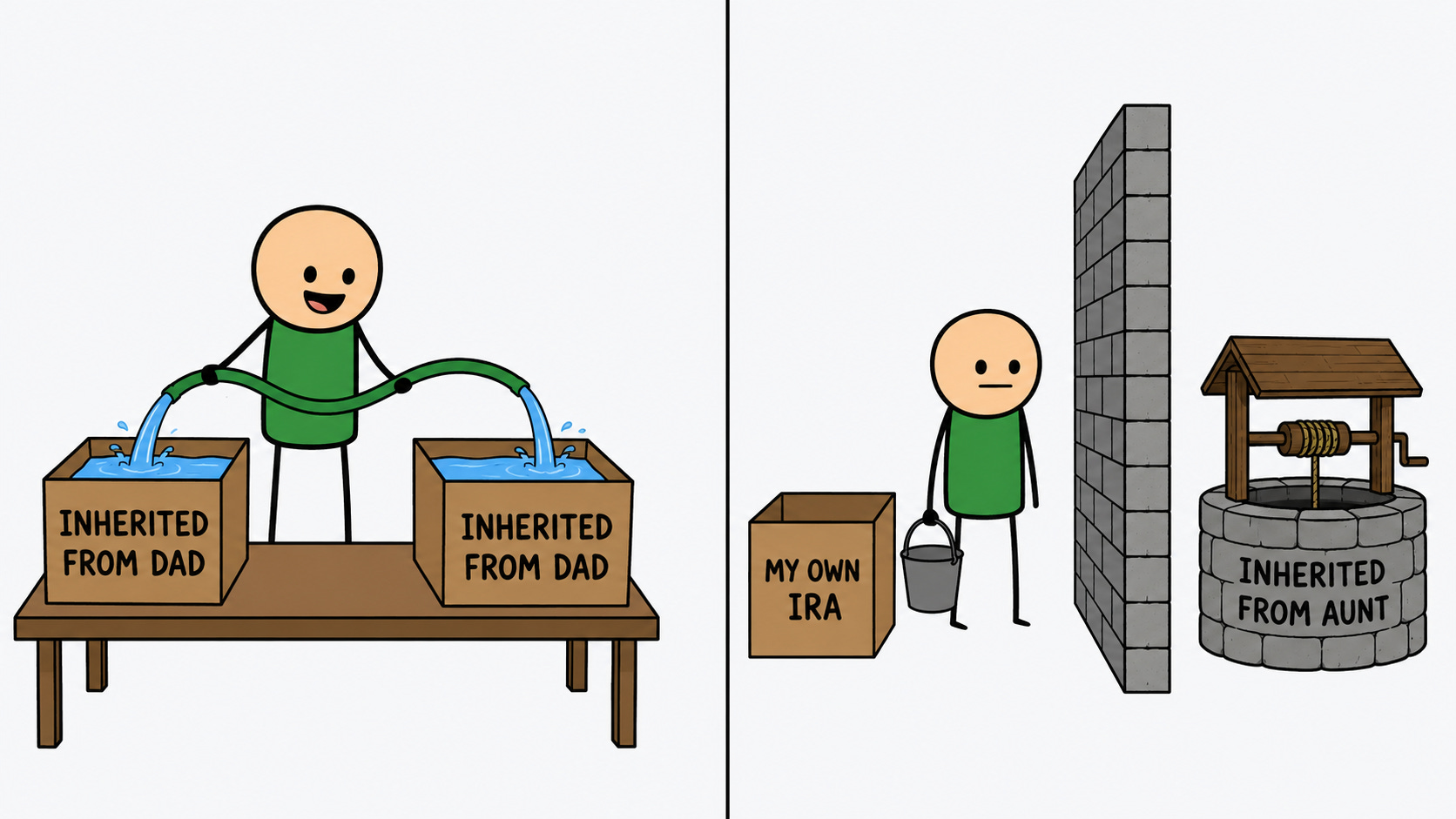
Someone inherits a couple of retirement accounts, already takes required distributions from their own IRAs, and assumes the inherited money folds into the same routine. Calculate everything, add it up, pull the total from wherever is convenient. This works for the IRAs a person owns outright. It does not work the moment an inherited account enters the picture, and the beneficiary who blends the two finds out that the IRS treats inherited money as its own sealed category with its own rules.
Aggregation for inherited IRAs runs on two conditions that both have to be true at the same time. The accounts must come from the same person who died, and they must sit in the same inherited account category, such as inherited traditional IRA with inherited traditional IRA, or inherited Roth IRA with inherited Roth IRA. When both conditions hold, the inherited accounts behave like owned IRAs behave among themselves. You calculate the required amount for each inherited account, add those amounts together, and satisfy the total from any one of them or any combination.
Break either condition and the pooling stops. Inherited accounts that came from two different people never combine, no matter how similar they look. An inherited IRA from a mother and an inherited IRA from an uncle are two separate obligations, each calculated on its own and each satisfied on its own. The reason sits underneath the surface. Each decedent brings a different distribution timeline, often a different set of dates and factors, and the IRS keeps those timelines from bleeding into one another by keeping the accounts separate.
The condition that catches the most people is the wall between inherited and owned. An inherited IRA and a personal IRA are different buckets even when they are the same type of account. A beneficiary who owns a traditional IRA and also inherited a traditional IRA cannot calculate both, add them, and take the whole thing from the personal account. The inherited required amount has to come out of the inherited account. Reaching into the account you own does nothing for the account you inherited, and the inherited one will still read as short at year end.
Inherited Roth IRAs follow the same logic. They can aggregate with other Roth IRAs inherited from the same decedent, and a distribution from a separate Roth IRA only counts if that Roth was inherited from the same person. Many beneficiaries are surprised an inherited Roth carries any distribution deadline at all, since the original owner never faced lifetime RMDs. Inheritance changes that, even though many inherited Roth beneficiaries may not have annual required distributions during years one through nine.
Picture a beneficiary who inherited two traditional IRAs from a father who had already been taking his own required distributions before he died, and assume annual beneficiary required distributions apply under the inherited IRA rules that govern this situation. Both accounts now carry an annual required amount, one of two thousand dollars and one of fifteen hundred. Same decedent, same category. These two combine. The beneficiary can pull the full thirty five hundred from either inherited account and both obligations are satisfied.
Now add an inherited traditional IRA from an aunt, carrying its own required amount of one thousand dollars. It is the same type of account, a traditional IRA, but it came from a different person. It cannot join the father’s pool. That thousand dollars has to come out of the aunt’s account specifically, calculated and satisfied entirely on its own.
Finally, the beneficiary also owns a personal traditional IRA with a required amount of three thousand. This one lives in a completely separate world from all the inherited accounts. It aggregates only with other personal IRAs the beneficiary owns, and its three thousand can never be covered by pulling extra from any inherited account, nor can any inherited amount be covered by pulling from it.
A required distribution missed from any of these accounts carries a penalty on the shortfall, and inherited accounts are the ones most often forgotten because they arrive outside a person’s normal routine. Under current rules the penalty runs at twenty five percent of the amount that should have come out, dropping to ten percent when the beneficiary corrects the miss within the two year window the law allows. The correction means taking the delayed amount out of the correct account and filing the form that reports the shortfall. Depending on the timing and facts, the beneficiary may qualify for the reduced ten percent rate or request waiver relief for reasonable error.
The clean way through is to treat every inherited account as its own separate obligation until proven otherwise, then look for the narrow case where pooling is allowed. Two accounts can only share if they came from the same person and they sit in the same inherited category. Anything short of both conditions means separate calculations and separate withdrawals from the specific accounts they belong to. Whether an inherited account even requires an annual distribution in the first place depends on the separate set of rules governing the ten year payout window, which turns on when the original owner died relative to their own required beginning date. That question decides if there is a required amount to aggregate at all, and it deserves its own careful read before any of this pooling logic comes into play.
I write one of these every day, one retirement rule, explained in plain language and verified against the source. The daily email is free: subscribe here.
Full archive, worksheets, and search live at RetirementNewsRundown.com.
Disclaimer
This article is for educational and informational purposes only. It is not tax, legal, or financial advice and does not create an advisor–client relationship. Always consult appropriate professionals regarding your specific situation.