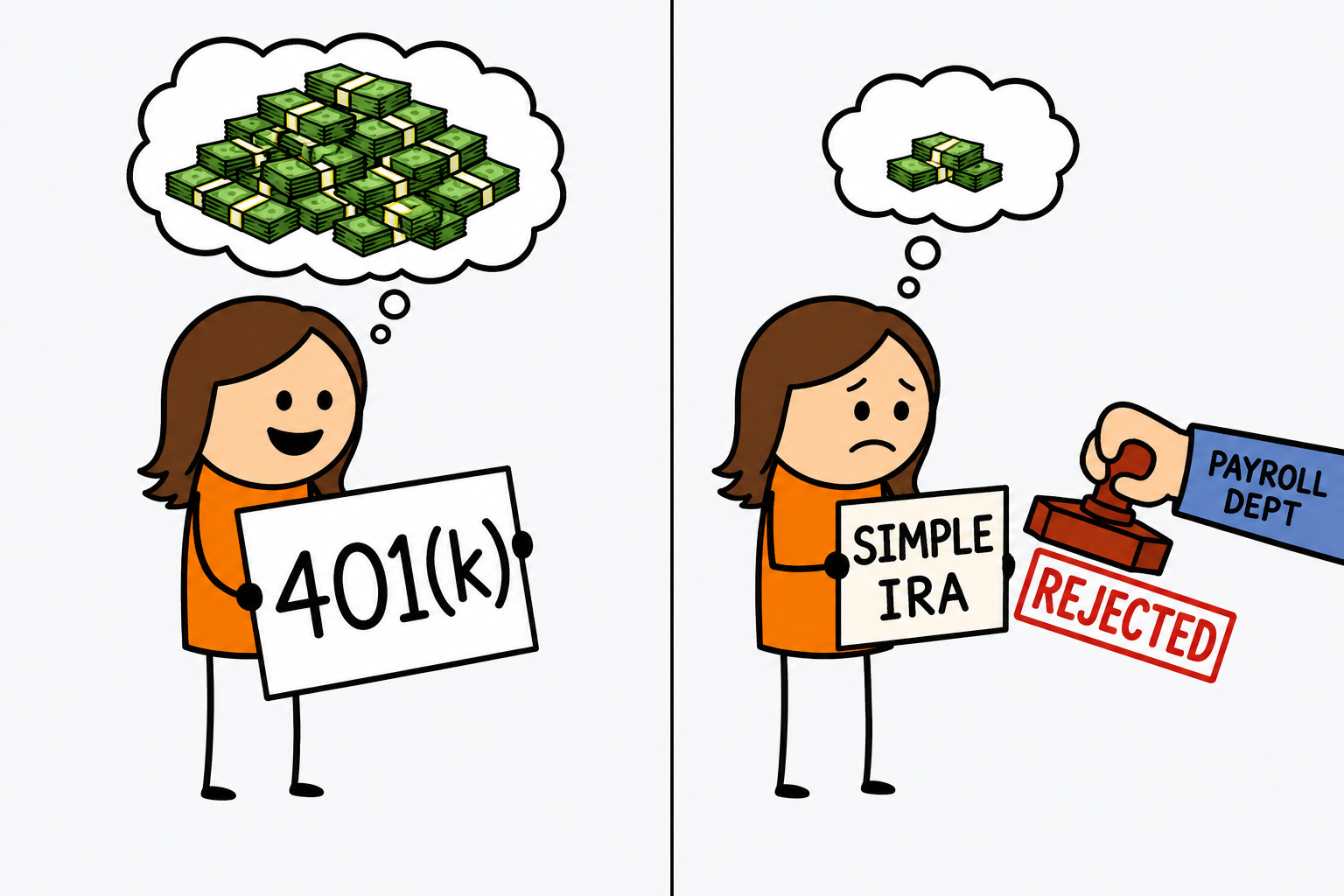
A new hire at a small accounting firm reads her SIMPLE IRA notice during onboarding. She’s used to the higher elective deferral limit from her old 401(k). She tries to set her SIMPLE IRA deferral at the same amount. Payroll bounces it back with an error: “Maximum SIMPLE IRA contribution exceeded.” She thinks payroll has it wrong and calls HR. HR tells her the SIMPLE IRA limit is lower than a 401(k) limit. The retirement plan at her new job has less savings room than the one at her old job, and nobody mentioned this during her interview.
Three moving pieces sit inside a SIMPLE IRA: the employee deferral, the employer contribution, and the catch-up for older workers.
Employee deferrals are made through salary reduction. The IRS sets an annual limit, indexed for inflation, that’s lower than the standard 401(k) limit. SECURE 2.0 added a wrinkle. Employers with 25 or fewer employees can allow deferrals up to 110% of the standard SIMPLE limit. Employers with 26 to 100 employees can also allow the higher limit if they bump up their match or non-elective contribution.
Employer contributions are mandatory. The employer chooses one of two options each year and tells employees in writing before the election period: a 3% match against employee deferrals (which can be reduced to as low as 1% in two out of every five years), or a 2% non-elective contribution made for every eligible employee regardless of whether they defer.
Catch-up contributions allow employees age 50 or older to defer additional amounts above the standard limit. SECURE 2.0 introduced an enhanced catch-up for ages 60 through 63 that sits above the standard catch-up. Under the SECURE 2.0 Roth catch-up rules, certain high earners must make catch-up contributions on a Roth basis if the plan allows catch-up contributions. The Roth catch-up does not reduce current-year taxable income.
Roth SIMPLE IRA contributions became allowed under SECURE 2.0. Employees can elect Roth treatment for their deferrals where the plan permits.
Employee deferrals must be deposited by the employer no later than 30 days after the end of the month in which the deferral was withheld. The Department of Labor’s stricter rule for small plans generally requires deposits within 7 business days. Late deposits are a fiduciary breach.
Employer contributions are due by the employer’s tax filing deadline including extensions. Employees get a 60-day window before the start of each plan year to elect their deferral percentage, generally November 2 through December 31 for a calendar-year plan.
If an employee exceeds the SIMPLE IRA elective deferral limit, the excess deferral generally must be distributed with earnings by April 15 of the following year. If it is not corrected by then, the excess may be taxable in the year deferred and taxed again when eventually distributed.
If an early withdrawal happens within the first 2 years of an employee’s participation in any SIMPLE IRA, the 10% early withdrawal penalty is increased to 25%. This is unique to SIMPLE IRAs and catches employees who don’t realize it.
A 12-employee accounting firm establishes a SIMPLE IRA effective January 1. The 52-year-old owner-employee earns $180,000 in W-2 wages. The firm elects the 3% match option for the year.
She elects to defer the standard SIMPLE IRA limit through salary reduction. Because the firm has fewer than 25 employees, the higher 110% deferral limit was available, but she sticks with the standard amount this year. She also makes the age-50 catch-up contribution. Assuming the Roth catch-up rule applies for the year and the plan offers Roth SIMPLE deferrals, the catch-up portion goes in as Roth and does not reduce her current-year taxable income.
The firm’s 3% match on her $180,000 salary equals $5,400, deposited by the tax filing deadline. The total going into her SIMPLE IRA for the year: her standard deferral, plus her Roth catch-up, plus the $5,400 match.
A 24-year-old hire joins in February. She makes $45,000 and elects to defer 0% during her first year. Under the 3% match formula, she gets no employer contribution since the match is tied to her deferral. If the firm had elected the 2% non-elective contribution instead, she would have received $900 regardless of her deferral choice.
Year two arrives. She decides to defer 5% of her salary, around $2,250. The firm’s 3% match equals $1,350. She’s still within 2 years of her first SIMPLE IRA contribution, so if she withdraws funds before age 59½, the 25% penalty applies instead of the standard 10%.
I write one of these every day, one retirement rule, explained in plain language and verified against the source. The daily email is free: subscribe here.
SIMPLE IRA contribution limits move on three independent dials: the employee deferral, the employer contribution, and the catch-up for older participants. SECURE 2.0 added more dials, with the 110% higher deferral limit, the enhanced catch-up for ages 60 through 63, the Roth catch-up requirement for high earners, and the option to receive deferrals as Roth where the plan permits.
What matters for any employee is knowing their own deferral limit applies, not the higher 401(k) limit, and knowing the employer contribution is required, but whether the employee receives one without deferring depends on whether the employer chose the match or the non-elective formula. What matters for an employer is choosing the match or non-elective contribution before the year starts and sticking to it for the year.
The penalty stack on early SIMPLE IRA distributions during the first 2 years is the trap that catches employees who switch jobs and try to roll the SIMPLE IRA somewhere else without thinking. The 25% penalty on early withdrawals during that window is unique among retirement accounts and costs more than people realize.
Full archive, worksheets, and search live at RetirementNewsRundown.com.
Disclaimer This article is for educational and informational purposes only. It is not tax, legal, or financial advice and does not create an advisor–client relationship. Always consult appropriate professionals regarding your specific situation.