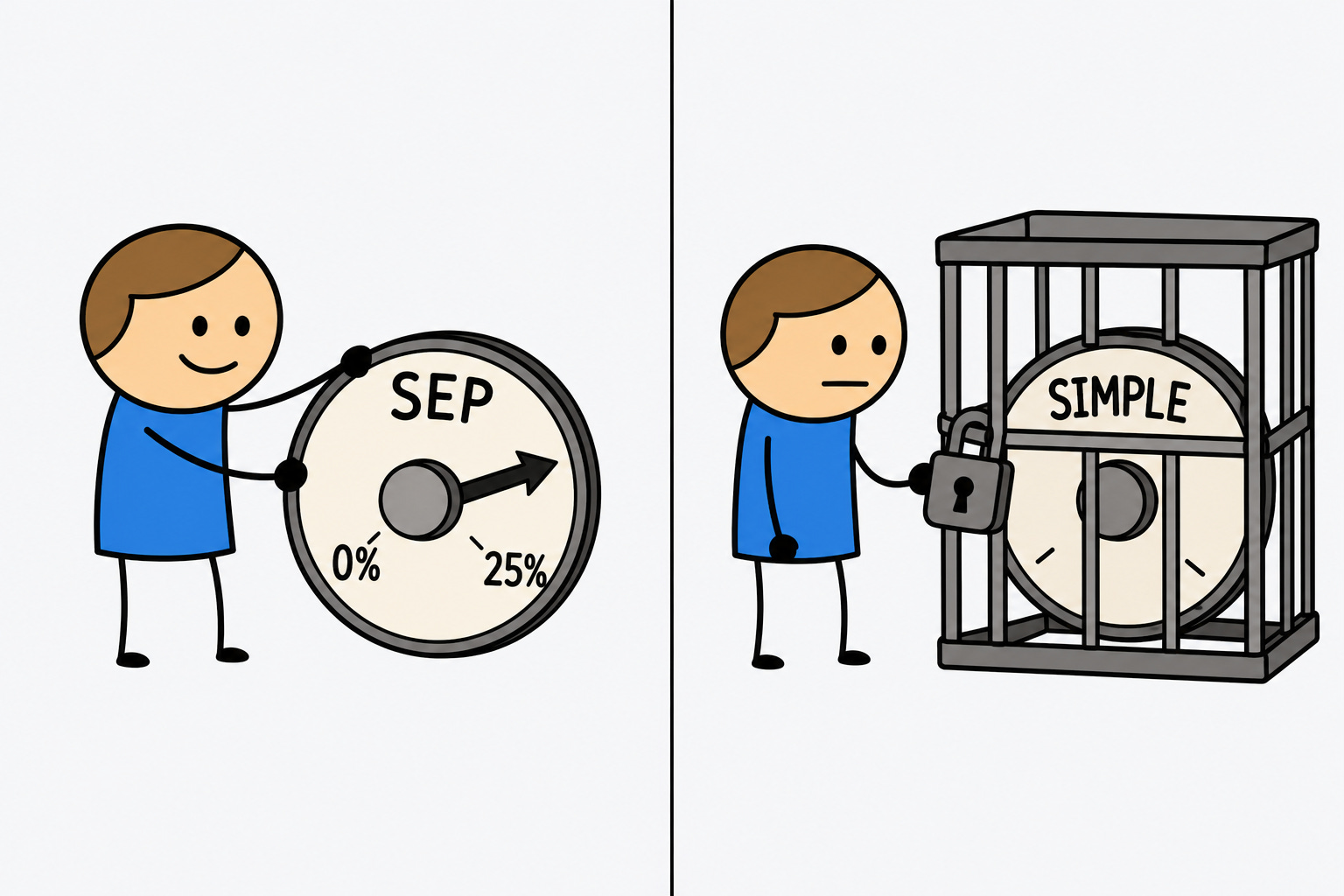
A business owner sits down with her CPA in February to talk about setting up a retirement plan for her seven-person consulting firm. The CPA asks whether she wants a SEP IRA or a SIMPLE IRA. She says yes to both, then no to both, then asks what the difference is. The CPA pulls out a comparison sheet and starts walking through the trade-offs. Forty minutes later she signs paperwork for the wrong plan because she answered one question wrong: how much flexibility she wanted on annual contributions.
A SEP IRA is an employer-only plan. The employer makes all contributions and must contribute the same percentage of compensation for every eligible employee. Employees never defer from their paycheck.
A SIMPLE IRA is split-funded. Employees can defer from their paycheck through salary reduction. The employer must also contribute, either through a 3% match against employee deferrals or a 2% non-elective contribution to every eligible employee.
The two plans differ on five practical questions.
Contribution caps. SEP IRA contributions generally run up to 25% of eligible compensation, capped at the annual IRS dollar limit. For self-employed owners, the calculation uses a special net-earnings formula. SIMPLE IRA employee deferrals have their own annual limit, lower than the 401(k) elective deferral limit but higher than the regular IRA contribution limit.
Setup deadline. A SEP IRA can be established and funded by the employer's tax filing deadline including extensions for the prior year. An employer can decide in September to set up a SEP for the prior tax year. A SIMPLE IRA generally must be established between January 1 and October 1 of the year it covers. A new employer formed after October 1 can establish one as soon as administratively feasible. A SIMPLE IRA cannot be set up retroactively for a prior year.
Funding flexibility. SEP IRA contributions are fully discretionary year to year. The employer can contribute 0% one year and 25% the next. SIMPLE IRA employer contributions are required every year. The 3% match can drop to as low as 1% in two of every five years, but a SIMPLE cannot be zeroed out without termination.
Exclusive plan rule. In general, an employer maintaining a SIMPLE IRA cannot maintain another retirement plan covering the same employees during the same year, outside limited transition exceptions. SEP IRAs do not carry this restriction.
Early withdrawal penalty. SEP IRA early distributions follow standard IRA rules with a 10% penalty before age 59½. SIMPLE IRA distributions face a 25% penalty during the employee's first 2 years of participation, dropping to the standard 10% after. Standard early-withdrawal exceptions can apply.
Two business owners walk into the same CPA’s office in January.
The first owns a consulting firm with herself and three employees. Revenue swings between $400,000 and $800,000 depending on the year. She wants to save aggressively when revenue is good and step back when revenue is tight. She doesn’t want her employees deferring through payroll.
The CPA recommends a SEP IRA. The employer-only structure, the discretionary contribution, and the year-to-year flexibility all fit. In a strong revenue year, she might contribute aggressively. In a weak revenue year, she might contribute little or nothing.
The second owns an accounting firm with twelve employees. Revenue is steady year over year. She wants to encourage employees to save through their own payroll deductions. She’s comfortable with a recurring employer contribution.
The CPA recommends a SIMPLE IRA. The employee-deferral feature lets her staff save through payroll. The 3% match cost is manageable and can be budgeted around, though the final cost depends on employee deferral behavior. The plan is administratively cheaper than a 401(k) at her staff size.
Run the first owner through a SIMPLE IRA scenario: she’d be locked into the 3% match or 2% non-elective every year, including the years revenue dropped. The plan wouldn’t let her zero out the employer contribution during a bad year. After three years of bad revenue, she’d be in trouble.
Run the second owner through a SEP IRA scenario: she’d lose the employee deferral feature, which is the main reason her staff stays engaged with the retirement plan. The full contribution responsibility would land on her, and many of her younger staff would feel they had less control over their own savings.
Same CPA, same week, two different right answers.
SEP IRAs and SIMPLE IRAs both serve small business retirement needs while answering different questions. The SEP is for owners who want maximum contribution flexibility and don’t need employees deferring from their own paychecks. The SIMPLE is for businesses where employees want to participate in saving and the owner is comfortable with a predictable annual contribution.
What changes the answer in most cases is revenue stability and how much the owner cares about employee engagement with the retirement plan. Stable revenue and a workforce that wants payroll-deduction saving usually favor SIMPLE. Variable revenue and an owner who wants full control over annual contributions usually favors SEP.
Either plan can be opened and funded without setting up a 401(k). Either plan provides immediate vesting. The right choice is the one that fits the current business. The decision can change later as the business evolves.
I write one of these every day, one retirement rule, explained in plain language and verified against the source. The daily email is free: subscribe here.
Full archive, worksheets, and search live at RetirementNewsRundown.com.
Disclaimer This article is for educational and informational purposes only. It is not tax, legal, or financial advice and does not create an advisor–client relationship. Always consult appropriate professionals regarding your specific situation.