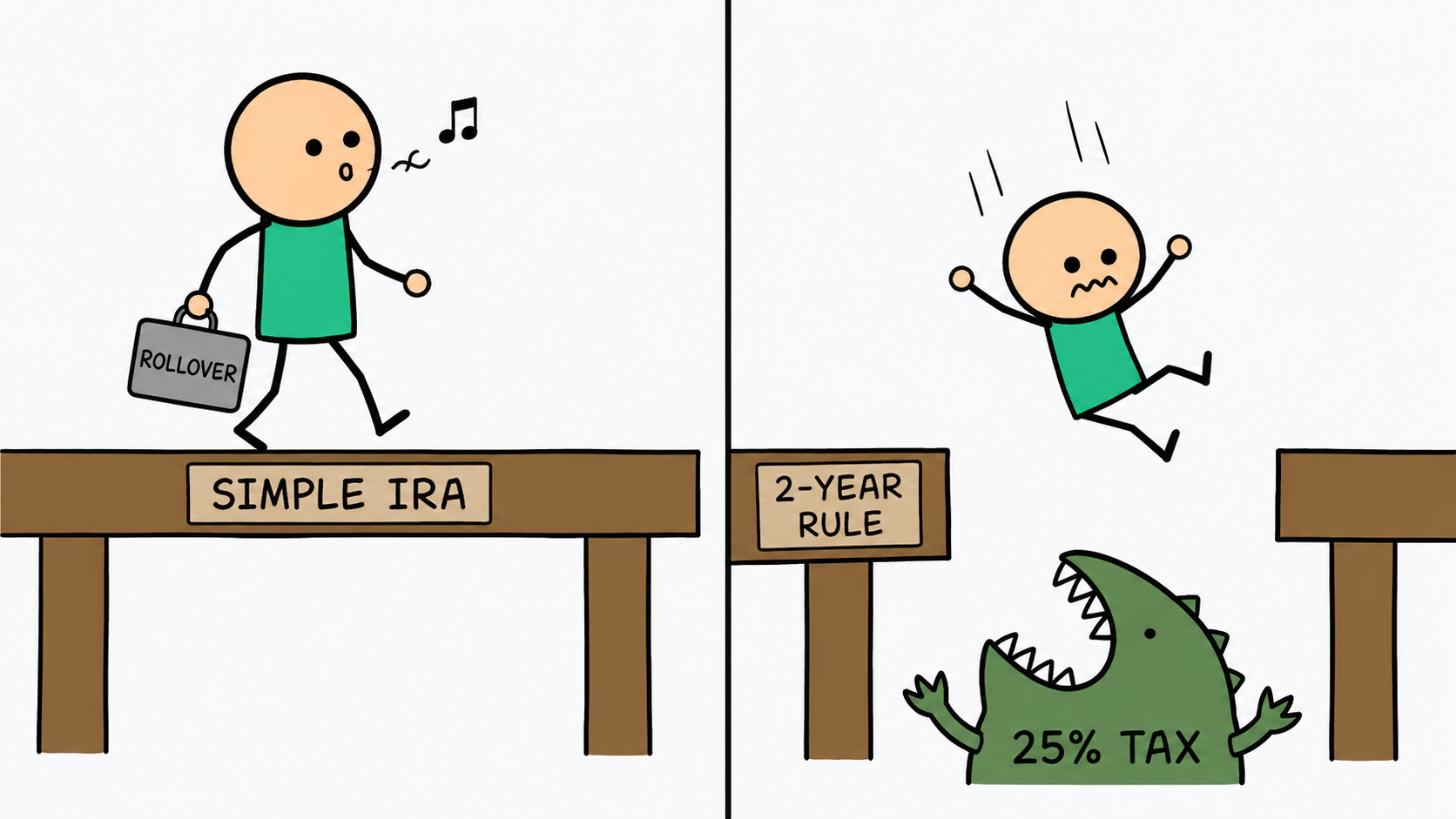
A SIMPLE IRA looks like a regular IRA until someone tries to move the money too soon. Then the system stops being simple, because apparently naming something SIMPLE was the IRS’s little joke for the day.
The trap usually shows up after a job change. An employee leaves a small business, sees an old SIMPLE IRA sitting at the custodian, and decides to consolidate it with the Traditional IRA they already have somewhere else. That sounds normal. It sounds responsible. It sounds like the kind of financial housekeeping people are told to do all the time.
Then the account gets moved before the two-year clock has finished running, and the tax result changes from “nice job consolidating” to “congratulations, you may have just triggered a 25% additional tax.”
That is the part people miss. SIMPLE IRAs have a special two-year rule. During that period, the account is not treated like every other IRA for rollover purposes.
The SIMPLE IRA two-year period starts on the first day a contribution is deposited into the employee’s SIMPLE IRA. Not the day the employee was hired. Not the day the plan was adopted. Not the day the employee filled out the enrollment paperwork while pretending to read the disclosures.
The clock starts when money first lands in that employee’s SIMPLE IRA.
During that first two-year period, money can generally move from one SIMPLE IRA to another SIMPLE IRA without creating the rollover problem. That part is allowed. The employee can change custodians. The account can be transferred. The money can stay inside the SIMPLE IRA universe.
The problem happens when the money leaves the SIMPLE IRA universe too early. Moving the balance to a Traditional IRA, rollover IRA, 401(k), 403(b), or other non-SIMPLE retirement account before the two-year period ends is not treated like a normal tax-free rollover. It can become a taxable distribution.
If the employee is under age 59½, the usual 10% early distribution penalty is replaced by a 25% additional tax during that first two-year window. Same early withdrawal concept, much sharper teeth. The IRS apparently looked at 10% and thought, “Cute. Let’s make this one memorable.”
The 25% penalty is on top of ordinary income tax. If someone pulls out $20,000 from a pre-tax SIMPLE IRA during the two-year period and no exception applies, the distribution can be included in taxable income, and the additional tax can be $5,000. That is before state tax enters the room and starts touching things.
The calendar year matters because the distribution is reported for the year it happens. A distribution taken in November belongs to that tax year. The tax-filing deadline matters because that is when the income and any additional tax are reported on the return. But the two-year SIMPLE clock is not a tax-filing deadline and it is not extended by filing later. April 15 does not magically bless a bad rollover from the prior November.
There also is not a normal “correction window” that works like an excess IRA contribution fix. Once the money leaves incorrectly and the transaction is treated as taxable, the issue is not solved by saying everyone meant well. Retirement accounts hear intent all the time. They remain deeply unimpressed.
Say Maria starts work at a dental office on March 1. She enrolls in the SIMPLE IRA right away. Her first salary deferral and employer match are deposited into her SIMPLE IRA on April 12.
That April 12 deposit starts Maria’s two-year clock.
One year later, Maria leaves the dental office for a larger employer with a 401(k). She has $18,000 in the SIMPLE IRA. A few weeks after she leaves, she rolls the full balance into her Traditional IRA because she wants all her retirement accounts in one place.
That sounds clean. It is not.
Her two-year period does not end until April 12 two years after the first contribution. The rollover happened before that clock finished. Since the money went from a SIMPLE IRA to a non-SIMPLE IRA inside the two-year period, the transaction can be treated as a taxable distribution. If Maria is 36 and no penalty exception applies, the 25% additional tax can apply.
On $18,000, that penalty alone is $4,500.
Same facts, different date. Maria waits until April 13 after the two-year period ends. Now she moves the SIMPLE IRA to a Traditional IRA. The special SIMPLE restriction no longer blocks the rollover. The movement can be handled like a normal IRA rollover or transfer, assuming the rest of the rollover rules are followed.
One day changes the result. Not because the investment changed. Not because Maria became smarter overnight. The clock simply finished running.
Now change the destination instead of the date. Maria leaves the job after one year but transfers the SIMPLE IRA balance directly into another SIMPLE IRA at a different custodian. That can fit within the two-year rule because the money stayed inside the SIMPLE IRA lane. Movement to another SIMPLE IRA stays inside the rule. Movement to a non-SIMPLE IRA before two years end creates the tax problem.
That distinction matters. “Don’t touch it for two years” is easy to remember, but it is not precise. “Don’t move it out of SIMPLE IRA status for two years unless you want a tax problem” is closer.
The SIMPLE IRA two-year rule is not a reason to panic. It is a reason to check the start date before moving the account.
The key date is the first contribution deposit. From there, the employee needs to know whether two full years have passed. If the answer is no, the safe movement is generally SIMPLE IRA to SIMPLE IRA. If the answer is yes, the account can usually move into the broader IRA and employer-plan world, subject to the normal rules of the receiving plan or account.
The rule is most dangerous because it shows up during ordinary life. People change jobs. They consolidate accounts. They clean up old balances. They follow a generic rollover checklist that works fine for an old 401(k) or Traditional IRA, then discover SIMPLE IRAs have their own little trapdoor.
The two-year clock runs from the first SIMPLE IRA contribution deposit. Calendar year does not reset it. Tax-filing deadline does not extend it. Do it later, after the two years are complete, and the special 25% problem usually goes away. Do it too early into the wrong account, and the tax system treats the same movement very differently.
The account is called SIMPLE. The rollover rules did not get the memo.
I write one of these every day, one retirement rule, explained in plain language and verified against the source. The daily email is free: subscribe here.
Full archive, worksheets, and search live at RetirementNewsRundown.com.
Disclaimer
This article is for educational and informational purposes only. It is not tax, legal, or financial advice and does not create an advisor–client relationship. Always consult appropriate professionals regarding your specific situation.