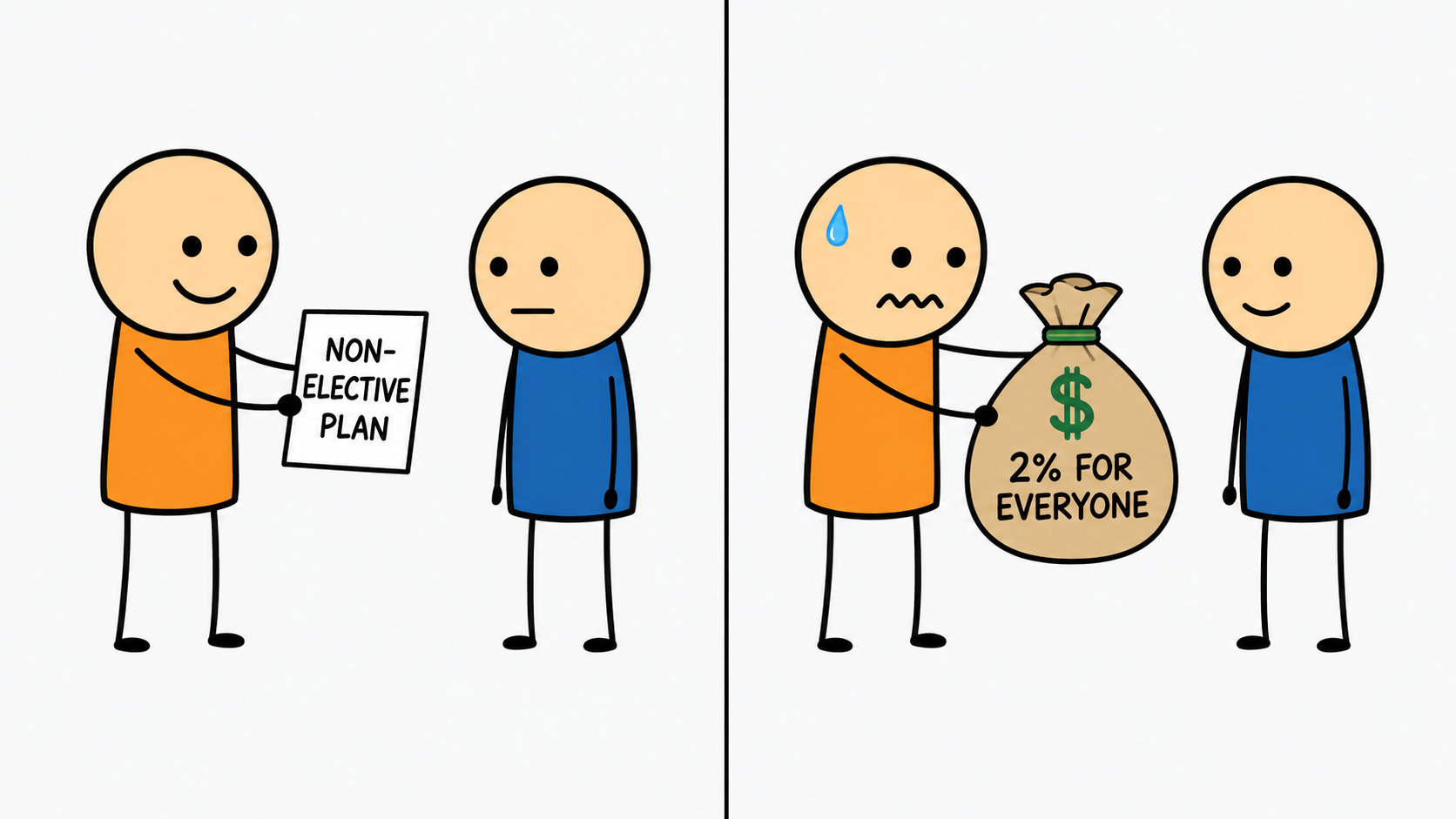
A SIMPLE IRA does not let an employer set up a plan, collect employee deferrals, smile for the brochure, and then decide the employer contribution is optional. The system has a built-in trade: simpler administration in exchange for mandatory employer funding.
That is where people get tripped up.
A small business owner hears “SIMPLE IRA” and thinks “cheap 401(k) alternative.” That part is mostly fair. The paperwork is lighter. The annual administration is usually easier. There is no full 401(k) testing circus with a tent, popcorn, and three people asking for census data.
Then the owner reaches a bad revenue year and asks whether the employer contribution can be skipped.
Usually, no.
The SIMPLE IRA bargain comes with a required employer contribution every year the plan is active. The employer generally chooses between a 3% matching contribution and a 2% non-elective contribution. Those sound similar until payroll starts doing math in public, which is always when the mood changes.
The 3% match is tied to employee deferrals. If an eligible employee contributes part of their pay to the SIMPLE IRA, the employer matches dollar-for-dollar up to 3% of that employee’s compensation.
If the employee defers nothing, the employer match for that employee is nothing. That is the cost-control feature. The employer is only matching people who actually save.
There is a limited escape hatch. The employer can reduce the match below 3%, but not below 1%, for no more than two years in a five-year period. That reduction has to be communicated properly. It is not a December surprise after the owner sees the cash balance and starts negotiating with reality.
The 2% non-elective contribution works differently. The employer contributes 2% of compensation for every eligible employee, whether the employee defers or not.
That means the employee who contributes zero still gets the employer contribution. Wonderful for employees. Slightly less wonderful for the owner who thought “non-elective” meant “I elect not to fund it.” The IRS, in a rare moment of comic timing, does not share that interpretation.
There is a third option that came in more recently. Under SECURE 2.0, the employer can make an additional non-elective contribution on top of the regular formula. The contribution can be up to 10% of compensation per eligible employee or an indexed annual dollar cap, whichever is less. The additional contribution has to be uniform for everyone eligible. It cannot be used to favor highly compensated workers or selectively reward a few favorites.
This option layers on top of the regular formula rather than replacing it. The employer still has to choose between the 3% match and the 2% non-elective contribution. The additional contribution is extra, available in years when the business wants to put more into employee retirement accounts than the base formula requires. Most small employers will not use it. Some will, especially in good years when the owner wants the deduction and the goodwill at the same time.
The choice between the 3% match and 2% non-elective contribution is made for the plan year and communicated to employees before their salary-reduction election period. For a calendar-year SIMPLE IRA, employees generally get a 60-day election window before the year begins, commonly running from early November through the end of December. That is the calendar-year planning deadline. The decision belongs before the year starts, not after everyone’s W-2s have been printed and the owner discovers feelings.
Employer contributions are generally due by the employer’s tax-filing deadline, including extensions. That is the tax-filing deadline piece. The business may decide the formula before the year begins, but the actual employer contribution can be funded later, by the return deadline with extensions.
Doing it later than that creates a different problem. The contribution does not simply vanish into a forgiveness cloud. Late or missed SIMPLE IRA employer contributions can become a plan failure that may need correction. Depending on the facts, the employer may have to make the missed contribution, adjust earnings, deal with deduction timing, and possibly use IRS correction procedures. That is the correction-window world, and it is much less fun than choosing the right formula before the plan year starts.
A small design firm has six eligible employees. The owner uses a SIMPLE IRA because she wants employees to defer from their paychecks without the cost of a full 401(k).
For the coming calendar year, she chooses the 3% match and gives employees the required notice before the election period. Three employees defer at least 3% of pay. Two employees defer 1%. One employee defers nothing.
The employer match follows the deferrals. The three employees who defer at least 3% receive the full 3% match. The two who defer 1% receive a 1% match. The employee who defers nothing receives no match.
Same business, different formula. The owner chooses the 2% non-elective contribution instead. Now all six eligible employees receive 2% of compensation from the employer, even the employee who contributes nothing.
That is the whole difference in one sentence. The match rewards deferrals. The non-elective contribution funds eligible employees regardless of deferrals.
Now give the same owner a rough year. Revenue drops. Payroll still has to run. The rent still gets paid. The printer still jams as if it has equity in the company.
If she chose the 3% match, her employer cost depends on how many employees defer and how much they defer, up to the 3% cap. If she chose the 2% non-elective contribution, she owes 2% for eligible employees regardless of employee participation.
If she wants to reduce the 3% match to 1% for that year and she still has reduction years available within the five-year limit, that can be part of the plan design, but it must be handled before the year through proper notice. If she waits until after the year and simply funds less than required, she has moved from planning into cleanup.
Cleanup is where fees, corrections, and stern letters live.
The SIMPLE IRA employer contribution requirement is not complicated, but it is easy to misunderstand because the plan feels informal compared with a 401(k). The name does some damage here. “Simple” describes the administration. It does not mean “optional when inconvenient.”
The employer has two main formulas. A 3% match follows employee deferrals, with limited ability to reduce the match in certain years. A 2% non-elective contribution goes to eligible employees whether they defer or not. SECURE 2.0 layered on a third option for employers who want to contribute more than the base formula requires.
The calendar-year issue is choosing and communicating the formula before employees make their deferral elections. The tax-filing deadline issue is when the employer contribution generally must be deposited. The correction issue begins when the employer misses or underfunds what the plan required.
There is no need to fear the rule. The key is knowing what kind of obligation the employer chose before the year started. Once that is clear, the math is usually less mysterious than the plan name suggests.
A SIMPLE IRA can be a good small-business plan. It just comes with a funding promise attached.
The IRS did not call it a “Maybe IRA” for a reason.
I write one of these every day, one retirement rule, explained in plain language and verified against the source. The daily email is free: subscribe here.
Full archive, worksheets, and search live at RetirementNewsRundown.com.
Disclaimer This article is for educational and informational purposes only. It is not tax, legal, or financial advice and does not create an advisor–client relationship. Always consult appropriate professionals regarding your specific situation.