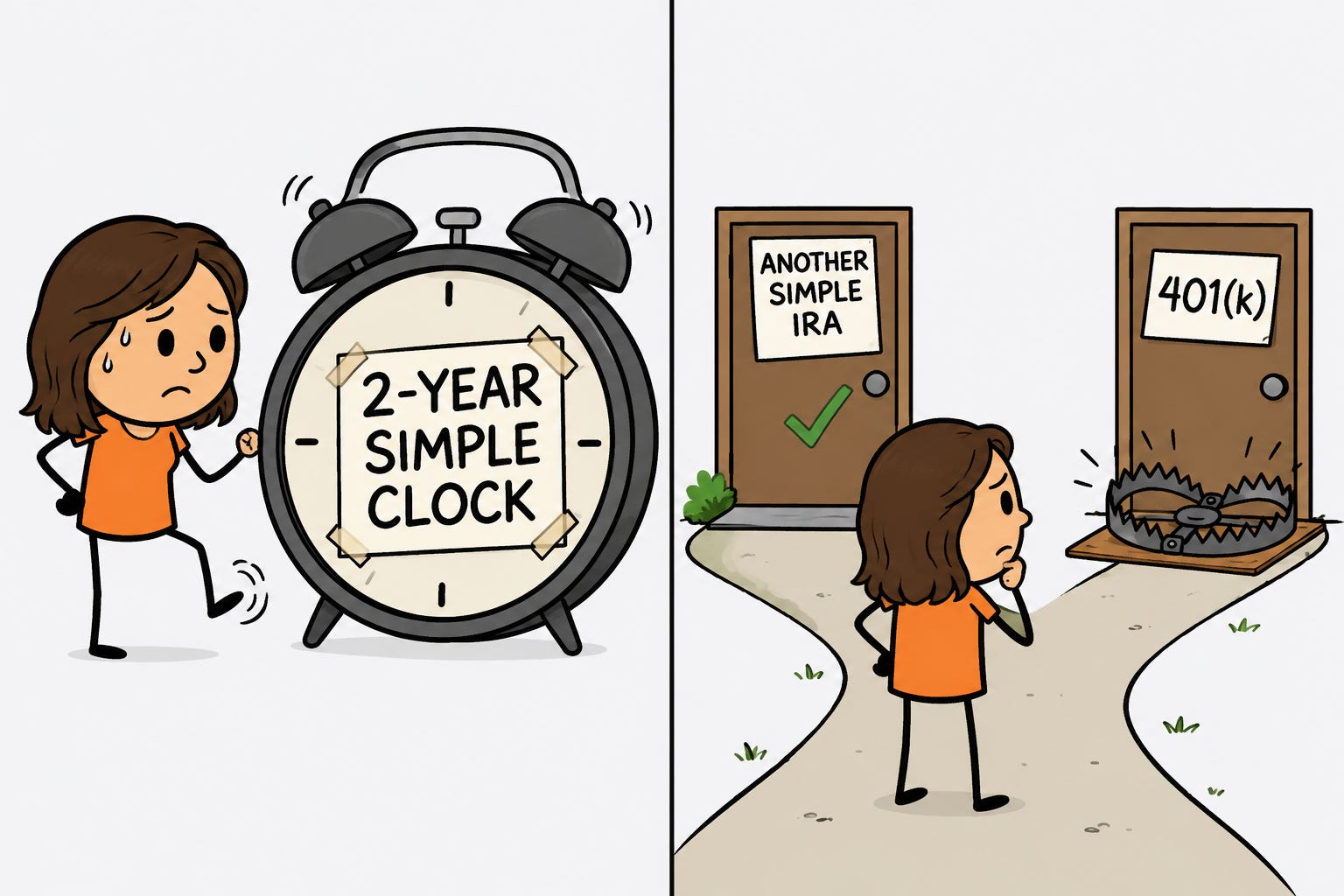
SIMPLE IRAs have a built-in trap that does not announce itself when someone changes jobs.
The account looks like an IRA. The new employer’s 401(k) looks like the obvious destination. The custodian may even have a rollover form ready, because forms are very good at existing and very bad at asking whether the rule clock has finished ticking.
A SIMPLE IRA can often be rolled into a 401(k), but the answer depends on two things: how long you have participated in the SIMPLE IRA plan, and whether the receiving 401(k) accepts that kind of rollover.
The money may be yours. The rule checks the clock first.
The big rule is the SIMPLE IRA two-year rule.
For the first two years after you first participate in an employer’s SIMPLE IRA plan, money in that SIMPLE IRA generally can only be moved tax-free to another SIMPLE IRA. That two-year period starts when you first participate in the plan, not when you leave the employer.
Once that two-year period has been satisfied, the SIMPLE IRA can generally be rolled into a qualified employer plan, including a 401(k), if the 401(k) plan accepts rollovers from SIMPLE IRAs.
That last phrase matters. Tax law may allow a rollover after the two-year period, but the receiving plan still has to allow it under its own plan rules. Some plans accept traditional IRA assets. Some accept SIMPLE IRA assets after the two-year period. Some require documentation. Some say no, because retirement plans apparently enjoy having house rules.
If the SIMPLE IRA is rolled to a 401(k) after the two-year period and the 401(k) accepts it, the rollover can be tax-free when handled properly. A direct rollover or trustee-to-trustee transfer is usually the cleanest path because the money goes from one retirement account system to another without passing through the owner’s checking account.
If the rollover is attempted too early, before the two-year clock is finished, the result can be ugly. During that first two-year period, the normal tax-free destination is another SIMPLE IRA, not a 401(k).
If the money comes out and is not validly rolled over, the taxable amount is generally income. If the participant is under age 59½, the early distribution penalty can apply. Because this is a SIMPLE IRA inside the first two years, the additional tax can be 25% instead of the usual 10%. The retirement system looked at the normal early withdrawal penalty and thought, “Nice start, but what if we made it meaner?”
There is no calendar-year deadline that makes the two-year rule disappear on December 31. There is no tax-filing deadline that fixes it because a return was extended. This rule is governed by the participation clock.
There can be a correction window if the money was distributed and needs to be placed into an eligible retirement account. The standard 60-day rollover window may matter, but during the first two years the eligible tax-free rollover target is generally another SIMPLE IRA, not a 401(k). After 60 days, the problem usually becomes harder because the money may be treated as distributed unless a waiver or valid relief applies. Filing the tax return later does not magically reopen the rollover window.
There is also a narrow employer-plan replacement situation where replacing a SIMPLE IRA with a 401(k) may create a different pathway. That is a plan-level transition issue, not the everyday “I left my job and want to consolidate accounts” situation.
Assume Maria first participated in her employer’s SIMPLE IRA plan on March 15.
She leaves the employer the next January and starts a new job with a 401(k). The new 401(k) accepts rollover contributions. Maria wants to move her old SIMPLE IRA into the new 401(k) immediately because one login sounds better than three logins, two forgotten passwords, and one security question whose answer she no longer remembers.
The problem is the two-year SIMPLE IRA clock.
If Maria tries to roll the SIMPLE IRA into the 401(k) that January, she is still inside the first two years. The 401(k) may accept other rollovers, but that does not make this one valid. Her tax-free rollover destination during that period is generally another SIMPLE IRA.
If Maria waits until after March 15 two years after she first participated, the SIMPLE IRA two-year clock has been satisfied. At that point, if the 401(k) accepts SIMPLE IRA rollover money, she can generally move the SIMPLE IRA into the 401(k) as a tax-free rollover.
If she takes a distribution too early and parks the money in her bank account, the 60-day window becomes important. If she gets the money into another SIMPLE IRA within that window, the damage may be avoided. If she sends it to the 401(k) during the restricted period, or misses the 60-day window entirely, the tax consequences can move from annoying to expensive quickly.
The practical answer is yes, a SIMPLE IRA can be rolled into a 401(k), but not whenever someone feels ready.
The first question is when the person first participated in the SIMPLE IRA plan. The second question is whether two full years have passed. The third question is whether the receiving 401(k) accepts that rollover.
No one needs to be afraid of SIMPLE IRAs. They are useful accounts with one timing rule that punishes people who treat them like regular IRAs too soon.
After the two-year clock has run, the door usually opens. Before it runs, the door may look open, but that is because retirement rules enjoy setting traps that are technically visible and practically invisible at the same time.
I write one of these every day, one retirement rule, explained in plain language and verified against the source. The daily email is free: subscribe here.
Full archive, worksheets, and search live at RetirementNewsRundown.com.
Disclaimer
This article is for educational and informational purposes only. It is not tax, legal, or financial advice and does not create an advisor–client relationship. Always consult appropriate professionals regarding your specific situation.